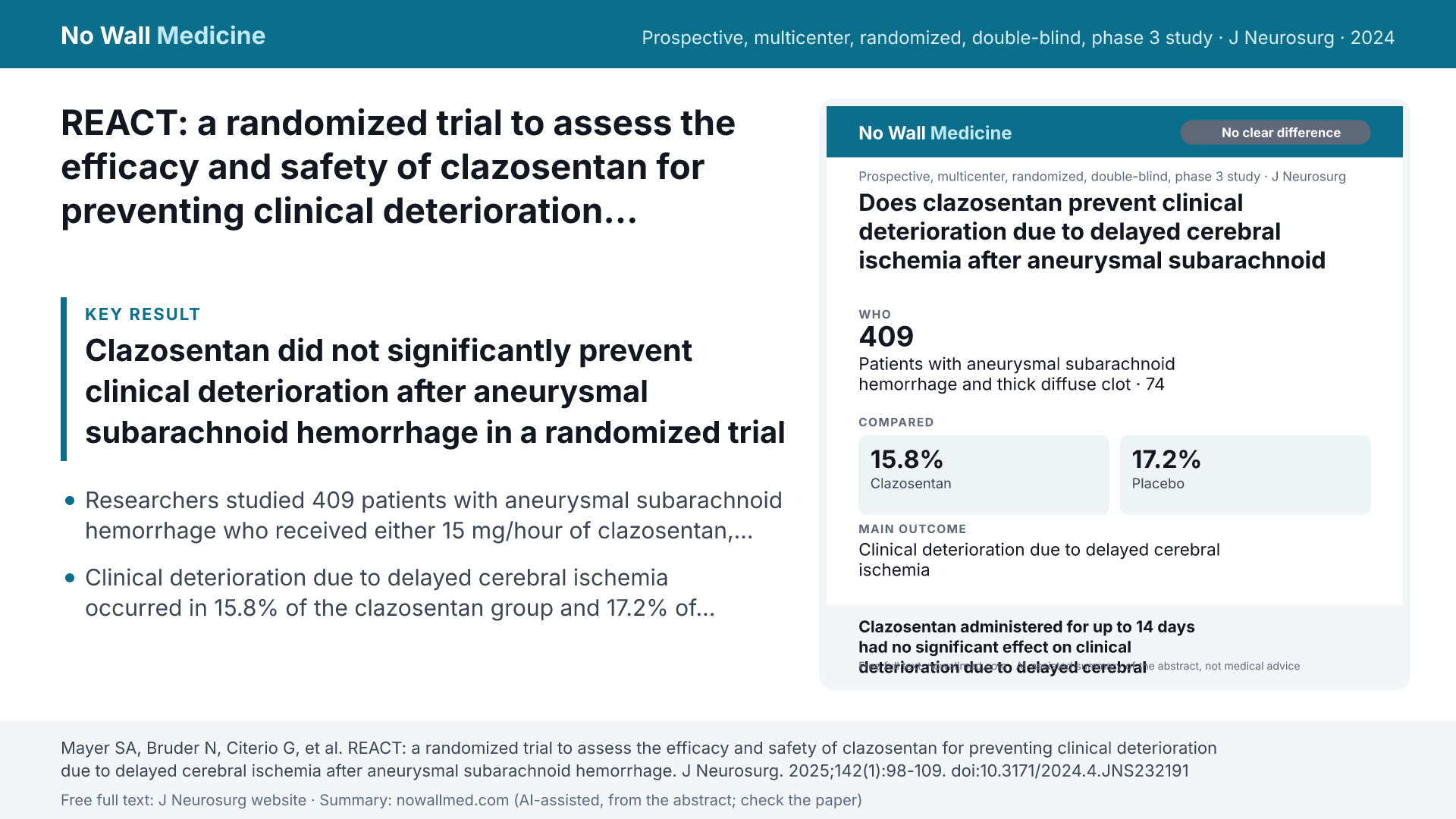
Clazosentan did not significantly prevent clinical deterioration after aneurysmal subarachnoid hemorrhage in a randomized trial
REACT: a randomized trial to assess the efficacy and safety of clazosentan for preventing clinical deterioration due to delayed cerebral ischemia after aneurysmal subarachnoid hemorrhage
Prospective, multicenter, randomized, double-blind, phase 3 studyNo clear difference
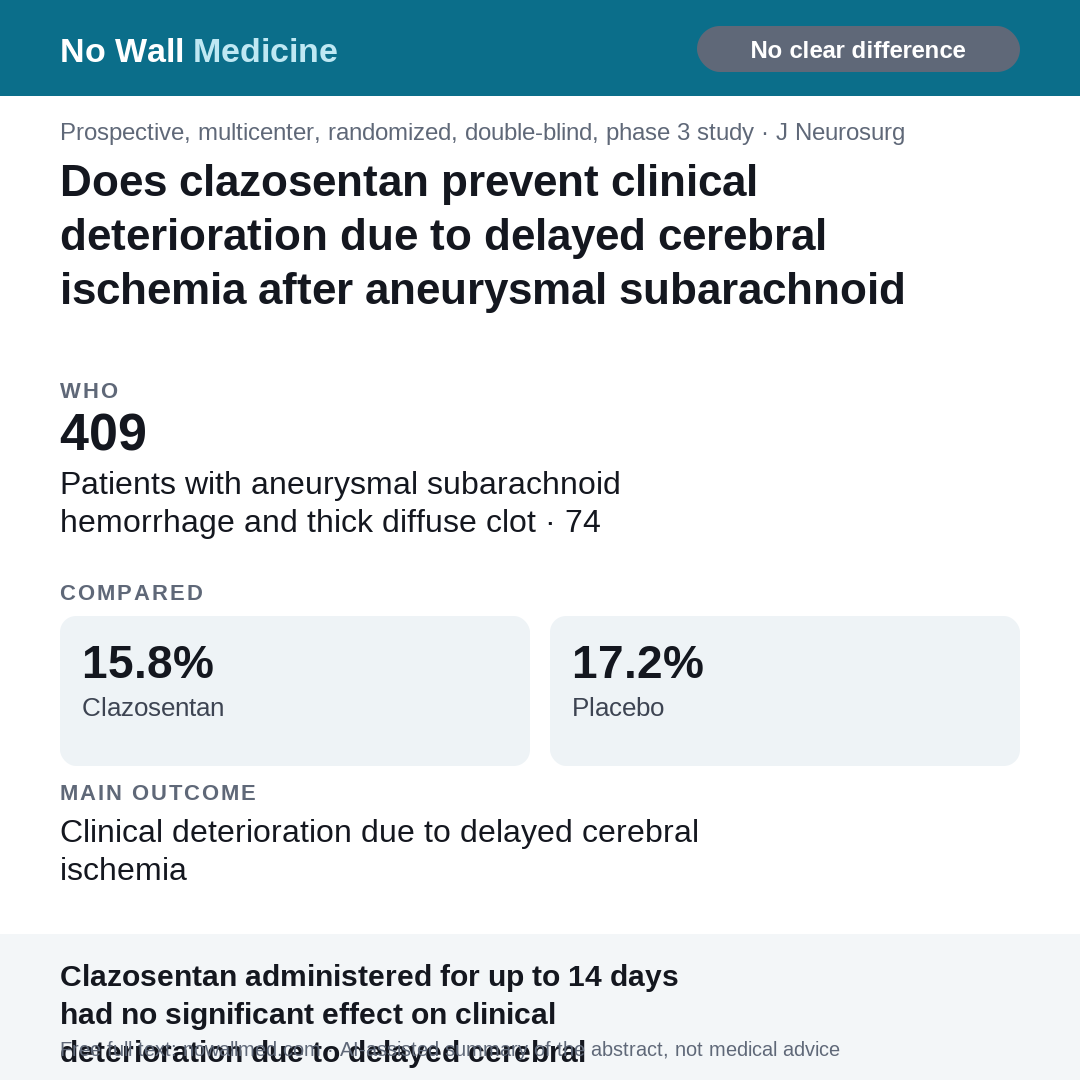
Does clazosentan prevent clinical deterioration due to delayed cerebral ischemia after aneurysmal subarachnoid hemorrhage?
Who
409
Patients with aneurysmal subarachnoid hemorrhage and thick diffuse clot · 74 international sites
Compared
15.8%Clazosentan (32/202)
17.2%Placebo (35/204)
Main outcome
Clinical deterioration due to delayed cerebral ischemia
Result: relative risk reduction 7.2%, 95% CI -42.6% to 39.6%
Bottom line: Clazosentan administered for up to 14 days had no significant effect on clinical deterioration due to delayed cerebral ischemia.
J Neurosurg · 2024-08-09Download image
Clinical question: Does clazosentan prevent clinical deterioration due to delayed cerebral ischemia after aneurysmal subarachnoid hemorrhage?
Why it matters: It was unknown if clazosentan could prevent clinical deterioration caused by delayed cerebral ischemia in patients with thick and diffuse clots following an aneurysmal subarachnoid hemorrhage.
Key points
- Researchers studied 409 patients with aneurysmal subarachnoid hemorrhage who received either 15 mg/hour of clazosentan, an endothelin receptor antagonist, or a placebo.
- Clinical deterioration due to delayed cerebral ischemia occurred in 15.8% of the clazosentan group and 17.2% of the placebo group, which was not a statistically significant difference.
- Clinically relevant cerebral infarction occurred in 7.4% of the clazosentan group compared to 11.3% in the placebo group, though this difference was also not statistically significant.
Headline and key points written with AI from the paper’s abstract, with every number checked against it. Read the paper before relying on them.
Was this summary helpful?
Subject terms
Cite this article
Mayer SA, Bruder N, Citerio G, et al. REACT: a randomized trial to assess the efficacy and safety of clazosentan for preventing clinical deterioration due to delayed cerebral ischemia after aneurysmal subarachnoid hemorrhage. J Neurosurg. 2024. doi:10.3171/2024.4.JNS232191
Spotted a mistake? Suggest a correction