Artificial intelligence tools in primary care show mixed results for diagnosis and patient outcomes
Real-World Effectiveness of AI-Enabled Clinical Decision Support in Primary Care: Systematic Review
Systematic reviewMixed results
What are the effects of AI-enabled clinical decision support in primary care?
Who
10
Clinicians using AI-enabled clinical decision support in primary or ambulatory care · Primary or ambulatory care
Compared
AI-enabled clinical decision support
Usual care
Main outcome
Diagnostic performance, changes in care, efficiency, and patient-important outcomes
Bottom line: AI-enabled clinical decision support showed mixed effects, improving some detection or processes but failing to demonstrate patient-important benefits.
Limitation: Heterogeneity and limited outcome measurement prevented causal explanations for differences.
J Med Internet Res · 2026-10-08Download image
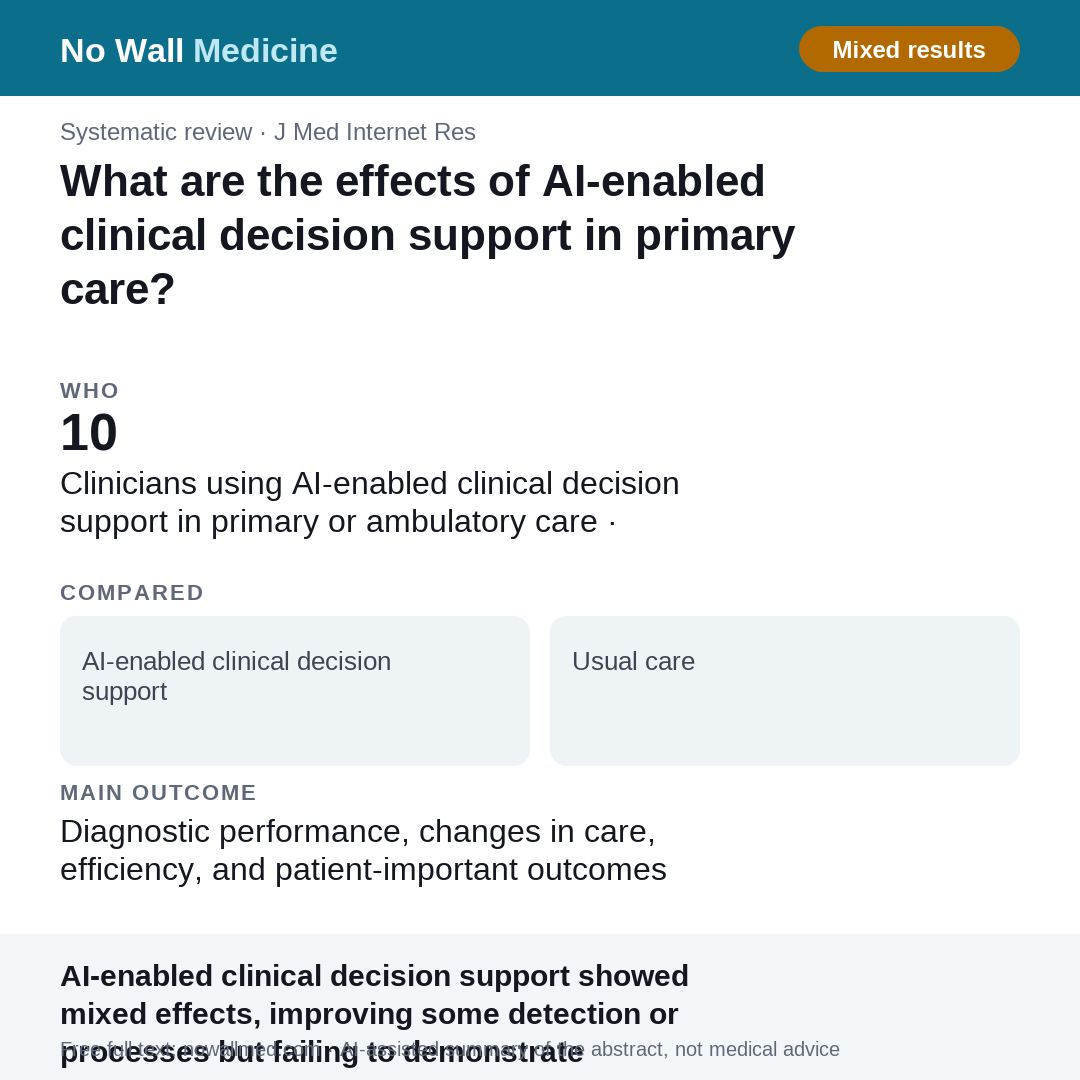
Clinical question: What are the effects of AI-enabled clinical decision support in primary care?
Why it matters: The effects of artificial intelligence clinical decision support systems on clinical decisions and patient outcomes in primary care remain uncertain.
Key points
- Researchers reviewed 24 studies, including 10 that evaluated artificial intelligence clinical decision support systems used by clinicians in routine primary or ambulatory care.
- Findings were inconsistent, showing increased low ejection fraction diagnoses with artificial intelligence electrocardiography but no demonstrated benefit for patient-important outcomes in any trial.
- Some tools showed high melanoma discrimination with an area under the receiver operating characteristic curve of 0.960, while others showed moderate glaucoma discrimination.
Limitation the authors note: Heterogeneity and limited outcome measurement prevented causal explanations for the differences observed in the results.
Headline and key points written with AI from the paper’s abstract, with every number checked against it. Read the paper before relying on them.
Topics
Cite this article
Jain Y, Wu D, Wang Z. Real-World Effectiveness of AI-Enabled Clinical Decision Support in Primary Care: Systematic Review. J Med Internet Res. 2026. doi:10.2196/98630
Spotted a mistake? Suggest a correction