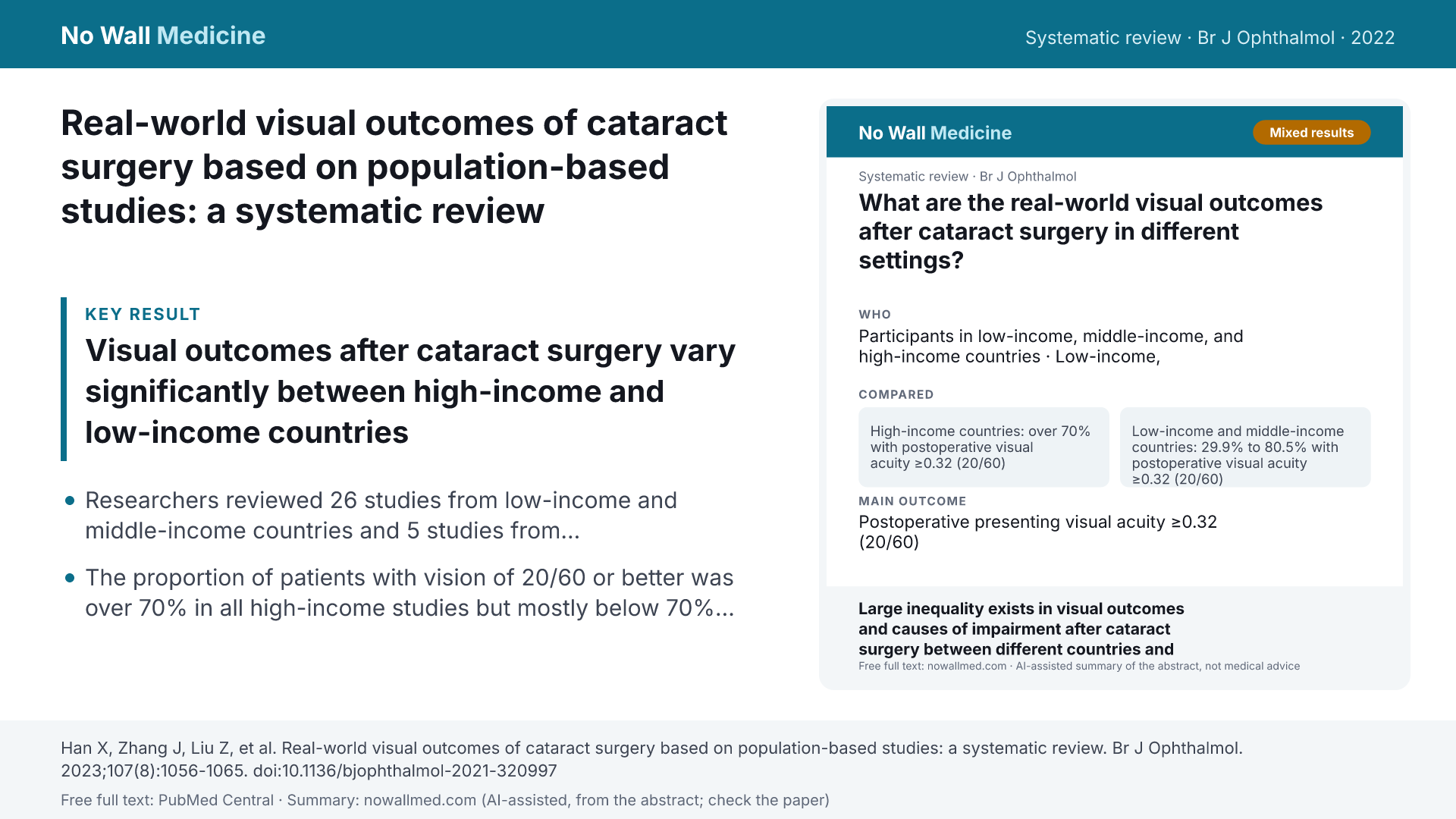
Visual outcomes after cataract surgery vary significantly between high-income and low-income countries
Real-world visual outcomes of cataract surgery based on population-based studies: a systematic review
Systematic reviewMixed results
What are the real-world visual outcomes after cataract surgery in different settings?
Who
Participants in low-income, middle-income, and high-income countries · Low-income, middle-income, and high-income countries
Compared
High-income countries: over 70% with postoperative visual acuity ≥0.32 (20/60)
Low-income and middle-income countries: 29.9% to 80.5% with postoperative visual acuity ≥0.32 (20/60)
Main outcome
Postoperative presenting visual acuity ≥0.32 (20/60)
Bottom line: Large inequality exists in visual outcomes and causes of impairment after cataract surgery between different countries and regions.
Br J Ophthalmol · 2022-04-11Download image
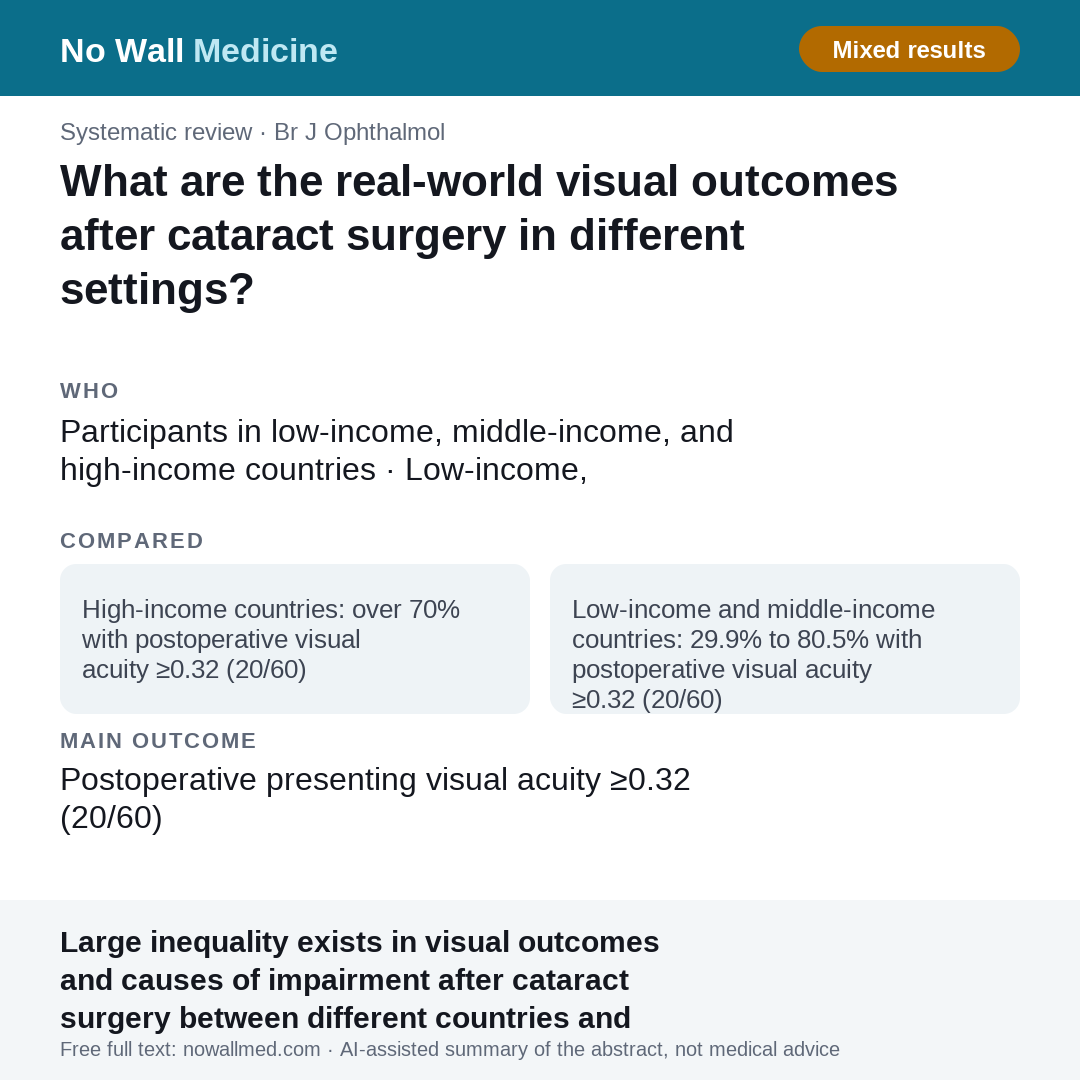
Clinical question: What are the real-world visual outcomes after cataract surgery in different settings?
Why it matters: The quality of care and real-world visual results following cataract surgery in different global settings are not well understood.
Key points
- Researchers reviewed 26 studies from low-income and middle-income countries and 5 studies from high-income countries regarding vision after cataract surgery.
- The proportion of patients with vision of 20/60 or better was over 70% in all high-income studies but mostly below 70% in low-income studies, ranging from 29.9% to 80.5%.
- Postoperative vision impairment was associated with refractive error, other eye diseases, and surgical complications like posterior capsule opacification, which is clouding of the lens capsule.
Headline and key points written with AI from the paper’s abstract, with every number checked against it. Read the paper before relying on them.
Was this summary helpful?
Abstract
Background/aims
Quantity of cataract surgery has long been an important public health indicator to assess health accessibility, however the quality of care has been less investigated. We aimed to summarise the up-to-date evidences to assess the real-world visual outcomes after cataract surgery in different settings. Methods
A systematic review was undertaken in October 2021. Population-based cross-sectional and longitudinal studies reporting vision-related outcomes after cataract surgery published from 2006 onward were included. A meta-analysis was not planned. Results
Twenty-six cross-sectional studies from low-income and middle-income countries (LMICs) and five cross-sectional studies from high-income countries (HICs) were included. The proportions of participants with postoperative presenting visual acuity (VA) ≥0.32 (20/60) were all over 70% in all HICS studies, but mostly below 70% in LMICS studies, ranging from 29.9% to 80.5%. Significant difference in postoperative VA was also observed within countries. The leading causes for postoperative visual impairment (defined mostly as presenting VA <20/60) mainly included refractive error, ocular comorbidities and surgical complications including posterior capsule opacification, except for one study in Nigeria wherein the leading cause was aphakia. Only four population-based cohort studies were included with 5-20 years of follow-up time, generally demonstrating no significant changes in postoperative visual outcomes during the follow-up. Conclusions
We observed large inequality in the visual outcomes and principal causes of visual impairment after cataract surgery among different countries and regions. Structured quality control and enhancement programmes are needed to improve the outcomes of cataract surgery and reduce inequality.
Abstract reproduced under the article’s CC BY NC licence.
Subject terms
Cite this article
Han X, Zhang J, Liu Z, Tan X, Jin G, He M. Real-world visual outcomes of cataract surgery based on population-based studies: a systematic review. Br J Ophthalmol. 2022. doi:10.1136/bjophthalmol-2021-320997
Spotted a mistake? Suggest a correction
Top studies every Monday
The week’s key trials and guidelines in your specialties, plus any topics you follow. By email, free.
Get the weekly digest