Combining adenovirus H101 with radiofrequency ablation did not significantly improve disease-free survival in liver cancer patients
Recombinant human type-5 adenovirus (H101) combined with radiofrequency ablation versus traditional radiofrequency ablation for hepatocellular carcinoma ≤ 3 cm: a phase III randomized controlled trial
Phase III randomized controlled trialNo clear difference
Does recombinant human type-5 adenovirus combined with radiofrequency ablation improve outcomes for small hepatocellular carcinoma?
Who
162
Patients with solitary hepatocellular carcinoma tumor diameter ≤3 cm
Compared
Radiofrequency ablation combined with H101: 54.00% 3-year disease-free survival rate
Traditional radiofrequency ablation: 41.20% 3-year disease-free survival rate
Main outcome
disease-free survival
Bottom line: Combining radiofrequency ablation with H101 did not significantly improve disease-free survival compared to traditional radiofrequency ablation alone.
Int J Surg · 2025-12-16 · Save PNG
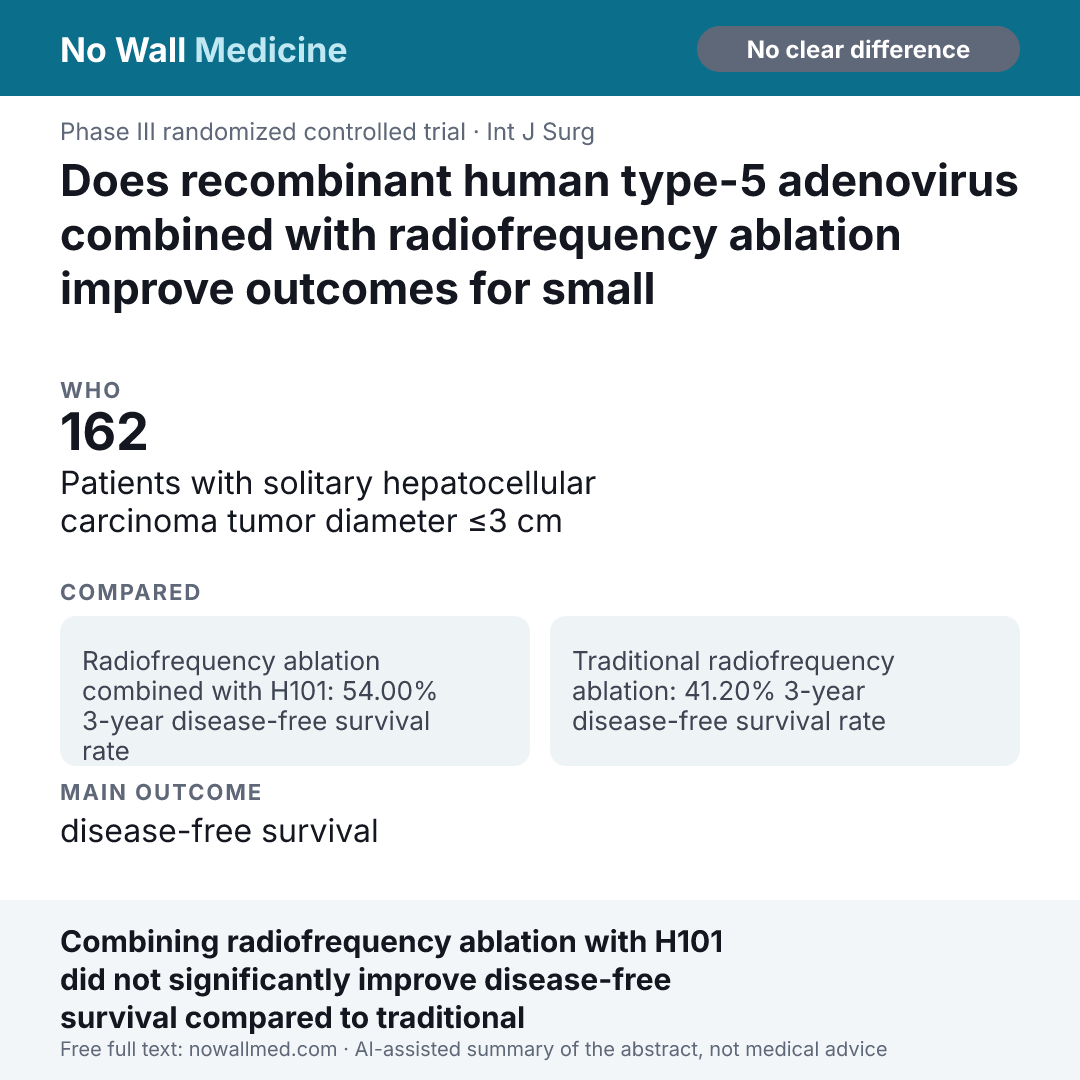
Clinical question: Does recombinant human type-5 adenovirus combined with radiofrequency ablation improve outcomes for small hepatocellular carcinoma?
Why it matters: Recurrence remains common for patients undergoing radiofrequency ablation, which is the standard treatment for small hepatocellular carcinoma.
Key points
- Researchers studied 162 patients with small liver cancer tumors measuring 3 cm or less, comparing radiofrequency ablation alone to a combination of ablation and H101 adenovirus.
- The 3-year disease-free survival rates were 54.00% for the combination group and 41.20% for the ablation-only group, but the difference was not statistically significant.
- The 3-year overall survival rates were 93.00% for the combination group and 92.90% for the ablation-only group, showing no significant difference between the two treatments.
Headline and key points written with AI from the paper’s abstract, with every number checked against it. Read the paper before relying on them.
Was this summary helpful?
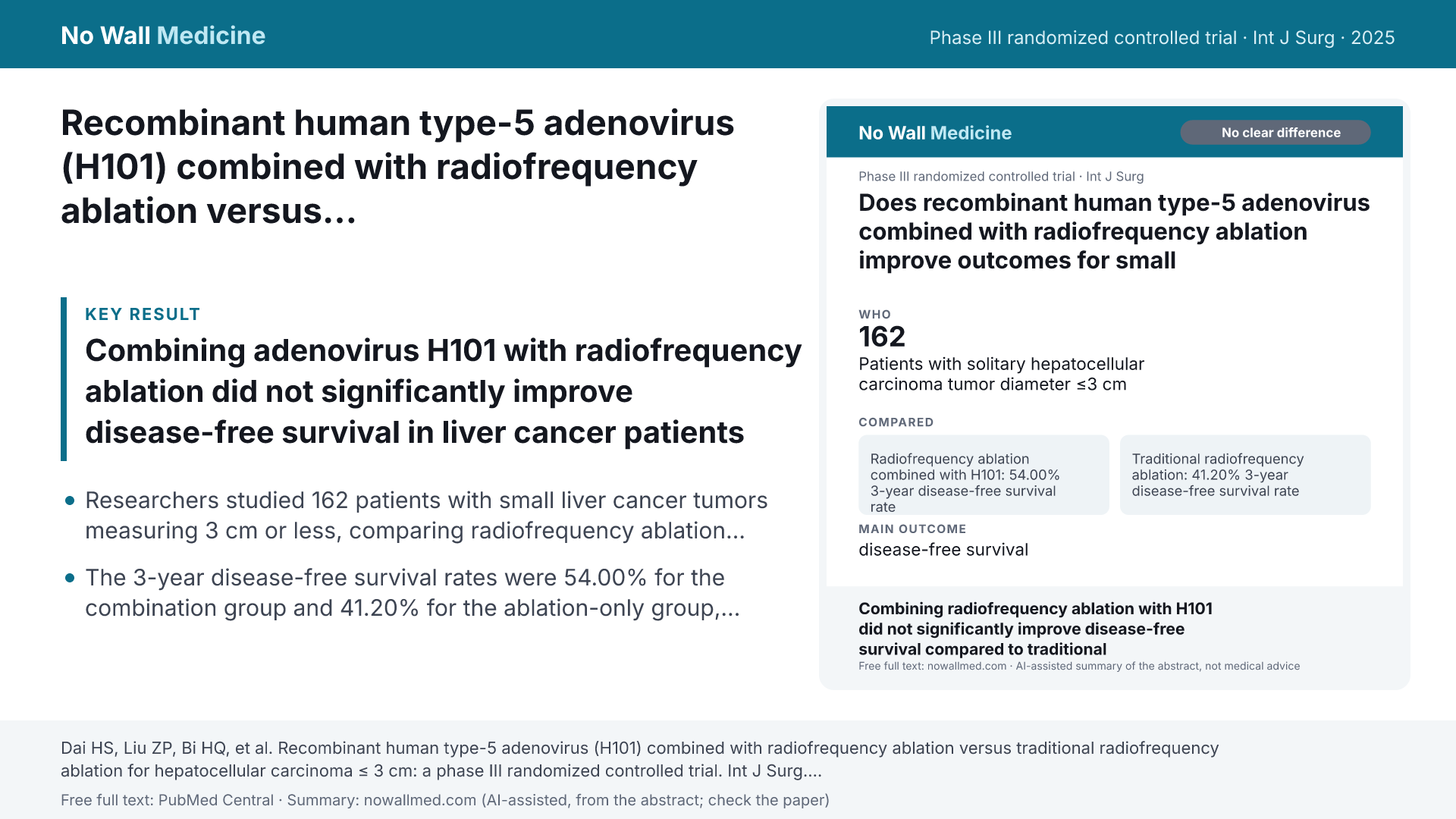
Headline, design, result, key points, caveat and citation as plain text.
Cite this article
Dai HS, Liu ZP, Bi HQ, et al. Recombinant human type-5 adenovirus (H101) combined with radiofrequency ablation versus traditional radiofrequency ablation for hepatocellular carcinoma ≤ 3 cm: a phase III randomized controlled trial. Int J Surg. 2025;112(6):12827-12834. doi:10.1097/JS9.0000000000004438
Spotted a mistake? Suggest a correction