Updated recommendations suggest expanding tumor genetic sequencing for several advanced cancer types
Recommendations for the use of next-generation sequencing (NGS) for patients with advanced cancer in 2024: a report from the ESMO Precision Medicine Working Group
Why it matters: The clinical impact of tumor genetic sequencing on treatment decisions and its cost-effectiveness and accessibility required updated guidance for routine practice.
Key points
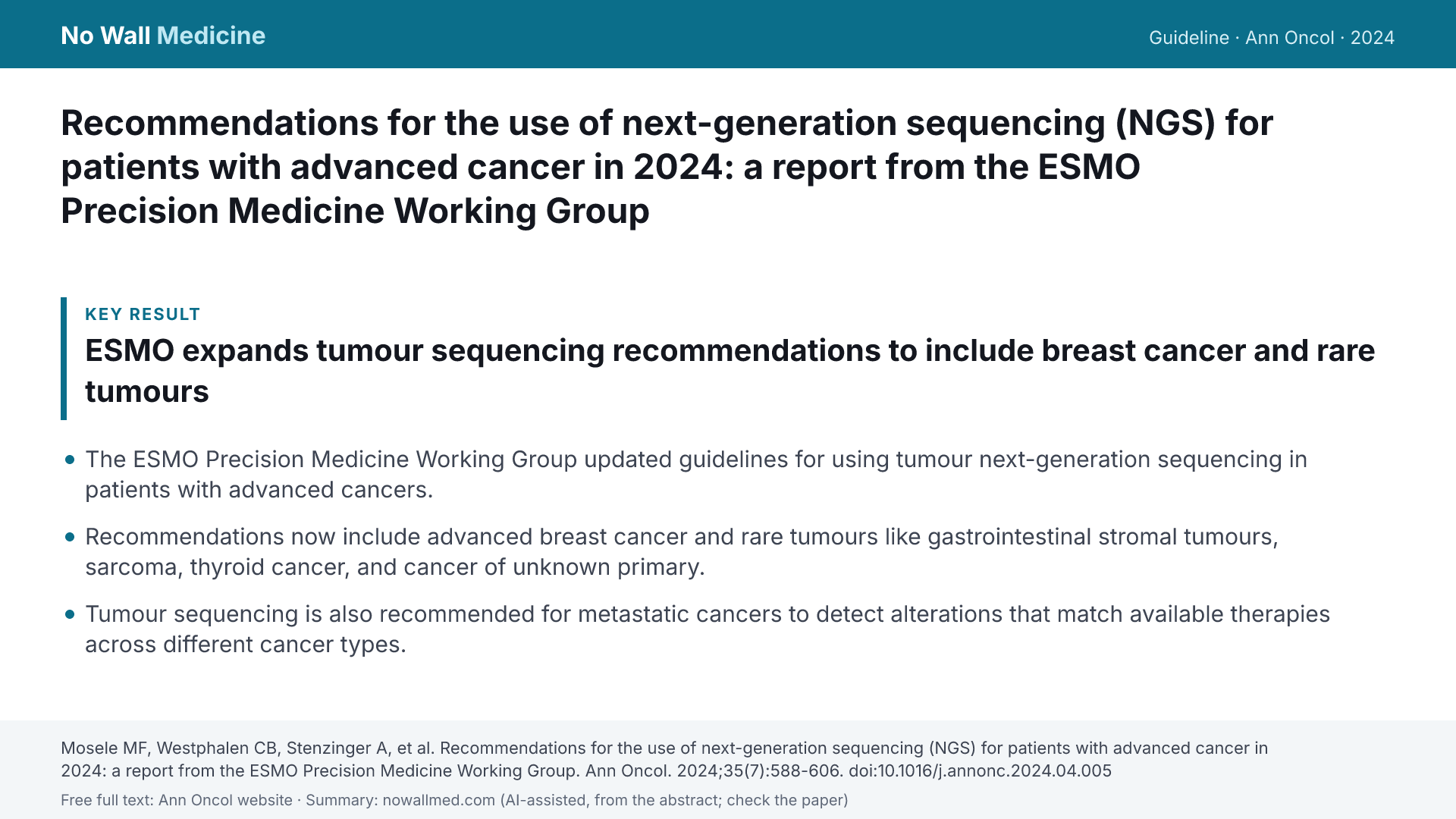
- The ESMO Precision Medicine Working Group updated recommendations for using next-generation sequencing, which is a method to analyze many genetic mutations at once.
- The group recommends sequencing for advanced non-squamous non-small-cell lung cancer, prostate cancer, colorectal cancer, cholangiocarcinoma, ovarian cancer, and now advanced breast cancer.
- Recommendations also include rare tumors like gastrointestinal stromal tumors, sarcoma, thyroid cancer, and cancer of unknown primary, as well as detecting tumor-agnostic alterations.
Headline and key points written with AI from the paper’s abstract, with every number checked against it. Read the paper before relying on them.
Was this summary helpful?
Subject terms
Cite this article
Mosele MF, Westphalen CB, Stenzinger A, Barlesi F, Bayle A, Bièche I. Recommendations for the use of next-generation sequencing (NGS) for patients with advanced cancer in 2024: a report from the ESMO Precision Medicine Working Group. Ann Oncol. 2024. doi:10.1016/j.annonc.2024.04.005
Spotted a mistake? Suggest a correction
Top studies every Monday
The week’s key trials and guidelines in your specialties, plus any topics you follow. By email, free.
Get the weekly digest