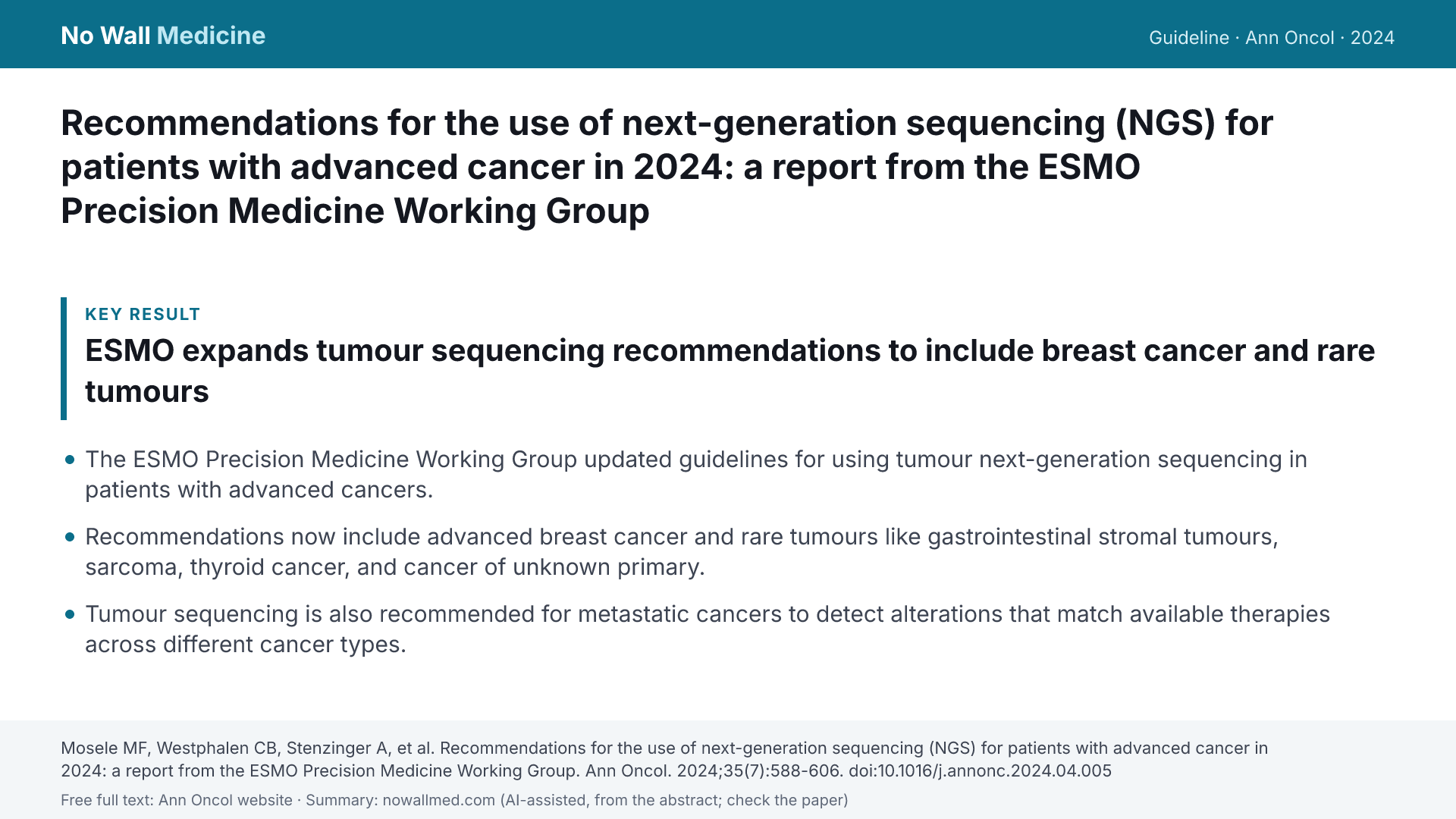
Recommendations for the use of next-generation sequencing (NGS) for patients with advanced cancer in 2024: a report from the ESMO Precision Medicine Working Group
Key result: ESMO expands tumour sequencing recommendations to include breast cancer and rare tumours
Key points
- The ESMO Precision Medicine Working Group updated guidelines for using tumour next-generation sequencing in patients with advanced cancers.
- Recommendations now include advanced breast cancer and rare tumours like gastrointestinal stromal tumours, sarcoma, thyroid cancer, and cancer of unknown primary.
- Tumour sequencing is also recommended for metastatic cancers to detect alterations that match available therapies across different cancer types.
Why it matters: Previous guidelines did not cover advanced breast cancer or specific rare tumours, leaving a gap in precision medicine recommendations for these patients.
Discussion prompts
- Would these patients look like yours? Who was left out?
- Is the main outcome one that matters to patients?
- Is the difference large enough to change what you do?
Cite: Mosele MF, Westphalen CB, Stenzinger A, et al. Recommendations for the use of next-generation sequencing (NGS) for patients with advanced cancer in 2024: a report from the ESMO Precision Medicine Working Group. Ann Oncol. 2024;35(7):588-606. doi:10.1016/j.annonc.2024.04.005
Free full text: Ann Oncol website · Summary and visual abstract: nowallmed.com/a/recommendations-for-the-use-of-next-generation-sequencing-ngs-for-dauyt7/ (AI-assisted from the abstract; check the paper before relying on it).