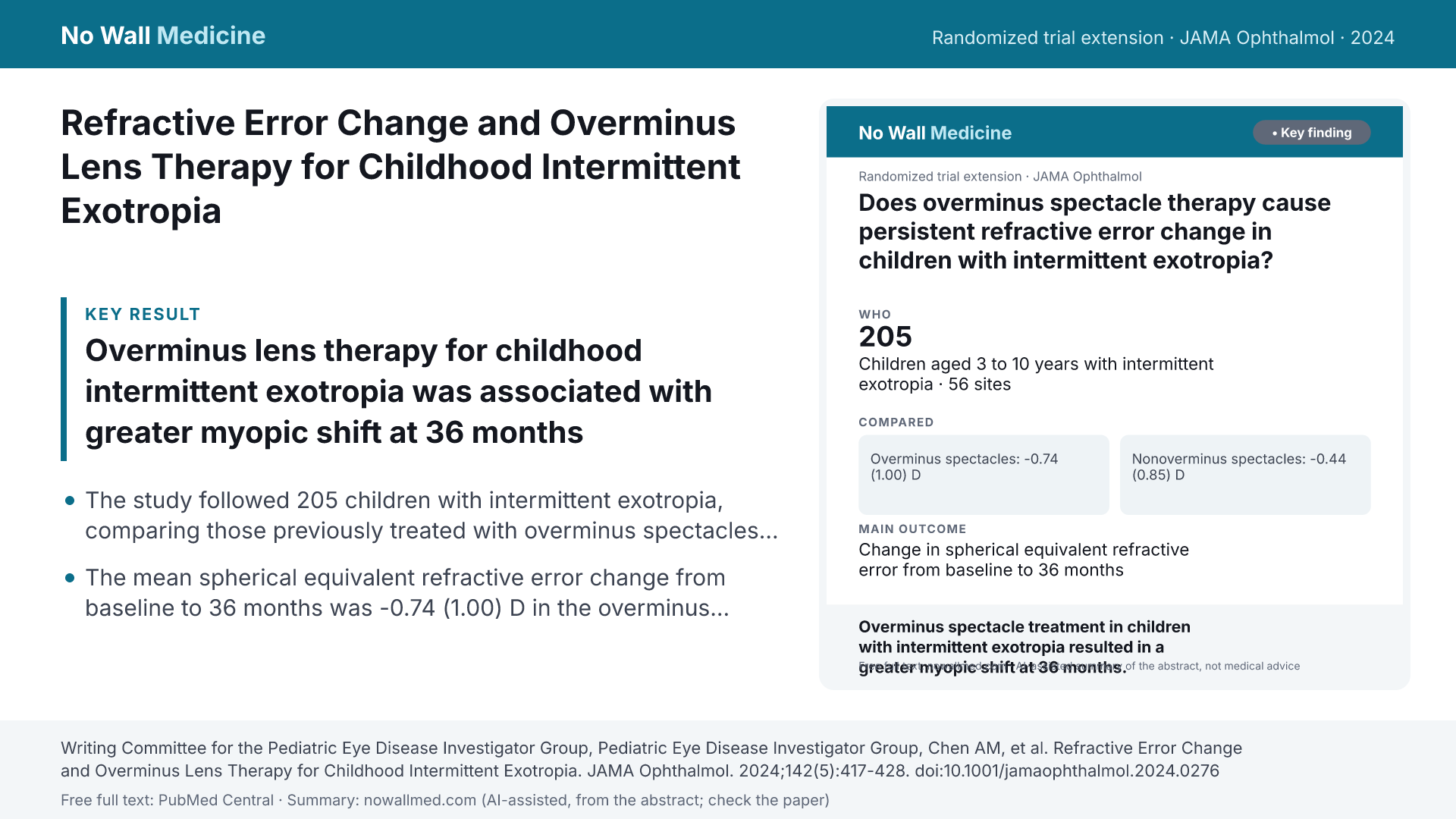
Overminus lens therapy for childhood intermittent exotropia was associated with greater myopic shift at 36 months
Refractive Error Change and Overminus Lens Therapy for Childhood Intermittent Exotropia
Randomized trial extensionHarm found
Does overminus spectacle therapy cause persistent refractive error change in children with intermittent exotropia?
Who
205
Children aged 3 to 10 years with intermittent exotropia · 56 sites
Compared
Overminus spectacles: -0.74 (1.00) D
Nonoverminus spectacles: -0.44 (0.85) D
Main outcome
Change in spherical equivalent refractive error from baseline to 36 months
Result: adjusted difference, -0.36 D; 95% CI, -0.59 to -0.12
Bottom line: Overminus spectacle treatment in children with intermittent exotropia resulted in a greater myopic shift at 36 months.
JAMA Ophthalmol · 2024-03-27Download image
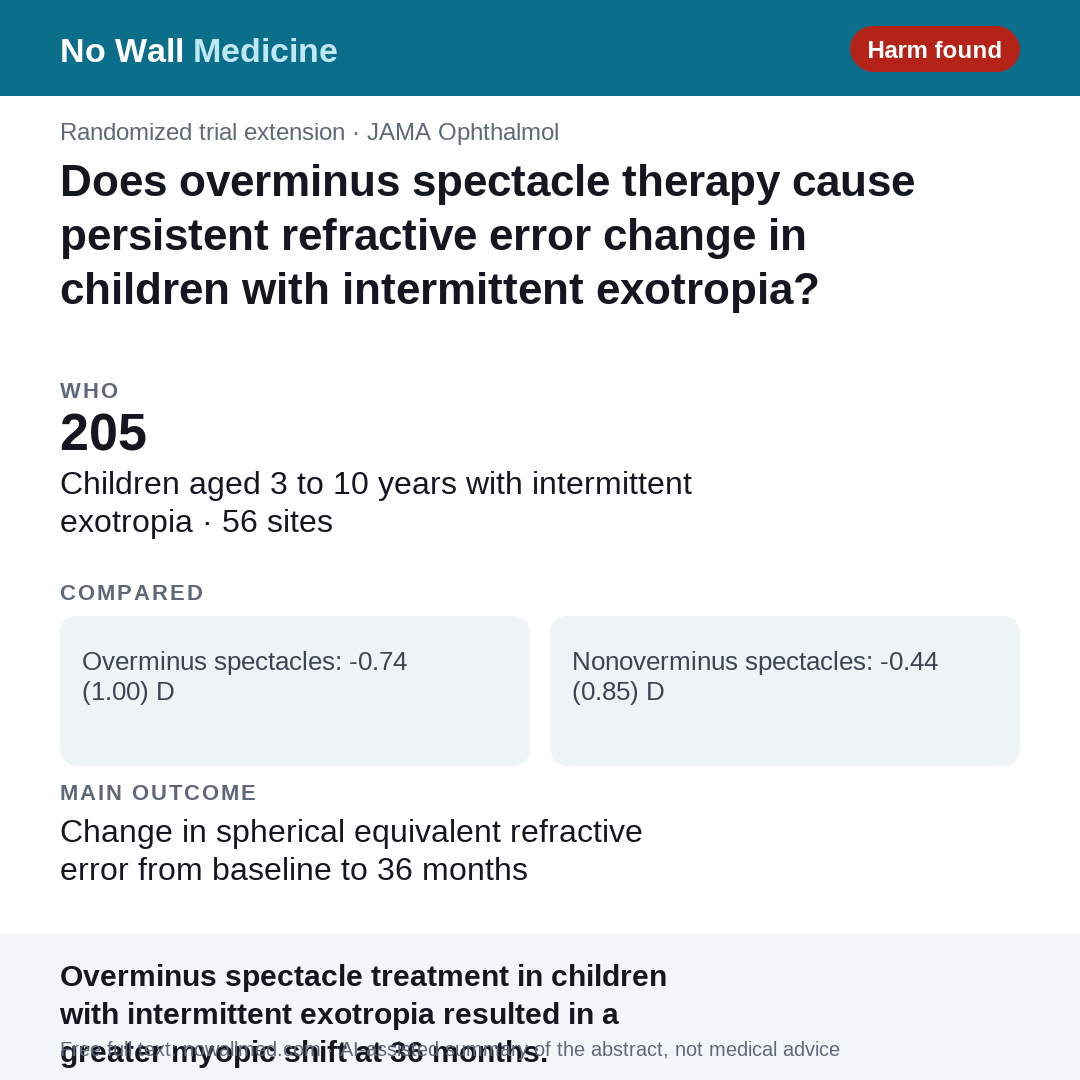
Clinical question: Does overminus spectacle therapy cause persistent refractive error change in children with intermittent exotropia?
Why it matters: It was unknown if the myopic shift, or increase in nearsightedness, associated with one year of overminus spectacle treatment persists after the treatment is stopped.
Key points
- The study followed 205 children with intermittent exotropia, comparing those previously treated with overminus spectacles to those treated with nonoverminus spectacles.
- The mean spherical equivalent refractive error change from baseline to 36 months was -0.74 (1.00) D in the overminus group compared to -0.44 (0.85) D in the nonoverminus group.
- Between 12 and 36 months, the mean myopic shift was -0.34 (0.67) D in the overminus group and -0.36 (0.66) D in the nonoverminus group.
Headline and key points written with AI from the paper’s abstract, with every number checked against it. Read the paper before relying on them.
Was this summary helpful?
Subject terms
Cite this article
Writing Committee for the Pediatric Eye Disease Investigator Group, Pediatric Eye Disease Investigator Group, Chen AM, Erzurum SA, Chandler DL, Hercinovic A. Refractive Error Change and Overminus Lens Therapy for Childhood Intermittent Exotropia. JAMA Ophthalmol. 2024. doi:10.1001/jamaophthalmol.2024.0276
Spotted a mistake? Suggest a correction
Top studies every Monday
The week’s key trials and guidelines in your specialties, plus any topics you follow. By email, free.
Get the weekly digest