Meta-analysis shows differences in how people with mood and anxiety disorders learn from rewards and punishments
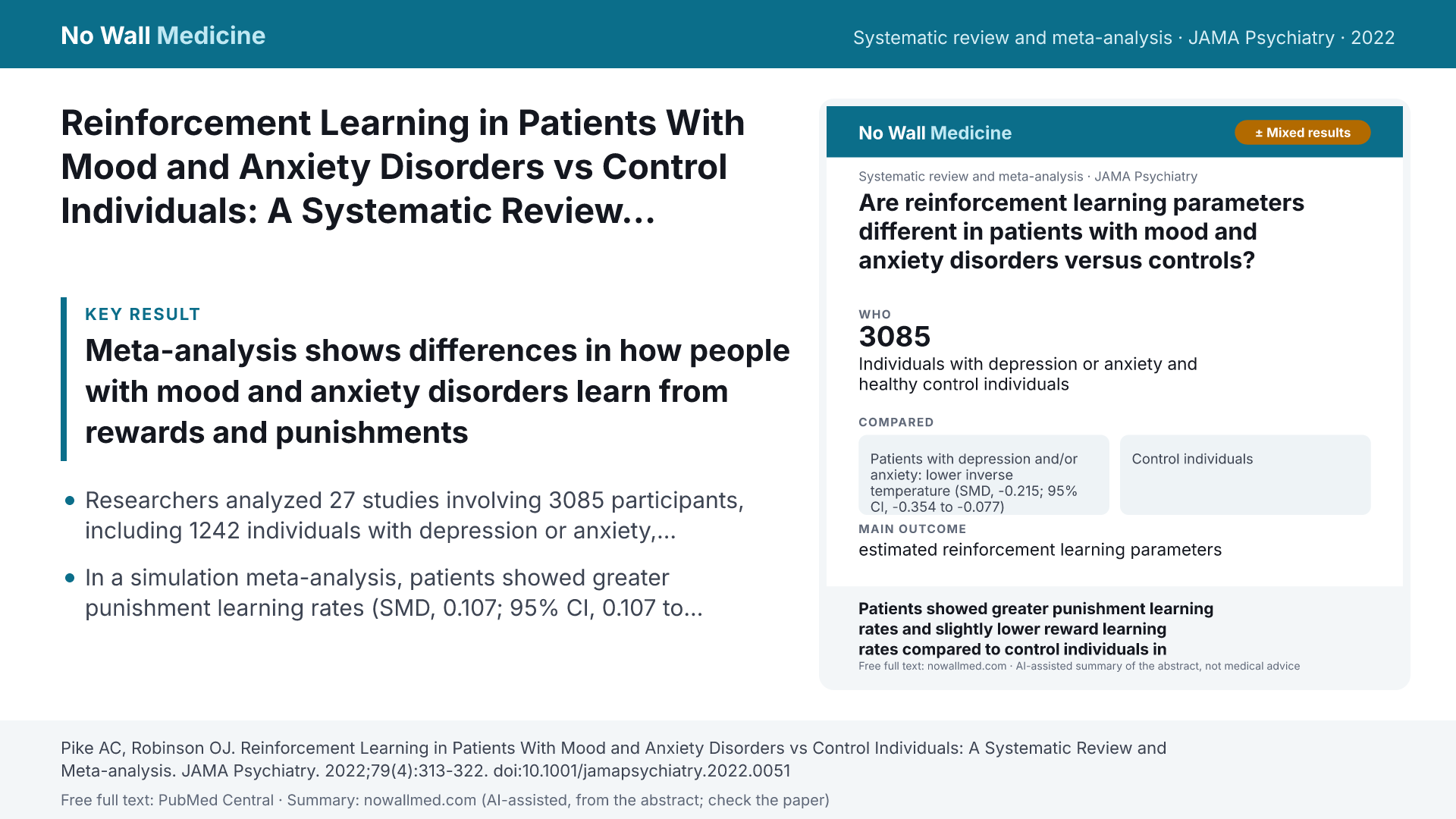
Reinforcement Learning in Patients With Mood and Anxiety Disorders vs Control Individuals: A Systematic Review and Meta-analysis
Systematic review and meta-analysisMixed results
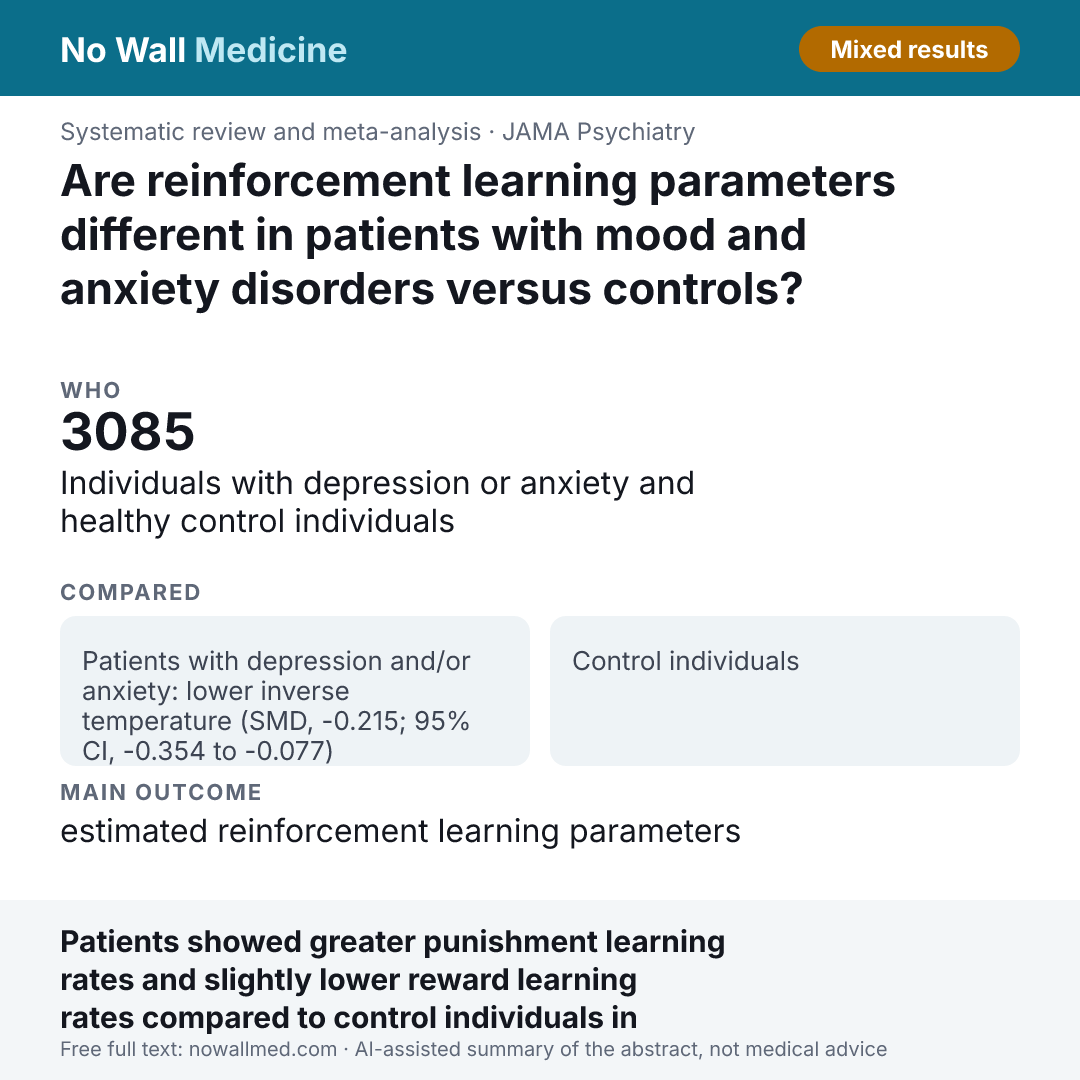
Are reinforcement learning parameters different in patients with mood and anxiety disorders versus controls?
Who
3085
Individuals with depression or anxiety and healthy control individuals
Compared
Patients with depression and/or anxiety: lower inverse temperature (SMD, -0.215; 95% CI, -0.354 to -0.077)
Control individuals
Main outcome
estimated reinforcement learning parameters
Result: SMD, 0.107 (95% CI, 0.107 to 0.108) for punishment learning rates
Bottom line: Patients showed greater punishment learning rates and slightly lower reward learning rates compared to control individuals in simulation meta-analysis.
Limitation: no parameters were common across all studies, limiting the ability to infer differences
JAMA Psychiatry · 2022-03-03 · Save PNG
Clinical question: Are reinforcement learning parameters different in patients with mood and anxiety disorders versus controls?
Why it matters: Results have been inconsistent regarding whether reinforcement learning parameters differ between individuals with mood and anxiety disorders and healthy control individuals.
Key points
- Researchers analyzed 27 studies involving 3085 participants, including 1242 individuals with depression or anxiety, to compare reinforcement learning parameters against healthy controls.
- In a simulation meta-analysis, patients showed greater punishment learning rates (SMD, 0.107; 95% CI, 0.107 to 0.108) and slightly lower reward learning rates (SMD, -0.021; 95% CI, -0.022 to -0.020).
- A conventional meta-analysis found patients had lower inverse temperature, which measures how much randomness is in decision-making, compared to controls (SMD, -0.215; 95% CI, -0.354 to -0.077).
Limitation the authors note: No parameters were common across all studies, limiting the ability to infer differences in the conventional meta-analysis.
Headline and key points written with AI from the paper’s abstract, with every number checked against it. Read the paper before relying on them.
Was this summary helpful?
Subject terms
Headline, design, result, key points, caveat and citation as plain text.
Cite this article
Pike AC, Robinson OJ. Reinforcement Learning in Patients With Mood and Anxiety Disorders vs Control Individuals: A Systematic Review and Meta-analysis. JAMA Psychiatry. 2022. doi:10.1001/jamapsychiatry.2022.0051
Spotted a mistake? Suggest a correction