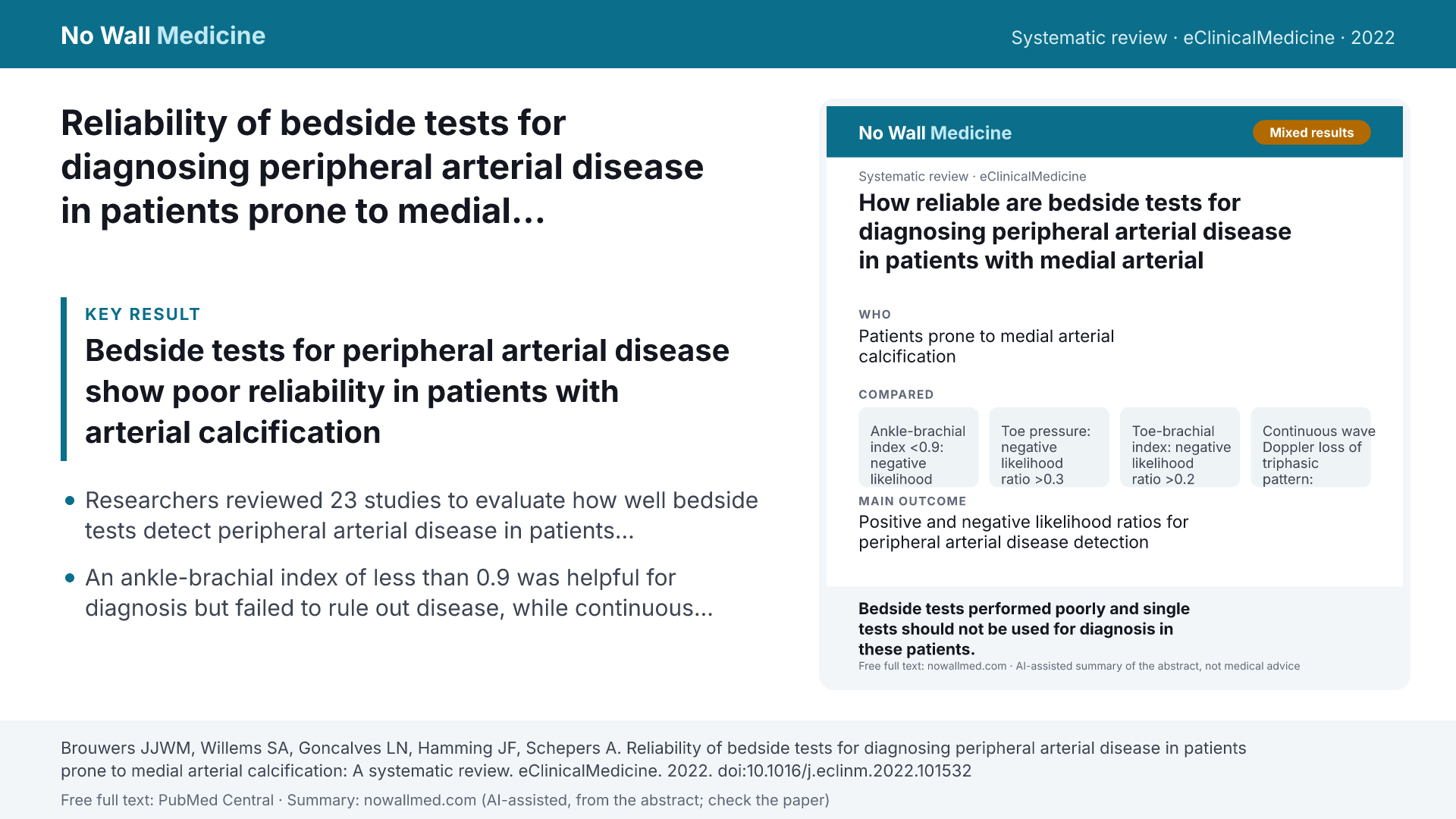
Bedside tests for peripheral arterial disease show poor reliability in patients with arterial calcification
Reliability of bedside tests for diagnosing peripheral arterial disease in patients prone to medial arterial calcification: A systematic review
Systematic reviewMixed results
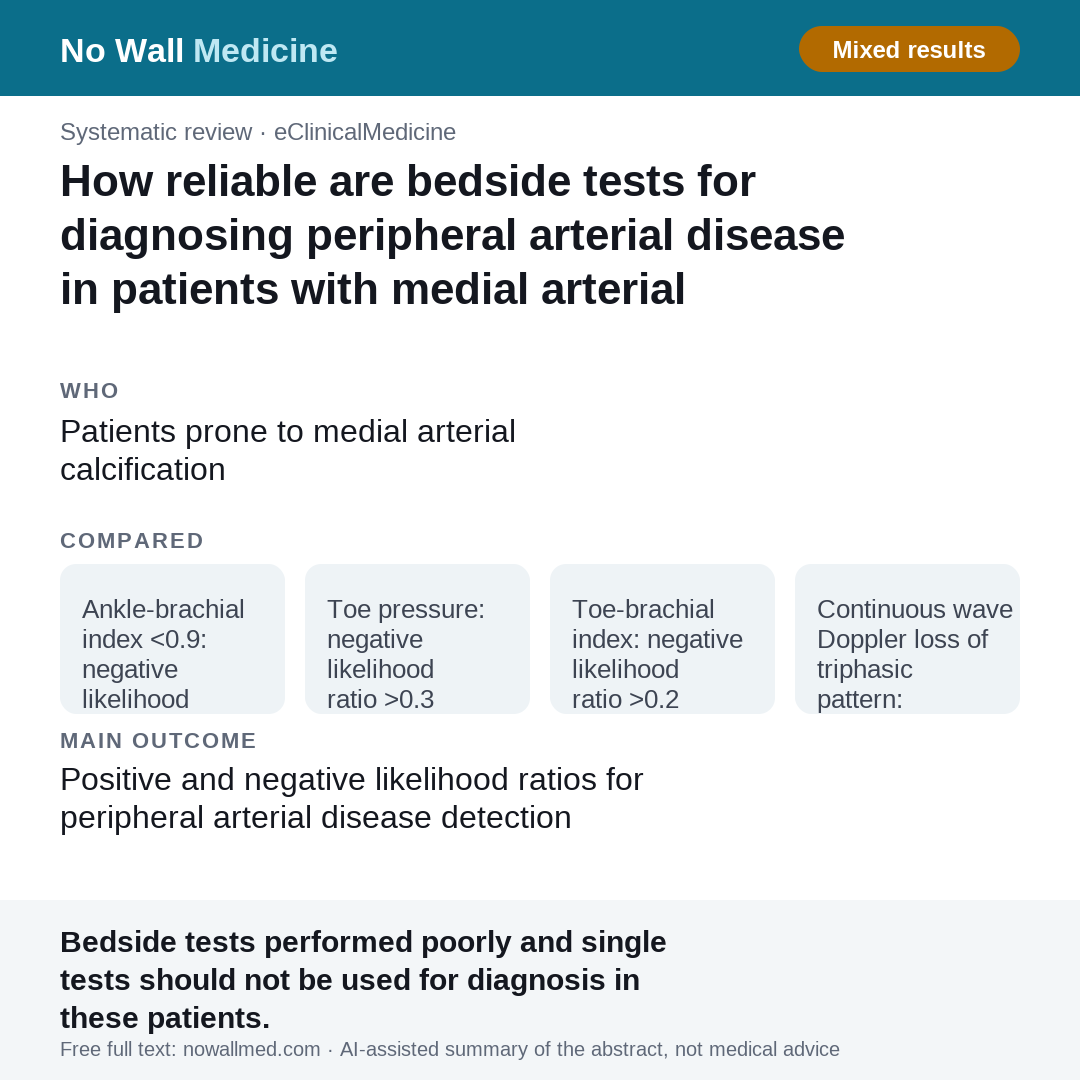
How reliable are bedside tests for diagnosing peripheral arterial disease in patients with medial arterial calcification?
Who
Patients prone to medial arterial calcification
Compared
Ankle-brachial index <0.9: negative likelihood ratio >0.2
Toe pressure: negative likelihood ratio >0.3
Toe-brachial index: negative likelihood ratio >0.2
Continuous wave Doppler loss of triphasic pattern: negative likelihood ratio 0-0.09
Main outcome
Positive and negative likelihood ratios for peripheral arterial disease detection
Bottom line: Bedside tests performed poorly and single tests should not be used for diagnosis in these patients.
Limitation: Methodological quality was poor with risk of bias in 20 studies.
eClinicalMedicine · 2022-07-01Download image
Clinical question: How reliable are bedside tests for diagnosing peripheral arterial disease in patients with medial arterial calcification?
Why it matters: Medial arterial calcification causes stiff arteries that may impede the accuracy of bedside tests used to diagnose peripheral arterial disease.
Key points
- Researchers reviewed 23 studies to evaluate how well bedside tests detect peripheral arterial disease in patients with medial arterial calcification, a condition causing stiff, incompressible arteries.
- An ankle-brachial index of less than 0.9 was helpful for diagnosis but failed to rule out disease, while continuous wave Doppler was reliable to exclude disease with a negative likelihood ratio of 0-0.09.
- The review found that most included studies had poor methodological quality, leading to a risk of bias in 20 studies.
Limitation the authors note: The methodological quality of the included studies was poor, which led to a risk of bias in 20 studies.
Headline and key points written with AI from the paper’s abstract, with every number checked against it. Read the paper before relying on them.
Was this summary helpful?
Cite this article
Brouwers JJWM, Willems SA, Goncalves LN, Hamming JF, Schepers A. Reliability of bedside tests for diagnosing peripheral arterial disease in patients prone to medial arterial calcification: A systematic review. eClinicalMedicine. 2022. doi:10.1016/j.eclinm.2022.101532
Spotted a mistake? Suggest a correction