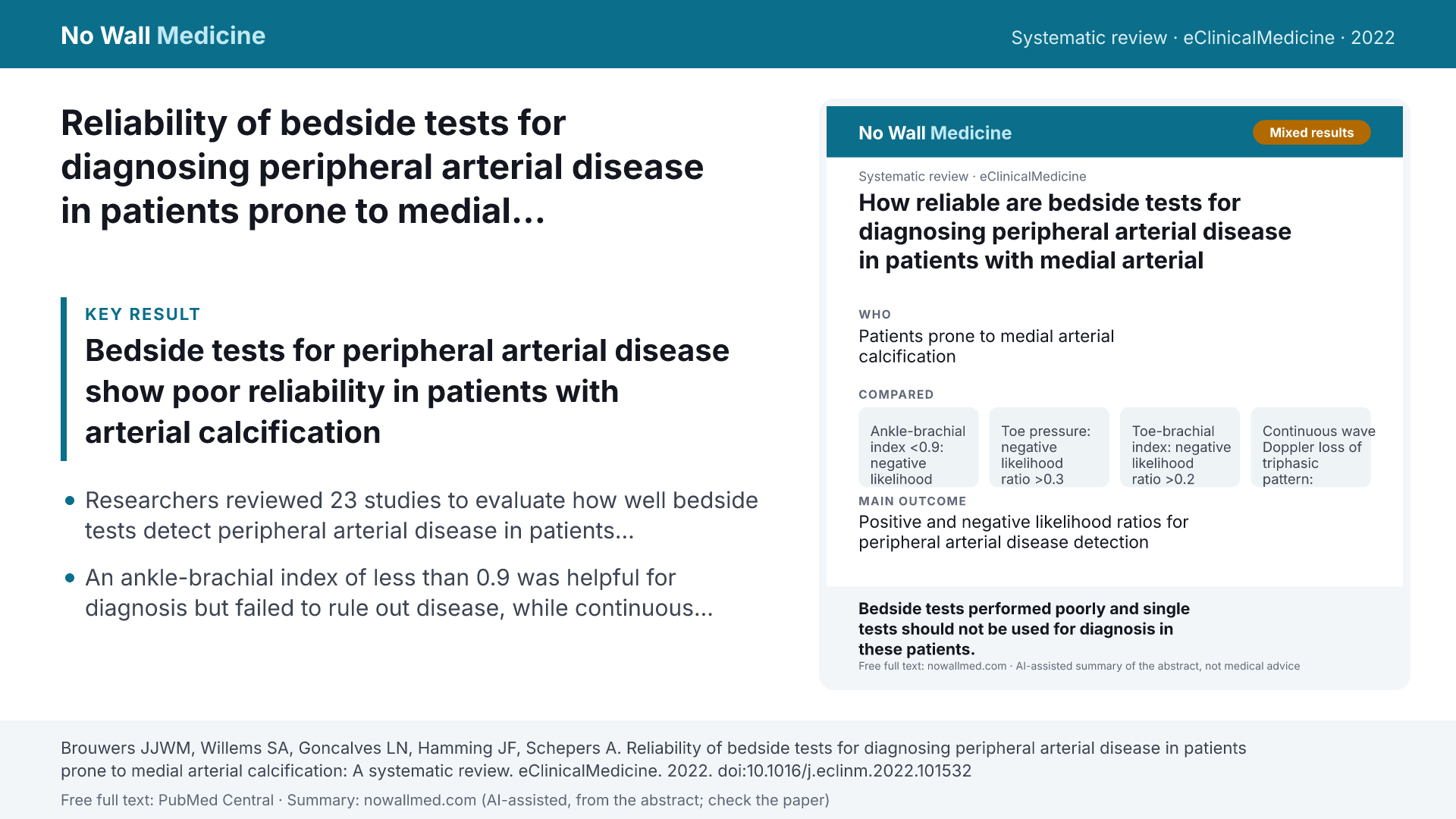
Reliability of bedside tests for diagnosing peripheral arterial disease in patients prone to medial arterial calcification: A systematic review
Key result: Bedside tests for peripheral arterial disease show poor reliability in patients with arterial calcification
Key points
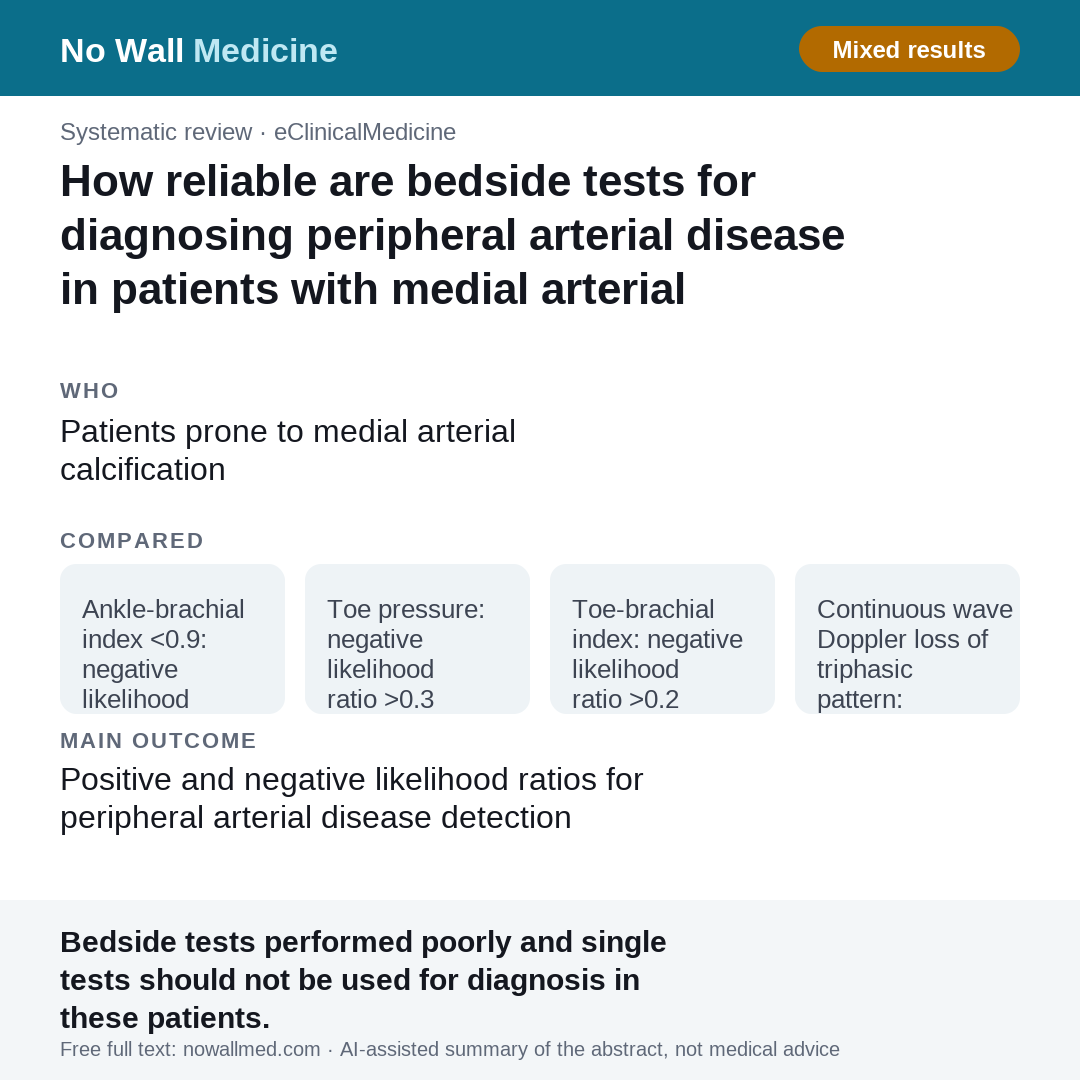
- Researchers reviewed 23 studies to evaluate how well bedside tests detect peripheral arterial disease in patients with medial arterial calcification, a condition causing stiff, incompressible arteries.
- An ankle-brachial index of less than 0.9 was helpful for diagnosis but failed to rule out disease, while continuous wave Doppler was reliable to exclude disease with a negative likelihood ratio of 0-0.09.
- The review found that most included studies had poor methodological quality, leading to a risk of bias in 20 studies.
Why it matters: Medial arterial calcification causes stiff arteries that may impede the accuracy of bedside tests used to diagnose peripheral arterial disease.
Limitation the authors note: The methodological quality of the included studies was poor, which led to a risk of bias in 20 studies.
Discussion prompts
- Would these patients look like yours? Who was left out?
- Is the main outcome one that matters to patients?
- Is the difference large enough to change what you do?
Cite: Brouwers JJWM, Willems SA, Goncalves LN, Hamming JF, Schepers A. Reliability of bedside tests for diagnosing peripheral arterial disease in patients prone to medial arterial calcification: A systematic review. eClinicalMedicine. 2022. doi:10.1016/j.eclinm.2022.101532
Free full text: PubMed Central · Summary and visual abstract: nowallmed.com/a/reliability-of-bedside-tests-for-diagnosing-peripheral-arterial-794r2b/ (AI-assisted from the abstract; check the paper before relying on it).