Remote lung fluid sensing guided discharge strategy improved outcomes one month after heart failure hospitalization
Remote Dielectric Sensing Before and After Discharge in Patients With ADHF: The ReDS-SAFE HF Trial
Single-blind, randomized, proof-of-concept trialBenefit found
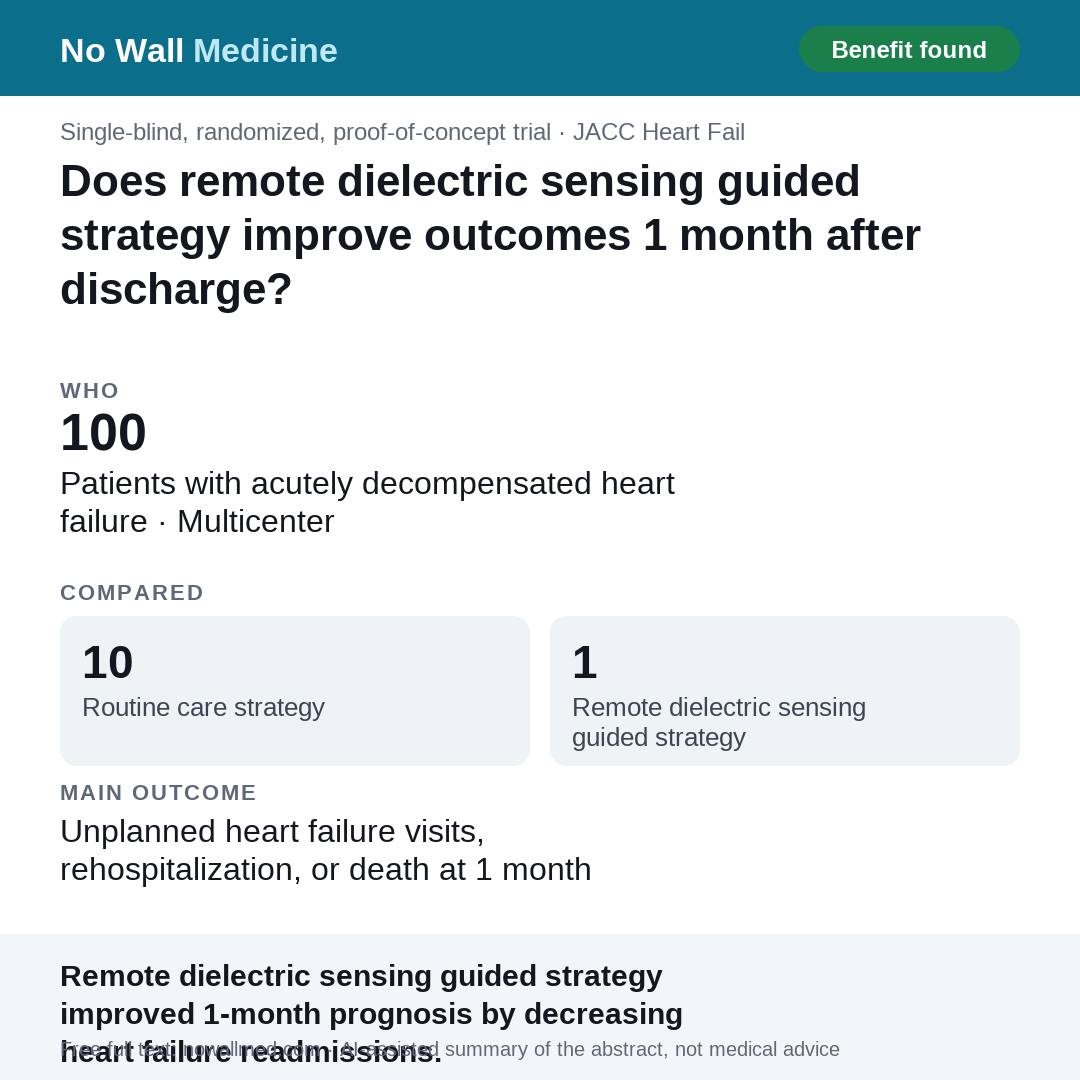
Does remote dielectric sensing guided strategy improve outcomes 1 month after discharge?
Who
100
Patients with acutely decompensated heart failure · Multicenter
Compared
10Routine care strategy (20%)
1Remote dielectric sensing guided strategy (2%)
Main outcome
Unplanned heart failure visits, rehospitalization, or death at 1 month
Result: hazard ratio 0.094 (95% CI: 0.012-0.731)
Bottom line: Remote dielectric sensing guided strategy improved 1-month prognosis by decreasing heart failure readmissions.
JACC Heart Fail · 2024-02-28Download image
Clinical question: Does remote dielectric sensing guided strategy improve outcomes 1 month after discharge?
Why it matters: It is unknown if using electromagnetic technology to quantify lung fluid concentration during hospitalization improves outcomes for patients with acutely decompensated heart failure.
Key points
- Researchers randomized 100 patients with acutely decompensated heart failure to either routine care or a strategy using remote dielectric sensing, a technology that measures lung fluid.
- The primary composite outcome of unplanned visits, rehospitalization, or death occurred in 20% of the routine care group compared to 2% in the sensing-guided group.
- The median length of stay was 8 days in the sensing-guided group versus 6 days in the routine care group, though this difference was not statistically significant.
Headline and key points written with AI from the paper’s abstract, with every number checked against it. Read the paper before relying on them.
Was this summary helpful?
Subject terms
Cite this article
Alvarez-Garcia J, Lala A, Rivas-Lasarte M, De Rueda C, Brunjes D, Lozano-Jimenez S. Remote Dielectric Sensing Before and After Discharge in Patients With ADHF: The ReDS-SAFE HF Trial. JACC Heart Fail. 2024. doi:10.1016/j.jchf.2024.01.002
Spotted a mistake? Suggest a correction
Top studies every Monday
The week’s key trials and guidelines in your specialties, plus any topics you follow. By email, free.
Get the weekly digest