Protocol for a trial to test remote spirometry and pulse oximetry in interstitial lung disease
REMOTE-ILD study: Description of the protocol for a multicentre, 12-month randomised controlled trial to assess the clinical and cost-effectiveness of remote monitoring of spirometry and pulse oximetry in patients with interstitial lung disease
Multicentre, 12-month randomised controlled trialUnclear result
Does remote monitoring of spirometry and pulse oximetry improve clinical and cost-effectiveness in interstitial lung disease?
Who
132
Patients with fibrotic interstitial lung disease
Compared
Usual care with remote digital monitoring
Usual care alone
Main outcome
Availability of spirometry measurements within 2 weeks preceding clinic appointments
Bottom line: This protocol describes a trial to assess remote monitoring utility in interstitial lung disease.
BMJ Open Respir Res · 2024-02-28Download image
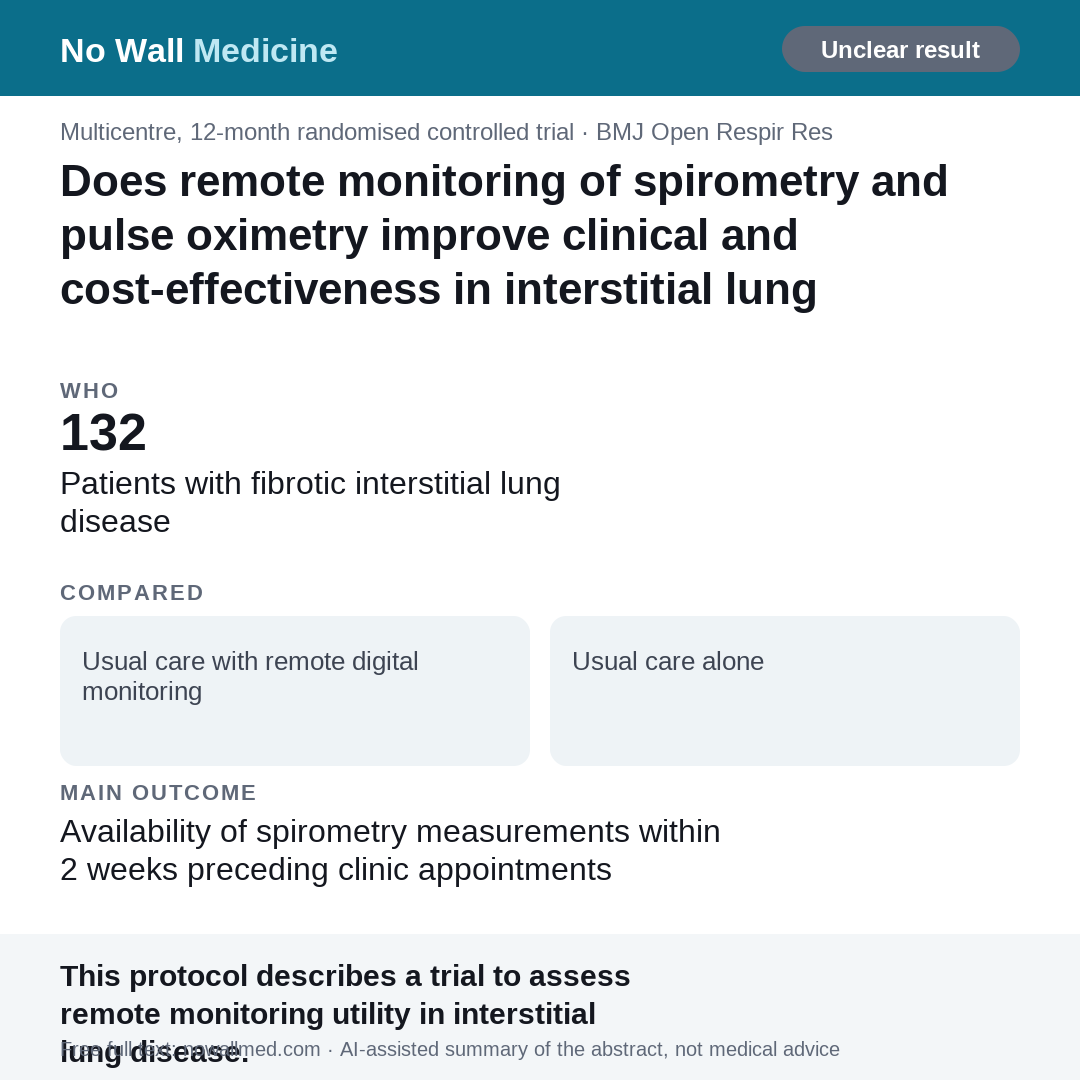
Clinical question: Does remote monitoring of spirometry and pulse oximetry improve clinical and cost-effectiveness in interstitial lung disease?
Why it matters: It is unknown if integrating frequent remote physiological measurements into clinical practice is clinically and cost-effective for patients with interstitial lung disease.
Key points
- The study will recruit 132 patients with fibrotic interstitial lung disease, a group with scarring in the lungs, to compare usual care with remote monitoring.
- Participants will be randomized to receive either usual care alone or usual care plus remote digital monitoring of home spirometry and pulse oximetry for 12 months.
- The primary goal is to compare the availability of spirometry measurements, which measure lung function, in the 2 weeks before planned clinic appointments.
Headline and key points written with AI from the paper’s abstract, with every number checked against it. Read the paper before relying on them.
Was this summary helpful?
Abstract
Introduction
Remote monitoring of home physiological measurements has been proposed as a solution to support patients with chronic diseases as well as facilitating virtual consultations and pandemic preparedness for the future. Daily home spirometry and pulse oximetry have been demonstrated to be safe and acceptable to patients with interstitial lung disease (ILD) but there is currently limited evidence to support its integration into clinical practice. Aim
Our aim is to understand the clinical utility of frequent remote physiological measurements in ILD and the impact of integrating these into clinical practice from a patient, clinical and health economic perspective. Methods and analysis
132 patients with fibrotic ILD will be recruited and randomised to receive either usual care with remote digital monitoring of home spirometry and pulse oximetry or usual care alone for 12 months. All participants will complete health-related quality of life and experience questionnaires.The primary outcome compares the availability of spirometry measurements within the 2 weeks preceding planned clinic appointments. Secondary outcomes will explore other aspects of clinical and cost-effectiveness of the remote monitoring programme. Ethics and dissemination
The study has been approved by the Camden and Kings Cross Research Ethics Committee (22/LO/0309). All participants will provide informed consent.This study is registered with www. Clinicaltrials
gov (NCT05662124).The results of the study will be submitted for presentation at regional and national conferences and submitted for peer-reviewed publication. Reports will be prepared for study participants with the support from our public involvement representatives through the charity Action for Pulmonary Fibrosis.
Abstract reproduced under the article’s CC BY licence.
Subject terms
Cite this article
Barth S, Edwards C, Borton R, Beever D, Adams W, Jenkins G. REMOTE-ILD study: Description of the protocol for a multicentre, 12-month randomised controlled trial to assess the clinical and cost-effectiveness of remote monitoring of spirometry and pulse oximetry in patients with interstitial lung disease. BMJ Open Respir Res. 2024. doi:10.1136/bmjresp-2023-002067
Spotted a mistake? Suggest a correction
Top studies every Monday
The week’s key trials and guidelines in your specialties, plus any topics you follow. By email, free.
Get the weekly digest