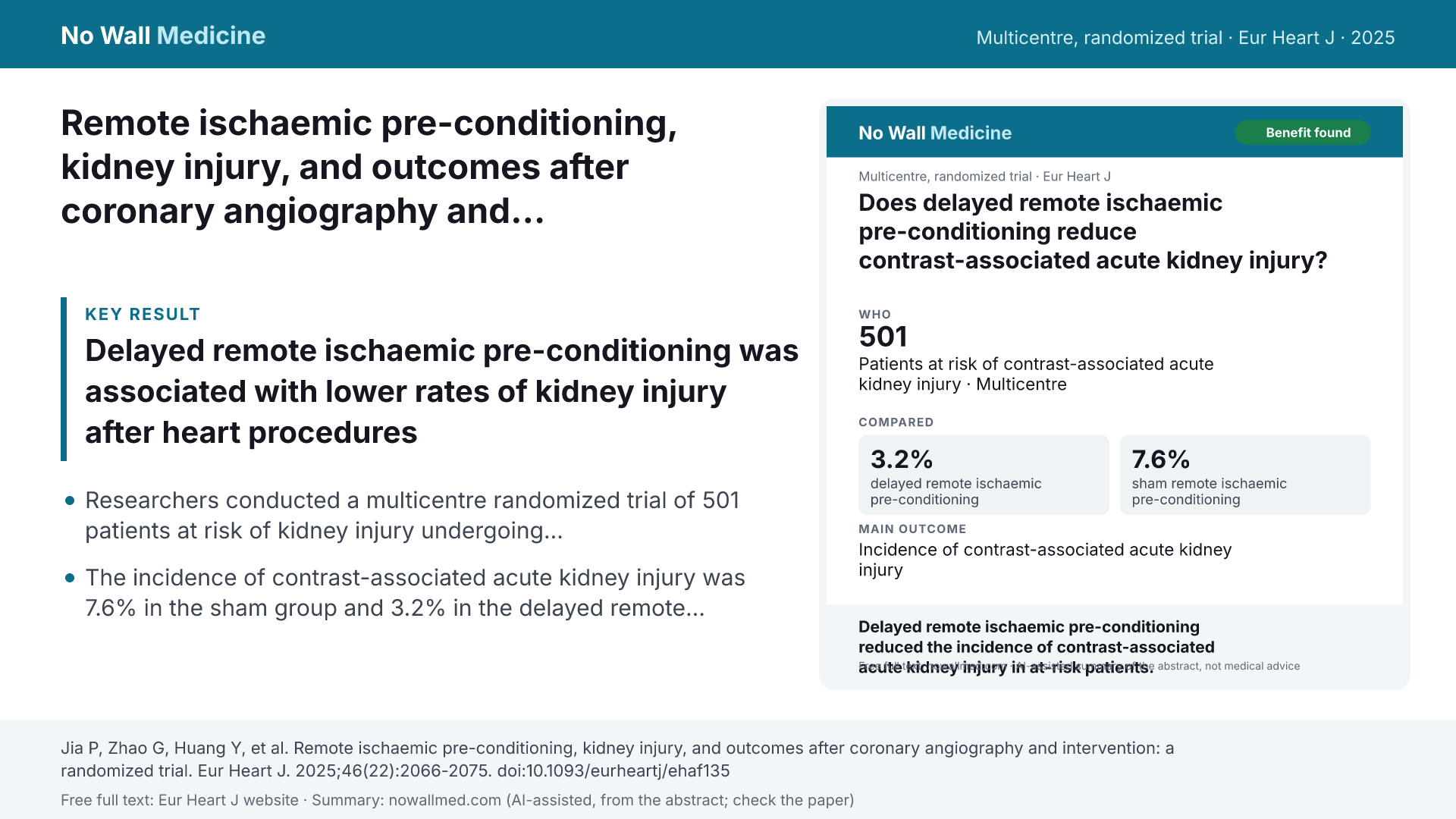
Delayed remote ischaemic pre-conditioning was associated with lower rates of kidney injury after heart procedures
Remote ischaemic pre-conditioning, kidney injury, and outcomes after coronary angiography and intervention: a randomized trial
Multicentre, randomized trialBenefit found
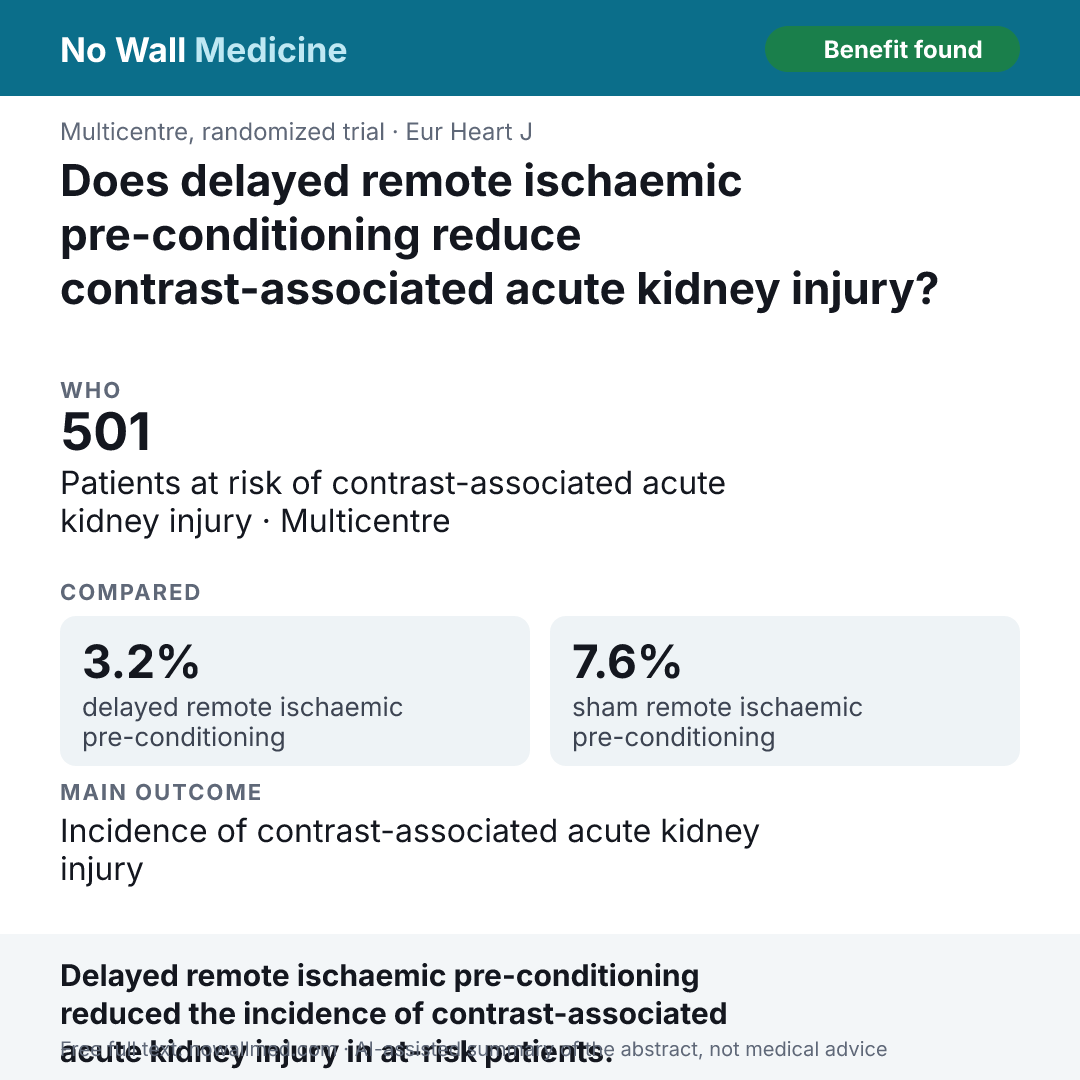
Does delayed remote ischaemic pre-conditioning reduce contrast-associated acute kidney injury?
Who
501
Patients at risk of contrast-associated acute kidney injury · Multicentre
Compared
3.2%delayed remote ischaemic pre-conditioning
7.6%sham remote ischaemic pre-conditioning
Main outcome
Incidence of contrast-associated acute kidney injury
Result: odds ratio 0.4 (95% confidence interval 0.17-0.94)
Bottom line: Delayed remote ischaemic pre-conditioning reduced the incidence of contrast-associated acute kidney injury in at-risk patients.
Eur Heart J · 2025-03-12 · Save PNG
Clinical question: Does delayed remote ischaemic pre-conditioning reduce contrast-associated acute kidney injury?
In absolute numbers
delayed remote ischaemic pre-conditioning: 3.2% · sham remote ischaemic pre-conditioning: 7.6% → a difference of 4.4 percentage points, so about 23 people would need the treatment for 1 more to benefit (number needed to treat) over the trial’s follow-up.
Worked out by us from the two group results above, not reported by the authors. Check the paper for the exact outcome and timing.
Key points
- Researchers conducted a multicentre randomized trial of 501 patients at risk of kidney injury undergoing coronary angiography or percutaneous coronary intervention.
- The incidence of contrast-associated acute kidney injury was 7.6% in the sham group and 3.2% in the delayed remote ischaemic pre-conditioning group.
- The trial was not adequately powered to show effects on secondary outcomes such as mortality, stroke, or the need for dialysis.
Headline and key points written with AI from the paper’s abstract, with every number checked against it. Read the paper before relying on them.
Was this summary helpful?
Subject terms
Headline, design, result, key points, caveat and citation as plain text.
Cite this article
Jia P, Zhao G, Huang Y, et al. Remote ischaemic pre-conditioning, kidney injury, and outcomes after coronary angiography and intervention: a randomized trial. Eur Heart J. 2025;46(22):2066-2075. doi:10.1093/eurheartj/ehaf135
Spotted a mistake? Suggest a correction