Low-intensity remote lifestyle program did not significantly improve cognition in adults with memory concerns
Remote, lower-intensity, multidomain lifestyle intervention for subjective cognitive decline or mild cognitive impairment (APPLE-Tree): a multicentre, single-masked, randomised controlled trial
Single-masked, multisite, randomised controlled clinical trialNo clear difference
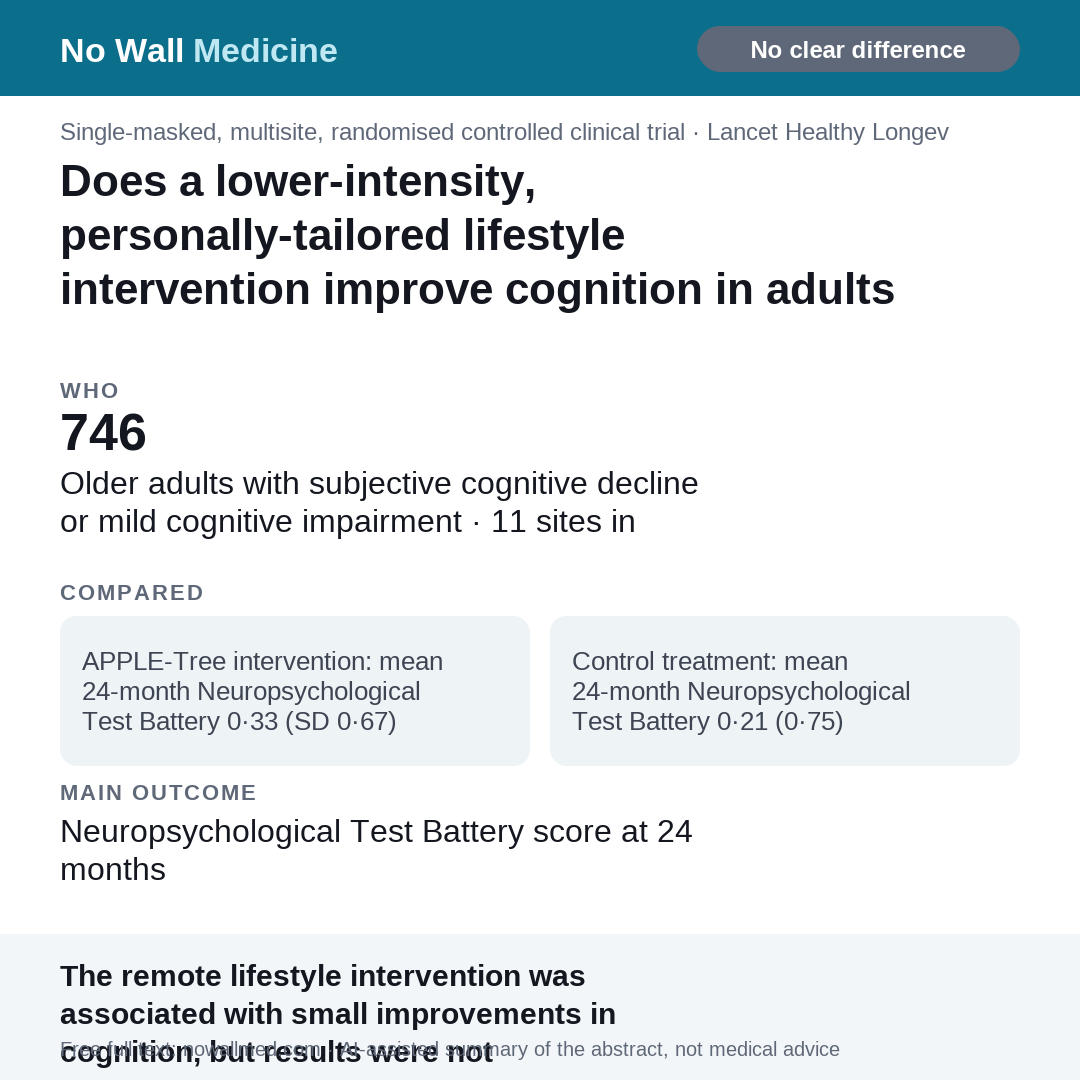
Does a lower-intensity, personally-tailored lifestyle intervention improve cognition in adults with cognitive decline?
Who
746
Older adults with subjective cognitive decline or mild cognitive impairment · 11 sites in England
Compared
APPLE-Tree intervention: mean 24-month Neuropsychological Test Battery 0·33 (SD 0·67)
Control treatment: mean 24-month Neuropsychological Test Battery 0·21 (0·75)
Main outcome
Neuropsychological Test Battery score at 24 months
Result: adjusted mean difference 0·06 (95% CI -0·001 to 0·128)
Bottom line: The remote lifestyle intervention was associated with small improvements in cognition, but results were not statistically significant.
Limitation: further work is needed to optimise the intervention for delivery in routine settings
Funded by: Economic and Social Research Council and National Institute for Health and Care Research
Lancet Healthy Longev · 2025-10-20Download image
Clinical question: Does a lower-intensity, personally-tailored lifestyle intervention improve cognition in adults with cognitive decline?
Why it matters: It is unclear if a lower-intensity, personally-tailored lifestyle program delivered remotely can effectively improve cognition in adults at risk of dementia.
Key points
- Researchers studied 746 adults with subjective cognitive decline or mild cognitive impairment, comparing a remote lifestyle intervention to usual care.
- The mean 24-month neuropsychological test battery score was 0.33 in the intervention group versus 0.21 in the control group, but the difference was not statistically significant.
- Serious adverse events occurred in 35 (9%) participants in the intervention group and 30 (8%) in the control group, though none were related to the intervention.
Headline and key points written with AI from the paper’s abstract, with every number checked against it. Read the paper before relying on them.
Topics
Cite this article
Demnitz-King H, Adeleke M, Barber JA, Poppe M, Budgett J, Alberts S. Remote, lower-intensity, multidomain lifestyle intervention for subjective cognitive decline or mild cognitive impairment (APPLE-Tree): a multicentre, single-masked, randomised controlled trial. Lancet Healthy Longev. 2025. doi:10.1016/j.lanhl.2025.100777
Spotted a mistake? Suggest a correction