Lifestyle interventions showed positive effects on cognition for people at risk of dementia in low-income countries
Lifestyle interventions for dementia prevention in low- and middle-income countries: a systematic review
Systematic review and meta-analysis of randomized controlled trialsBenefit found
Do lifestyle interventions prevent dementia in low- and middle-income countries?
Who
1304
Individuals with mild cognitive impairment and subjective cognitive decline · Six countries, mostly in China
Compared
Interventions
Control
Main outcome
Cognition
Result: standardised mean difference 1.49 (95% CI 1.06 to 1.93)
Bottom line: Lifestyle interventions show significant positive effects on cognition in low- and middle-income countries.
Limitation: There was significant publication bias.
BMJ Glob Health · 2026-06-22Download image
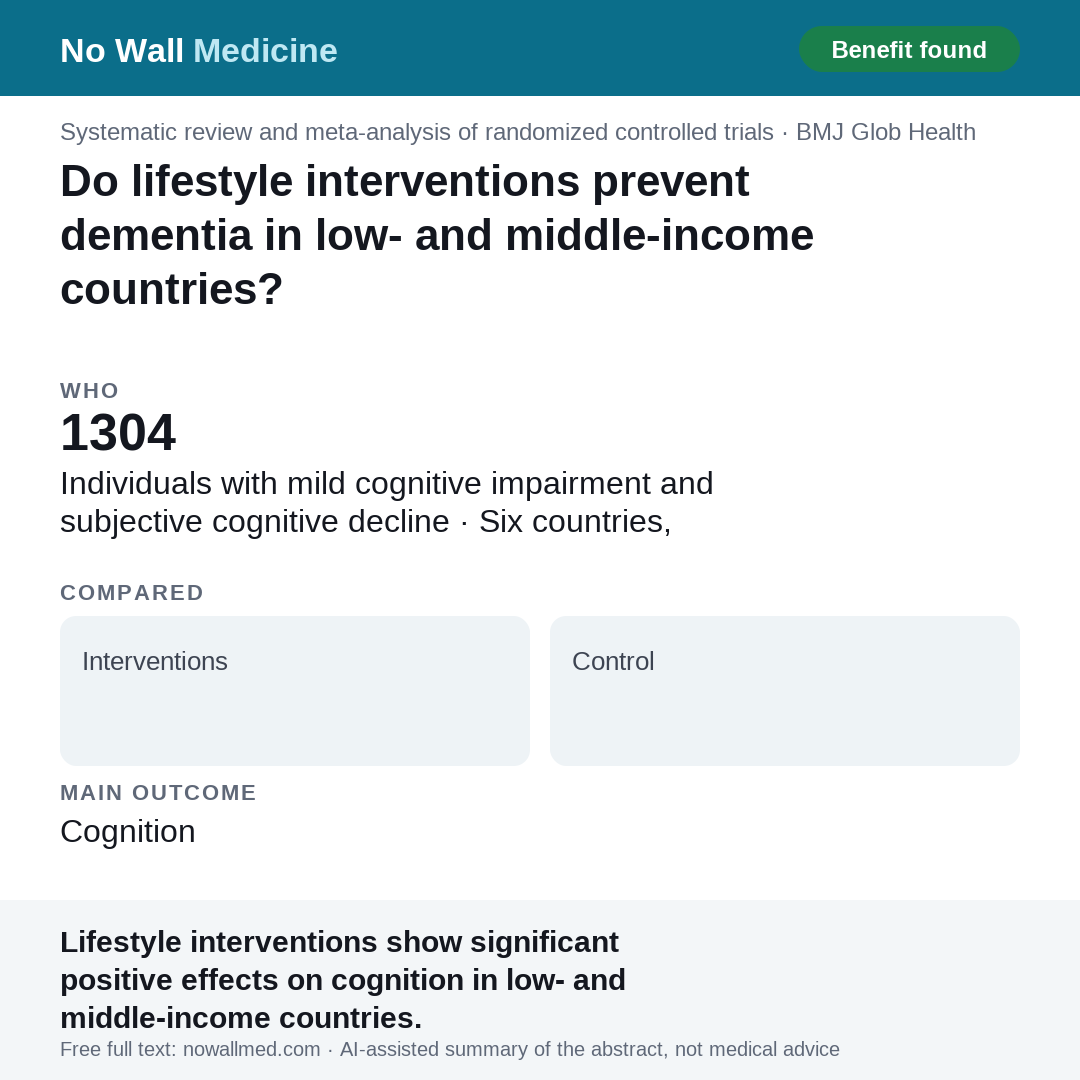
Clinical question: Do lifestyle interventions prevent dementia in low- and middle-income countries?
Why it matters: Most multimodal prevention lifestyle interventions for people at risk of dementia are being developed predominantly in higher-income countries.
Key points
- Researchers reviewed 25 randomized controlled trials involving 1304 participants in low- and middle-income countries to evaluate non-drug lifestyle interventions.
- The meta-analysis of 15 studies showed significant positive effects on cognition with a standardized mean difference of 1.49 (95% CI 1.06 to 1.93).
- Exercise and multidomain interventions showed replicated evidence of effectiveness, while there was insufficient data to analyze arts or creative expression categories.
Limitation the authors note: There was significant publication bias.
Headline and key points written with AI from the paper’s abstract, with every number checked against it. Read the paper before relying on them.
Abstract
Introduction
By 2050, two-thirds of people with dementia will live in low-and-middle-income countries (LMICs). However, multimodal prevention lifestyle interventions for people at risk are being developed predominantly in higher-income countries. Methods
We systematically reviewed randomised controlled trials (RCTs) evaluating non-pharmacological interventions in individuals with mild cognitive impairment and subjective cognitive decline in LMICs. We assessed quality using the Mixed Methods Assessment Tool, meta-analysed and synthesised evidence. Results
We included 25 RCTs from six countries (most in China, n=17), involving 1304 participants. In the 15 studies with sufficient data to meta-analyse, we found significant positive effects on cognition favouring interventions (1.49 (standardised mean difference, 95% CI 1.06 to 1.93)). There was significant publication bias. We classified interventions into exercise, multidomain and arts/creative expression. Exercise (1.67, 95% CI 1.24 to 2.11, n=8) and multidomain (1.22, 95% CI 0.22 to 2.21, n=5) had replicated evidence of effectiveness. There was insufficient data to meta-analyse the arts/creative category. Conclusion
We propose greater consideration and investment in the development of interventions accounting for specific LMIC contexts from the outset, so they are acceptable and used by local services. Prospero registration number
CRD42023403908.
Abstract reproduced under the article’s CC BY NC licence.
Topics
Cite this article
Espinoza Jeraldo RI, Zabihi S, Miranda-Castillo C, Marshall CR, Cooper C. Lifestyle interventions for dementia prevention in low- and middle-income countries: a systematic review. BMJ Glob Health. 2026. doi:10.1136/bmjgh-2024-017630
Spotted a mistake? Suggest a correction