Acetazolamide increases decongestion in heart failure patients across different levels of kidney function
Renal function and decongestion with acetazolamide in acute decompensated heart failure: the ADVOR trial
Randomized trialMixed results
Does acetazolamide improve decongestion across different levels of renal function in heart failure?
Who
519
Patients with acute decompensated heart failure
Compared
Intravenous acetazolamide: 40.5% worsening renal function
Matching placebo: 18.9% worsening renal function
Main outcome
Decongestion, diuresis, natriuresis, and clinical outcomes
Bottom line: Acetazolamide improves decongestion across renal function ranges but increases the incidence of worsening renal function.
Eur Heart J · 2023-08-25Download image
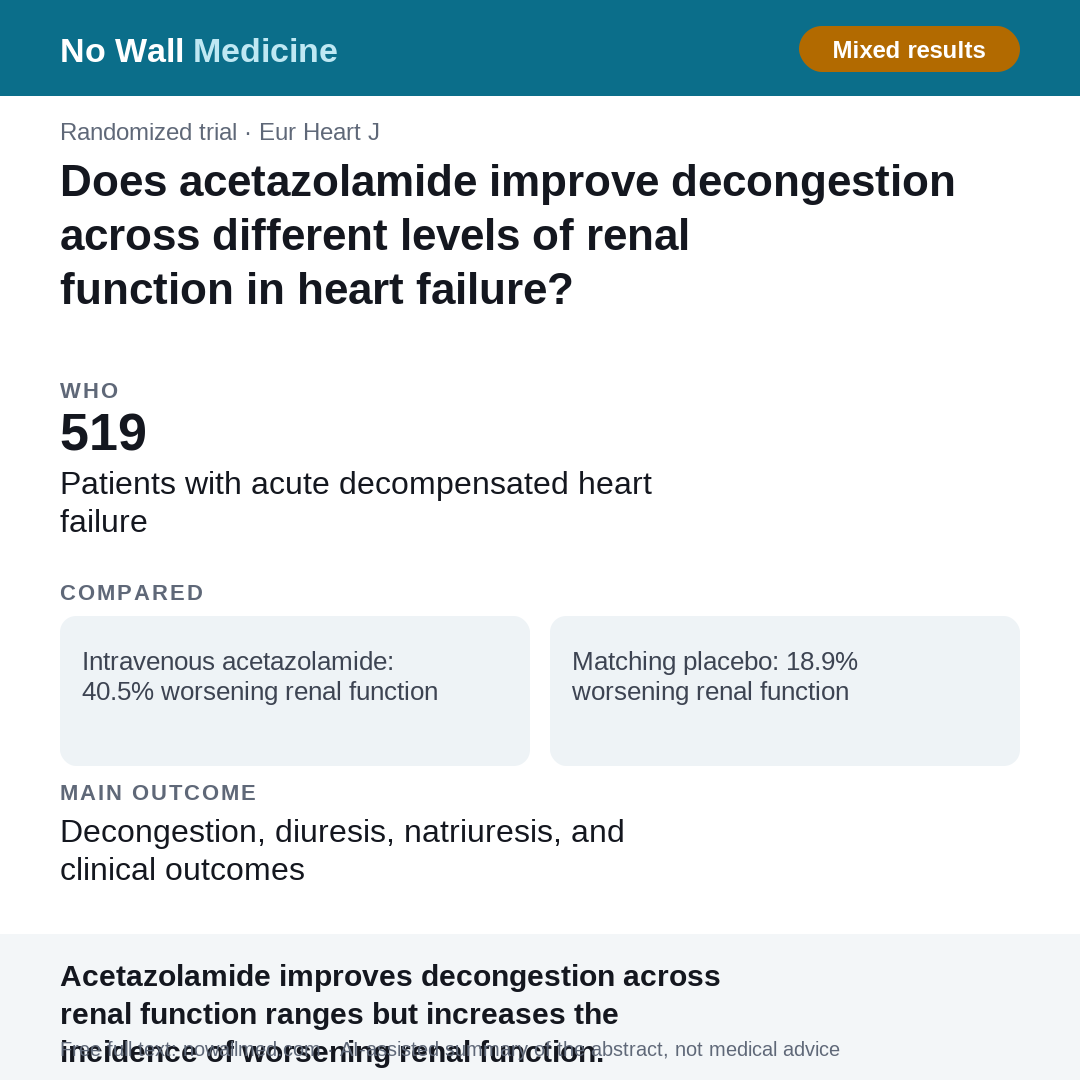
Clinical question: Does acetazolamide improve decongestion across different levels of renal function in heart failure?
Why it matters: It was unclear if the benefits of adding acetazolamide to diuretics for heart failure are consistent across the entire range of kidney function.
Key points
- Researchers analyzed 519 patients with acute decompensated heart failure randomized to receive intravenous acetazolamide or a placebo alongside intravenous loop diuretics.
- Acetazolamide was associated with higher natriuresis and diuresis, with a larger effect seen in patients with lower estimated glomerular filtration rate (kidney function).
- Acetazolamide was associated with a higher incidence of worsening renal function, defined as a rise in creatinine of ≥ 0.3 mg/dL, at 40.5% versus 18.9%.
Headline and key points written with AI from the paper’s abstract, with every number checked against it. Read the paper before relying on them.
Was this summary helpful?
Subject terms
Cite this article
Meekers E, Dauw J, Martens P, Dhont S, Verbrugge FH, Nijst P. Renal function and decongestion with acetazolamide in acute decompensated heart failure: the ADVOR trial. Eur Heart J. 2023. doi:10.1093/eurheartj/ehad557
Spotted a mistake? Suggest a correction
Top studies every Monday
The week’s key trials and guidelines in your specialties, plus any topics you follow. By email, free.
Get the weekly digest