Renal resistance trajectories during kidney perfusion were not linked to posttransplant outcomes
Renal resistance trajectories during hypothermic machine perfusion in kidneys donated after circulatory death: Associations with donor characteristics and posttransplant outcomes-An analysis of COMPARE trial data
Analysis of randomized trial dataNo clear difference
Does renal resistance trajectory during hypothermic machine perfusion predict posttransplant outcomes?
Who
Kidneys donated after circulatory death · Consortium for Organ Preservation in Europe
Compared
Renal resistance trajectory
Terminal renal resistance: odds ratio 1.14 (95% CI, 1.009-1.298)
Main outcome
Delayed graft function and other posttransplant outcomes
Result: odds ratio 1.14 (95% CI, 1.009-1.298)
Bottom line: Renal resistance trajectory does not predict posttransplant outcomes, so it should not be used alone for kidney discard.
Limitation: Findings call for further validation in larger, more diverse cohorts.
Am J Transplant · 2025-06-21Download image
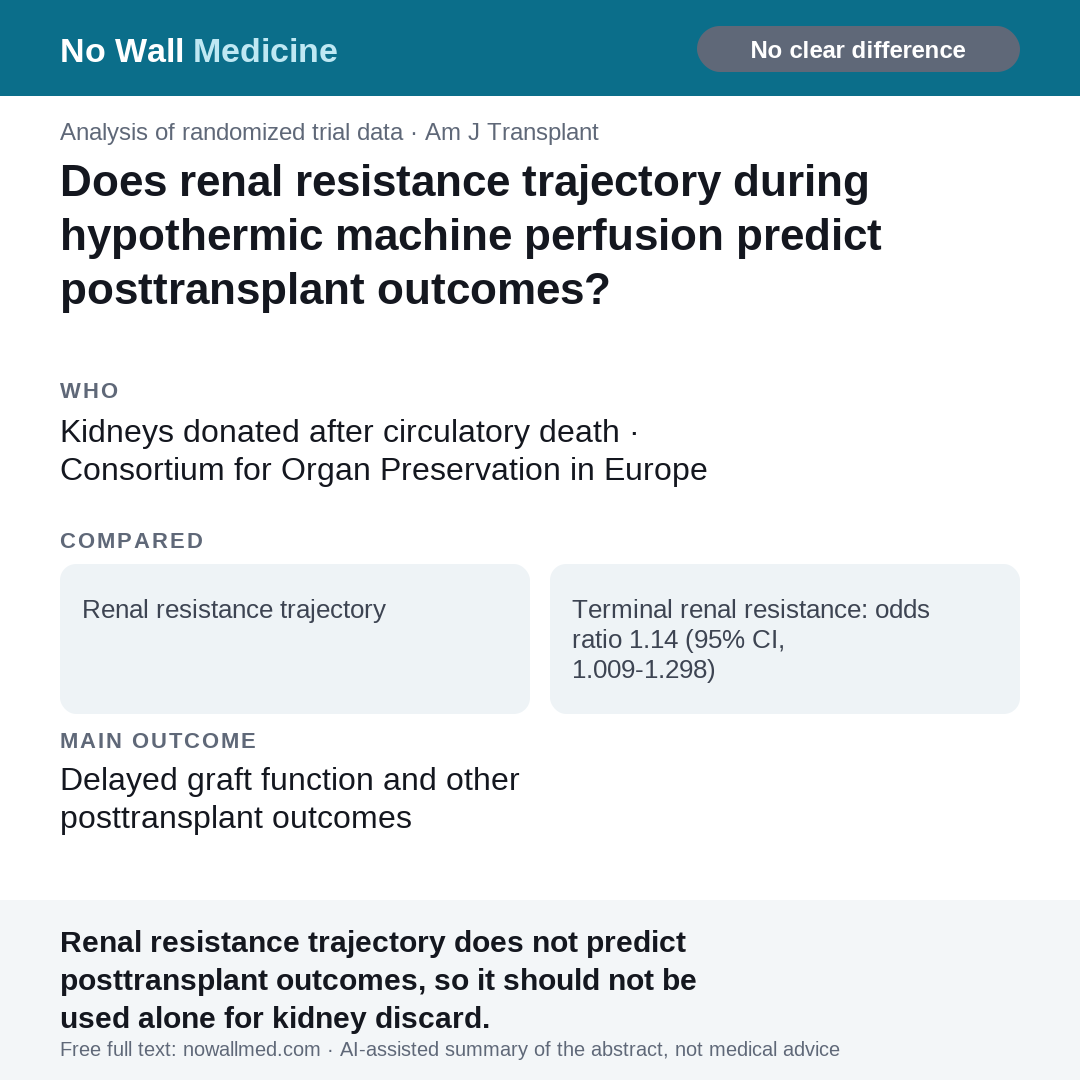
Clinical question: Does renal resistance trajectory during hypothermic machine perfusion predict posttransplant outcomes?
Why it matters: Most studies focus only on the final renal resistance measurement rather than the entire pattern of resistance during the organ preservation process.
Key points
- Researchers analyzed data from the randomized Consortium for Organ Preservation in Europe trial to examine how renal resistance, or fluid resistance in the kidney, changes during cooling perfusion.
- The renal resistance trajectory was associated with donor weight and cause of death, but was not linked to delayed graft function, organ rejection, or 1-year kidney survival.
- Terminal renal resistance was associated with delayed graft function with an odds ratio of 1.14, though it had limited prognostic value.
Limitation the authors note: The authors state that the findings require further validation in larger, more diverse cohorts.
Headline and key points written with AI from the paper’s abstract, with every number checked against it. Read the paper before relying on them.
Was this summary helpful?
Subject terms
Cite this article
Verstraeten L, Fieuws S, Hofker HS, Leuvenink HGD, Ploeg RJ, Pirenne J. Renal resistance trajectories during hypothermic machine perfusion in kidneys donated after circulatory death: Associations with donor characteristics and posttransplant outcomes-An analysis of COMPARE trial data. Am J Transplant. 2025. doi:10.1016/j.ajt.2025.06.014
Spotted a mistake? Suggest a correction
Top studies every Monday
The week’s key trials and guidelines in your specialties, plus any topics you follow. By email, free.
Get the weekly digest