Repeated cell therapy was associated with slower upper limb function decline in Duchenne muscular dystrophy
Repeated intravenous cardiosphere-derived cell therapy in late-stage Duchenne muscular dystrophy (HOPE-2): a multicentre, randomised, double-blind, placebo-controlled, phase 2 trial
Randomised, double-blind, placebo-controlled, phase 2 trialBenefit found
Does repeated intravenous cardiosphere-derived cell therapy improve upper limb function in Duchenne muscular dystrophy?
Who
26
Male patients with Duchenne muscular dystrophy aged 10 years or older · Seven centres in the USA
Compared
CAP-1002: difference of 2.6 points
placebo
Main outcome
change in mid-level elbow Performance of Upper Limb version 1.2 score
Result: percentile difference 36.2, 95% CI 12.7-59.7
Bottom line: CAP-1002 cell therapy appears safe and effective in reducing upper limb function deterioration in late-stage Duchenne muscular dystrophy.
Funded by: Capricor Therapeutics
Lancet · 2022-03-13Download image
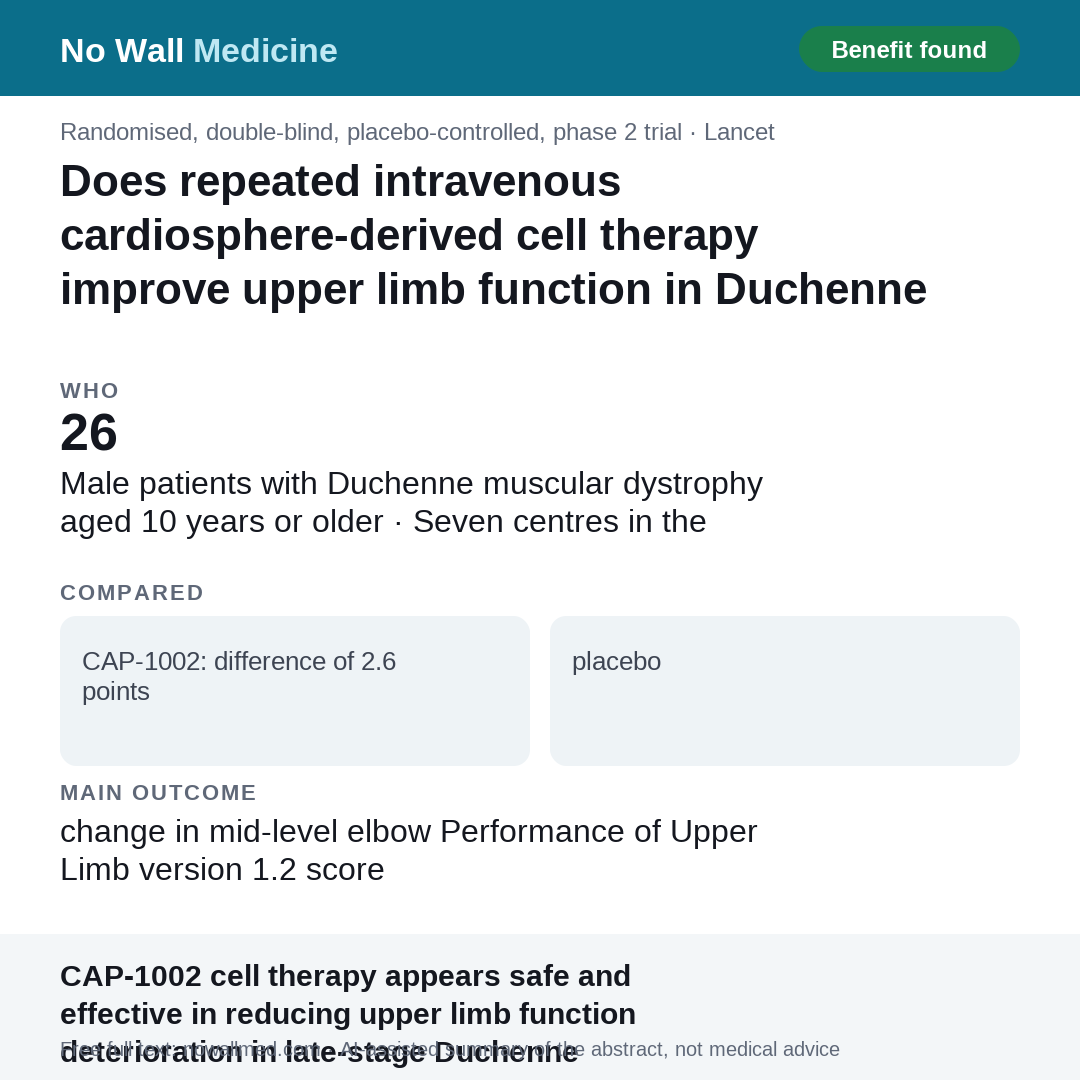
Clinical question: Does repeated intravenous cardiosphere-derived cell therapy improve upper limb function in Duchenne muscular dystrophy?
Why it matters: It was unknown if sequential infusions of cardiosphere-derived cells are safe and effective for treating skeletal and cardiac muscle deterioration in late-stage Duchenne muscular dystrophy.
Key points
- The trial studied 26 male patients with Duchenne muscular dystrophy, comparing four intravenous infusions of cardiosphere-derived cells to a placebo.
- In patients receiving post-treatment assessment, the cell therapy group showed a 2.6 point difference in mid-level elbow Performance of Upper Limb version 1.2 scores compared to placebo.
- Three patients experienced infusion-related hypersensitivity reactions, and one patient stopped therapy due to a severe allergic reaction.
Headline and key points written with AI from the paper’s abstract, with every number checked against it. Read the paper before relying on them.
Was this summary helpful?
Subject terms
Cite this article
McDonald CM, Marbán E, Hendrix S, Hogan N, Ruckdeschel Smith R, Eagle M. Repeated intravenous cardiosphere-derived cell therapy in late-stage Duchenne muscular dystrophy (HOPE-2): a multicentre, randomised, double-blind, placebo-controlled, phase 2 trial. Lancet. 2022. doi:10.1016/S0140-6736(22)00012-5
Spotted a mistake? Suggest a correction
Top studies every Monday
The week’s key trials and guidelines in your specialties, plus any topics you follow. By email, free.
Get the weekly digest