Magnetic resonance imaging shows high reliability and responsiveness for monitoring knee osteoarthritis structural changes
Responsiveness and reliability of MRI in knee osteoarthritis: An updated meta-analysis
Meta-analysis of 145 studiesBenefit found
How reliable and responsive is magnetic resonance imaging for assessing knee osteoarthritis structural changes?
Who
Patients with knee osteoarthritis
Compared
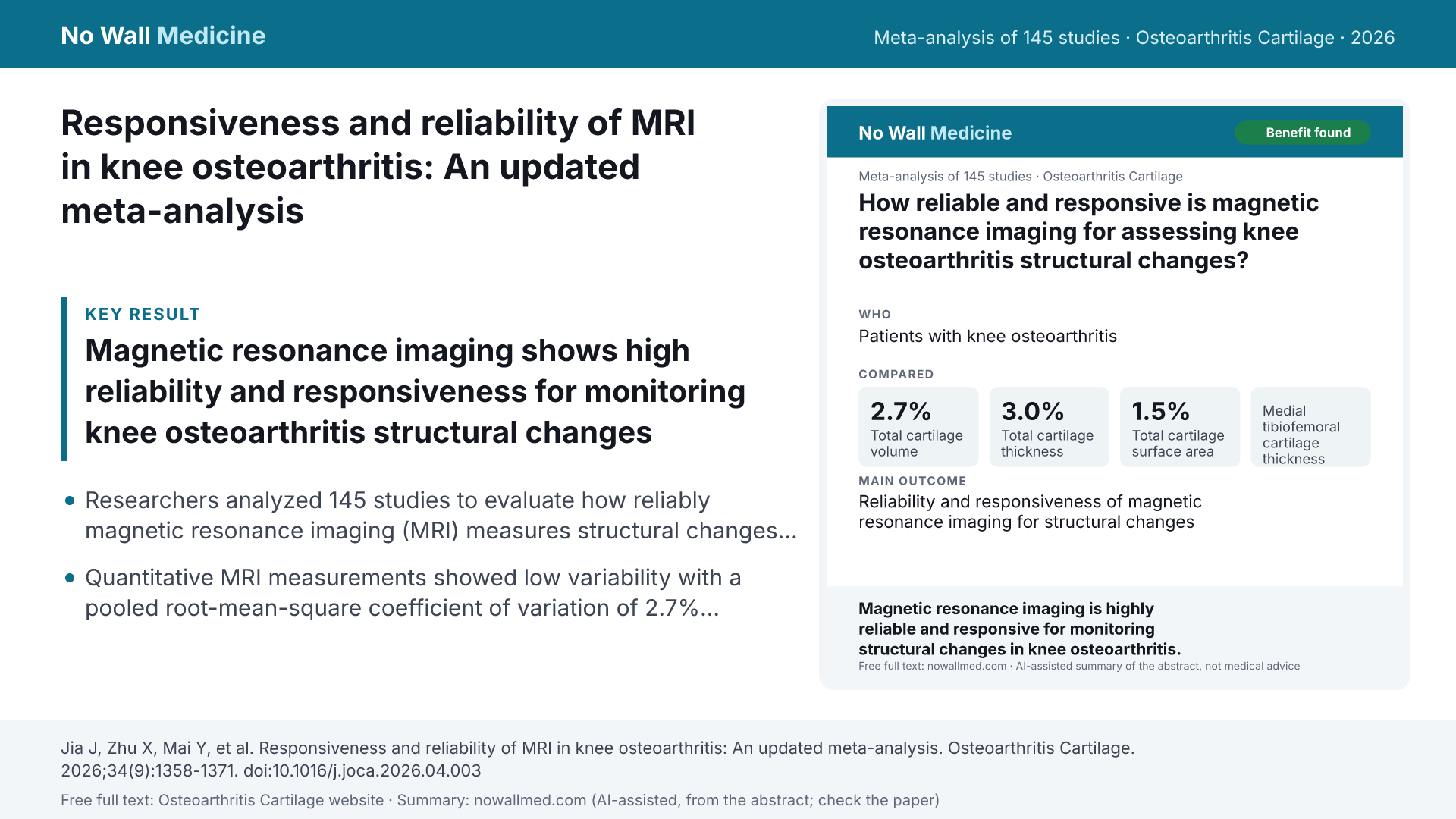
2.7%Total cartilage volume reliability (95% CI: 1.9-3.8%)
3.0%Total cartilage thickness reliability (95% CI: 2.1-4.2%)
1.5%Total cartilage surface area reliability (95% CI: 0.9-2.7%)
Medial tibiofemoral cartilage thickness responsiveness: SRM=-0.350, 95% CI: -0.405 to -0.294
Main outcome
Reliability and responsiveness of magnetic resonance imaging for structural changes
Bottom line: Magnetic resonance imaging is highly reliable and responsive for monitoring structural changes in knee osteoarthritis.
Osteoarthritis Cartilage · 2026-04-21 · Save PNG

Clinical question: How reliable and responsive is magnetic resonance imaging for assessing knee osteoarthritis structural changes?
Key points
- Researchers analyzed 145 studies to evaluate how reliably magnetic resonance imaging (MRI) measures structural changes in knee osteoarthritis.
- Quantitative MRI measurements showed low variability with a pooled root-mean-square coefficient of variation of 2.7% for total cartilage volume and 3.0% for total cartilage thickness.
- The highest responsiveness was found in the annualized standardized response mean of medial tibiofemoral cartilage thickness, which was -0.350.
Headline and key points written with AI from the paper’s abstract, with every number checked against it. Read the paper before relying on them.
Was this summary helpful?
Subject terms
Headline, design, result, key points, caveat and citation as plain text.
Cite this article
Jia J, Zhu X, Mai Y, et al. Responsiveness and reliability of MRI in knee osteoarthritis: An updated meta-analysis. Osteoarthritis Cartilage. 2026;34(9):1358-1371. doi:10.1016/j.joca.2026.04.003
Spotted a mistake? Suggest a correction