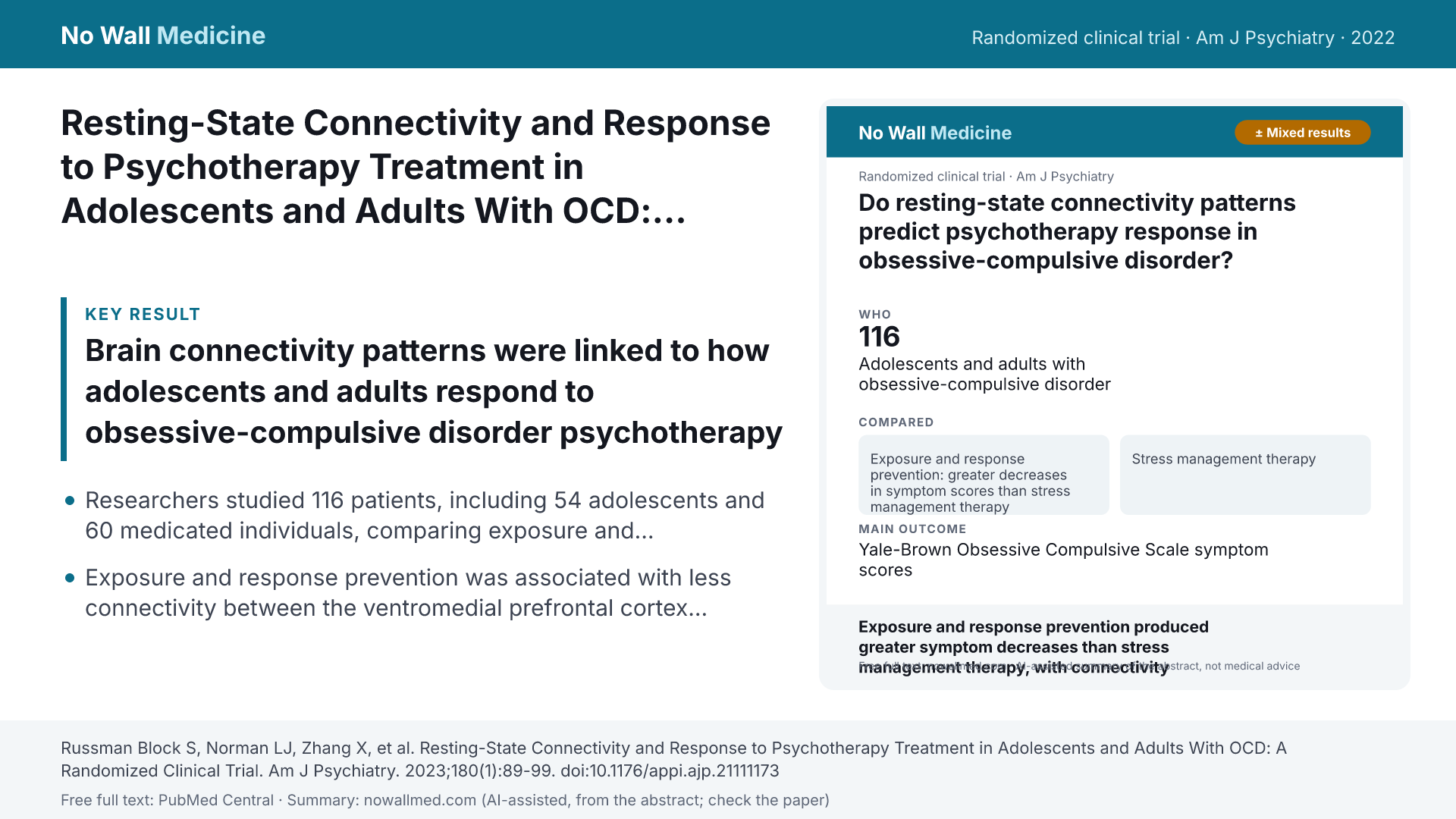
Brain connectivity patterns were linked to how adolescents and adults respond to obsessive-compulsive disorder psychotherapy
Resting-State Connectivity and Response to Psychotherapy Treatment in Adolescents and Adults With OCD: A Randomized Clinical Trial
Randomized clinical trialMixed results
Do resting-state connectivity patterns predict psychotherapy response in obsessive-compulsive disorder?
Who
116
Adolescents and adults with obsessive-compulsive disorder
Compared
Exposure and response prevention: greater decreases in symptom scores than stress management therapy
Stress management therapy
Main outcome
Yale-Brown Obsessive Compulsive Scale symptom scores
Bottom line: Exposure and response prevention produced greater symptom decreases than stress management therapy, with connectivity patterns predicting response.
Am J Psychiatry · 2022-12-07Download image
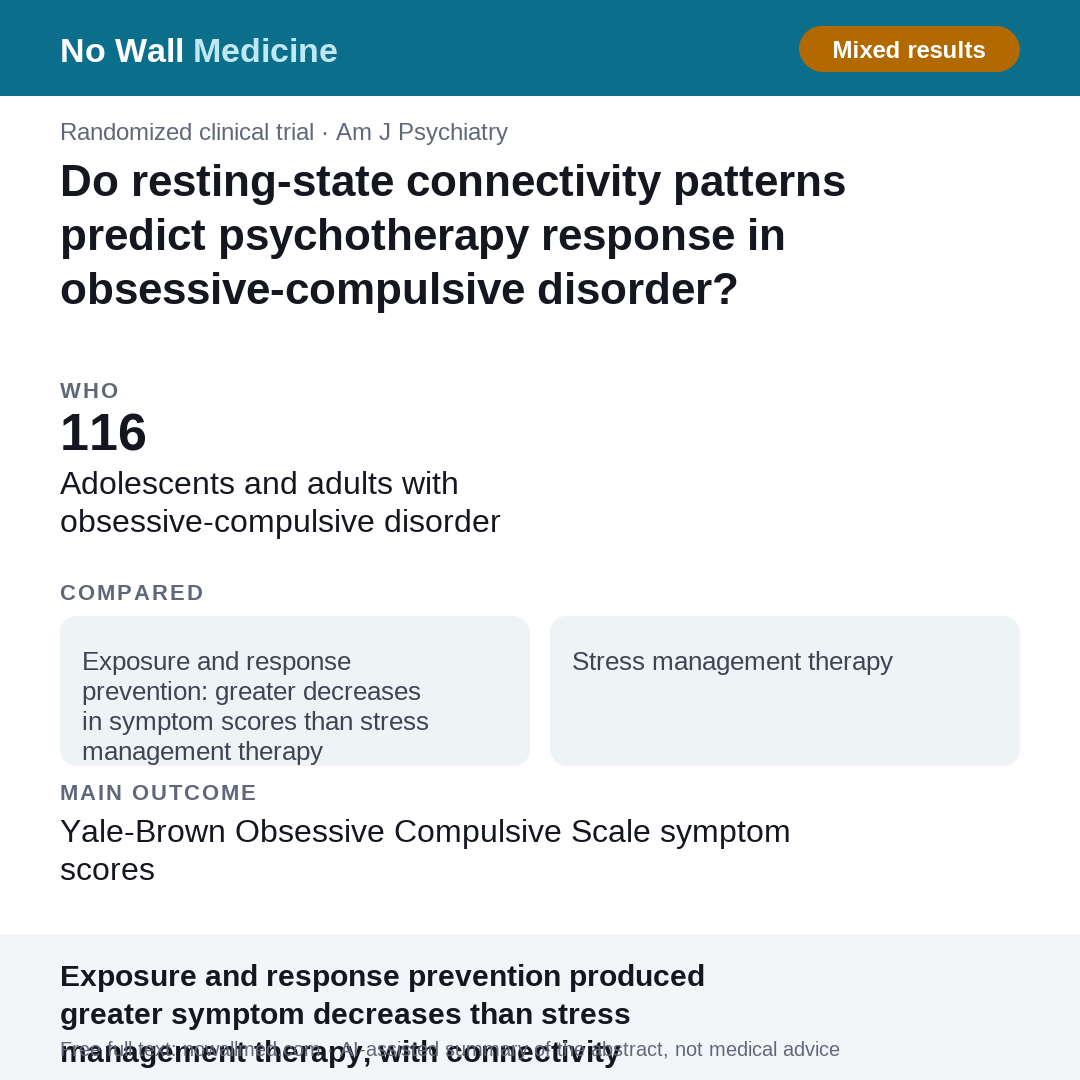
Clinical question: Do resting-state connectivity patterns predict psychotherapy response in obsessive-compulsive disorder?
Key points
- Researchers studied 116 patients, including 54 adolescents and 60 medicated individuals, comparing exposure and response prevention to stress management therapy.
- Exposure and response prevention was associated with less connectivity between the ventromedial prefrontal cortex and subcortical regions like the caudate and thalamus.
- Greater symptom improvement with both therapies was associated with higher connectivity in cognitive-control and subcortical regions across all age groups.
Headline and key points written with AI from the paper’s abstract, with every number checked against it. Read the paper before relying on them.
Was this summary helpful?
Subject terms
Headline, design, result, key points, caveat and citation as plain text.
Cite this article
Russman Block S, Norman LJ, Zhang X, et al. Resting-State Connectivity and Response to Psychotherapy Treatment in Adolescents and Adults With OCD: A Randomized Clinical Trial. Am J Psychiatry. 2023;180(1):89-99. doi:10.1176/appi.ajp.21111173
Spotted a mistake? Suggest a correction