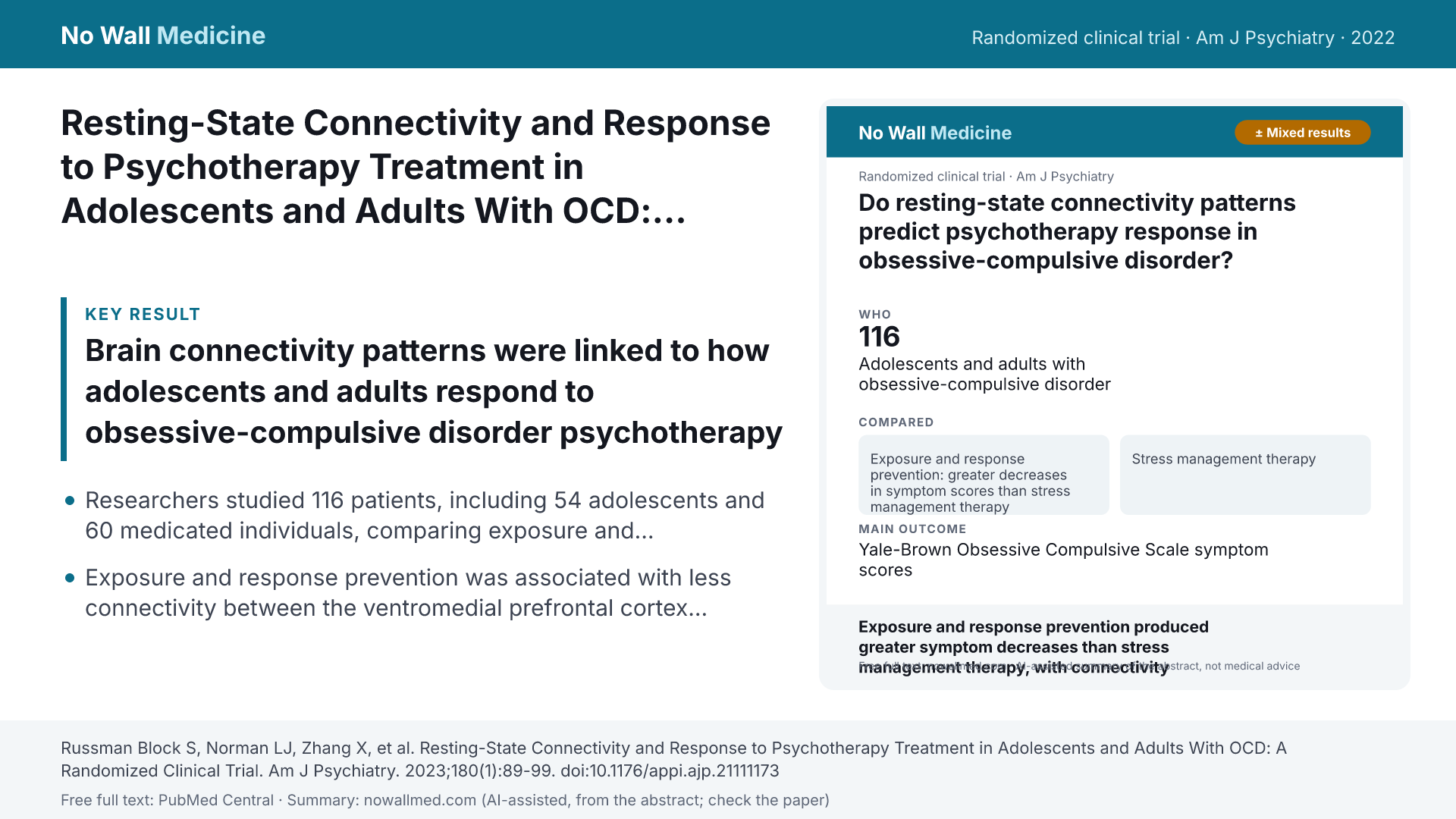
Resting-State Connectivity and Response to Psychotherapy Treatment in Adolescents and Adults With OCD: A Randomized Clinical Trial
Key result: Brain connectivity patterns were linked to how adolescents and adults respond to obsessive-compulsive disorder psychotherapy
Randomized clinical trialMixed results
Do resting-state connectivity patterns predict psychotherapy response in obsessive-compulsive disorder?
Who
116
Adolescents and adults with obsessive-compulsive disorder
Compared
Exposure and response prevention: greater decreases in symptom scores than stress management therapy
Stress management therapy
Main outcome
Yale-Brown Obsessive Compulsive Scale symptom scores
Bottom line: Exposure and response prevention produced greater symptom decreases than stress management therapy, with connectivity patterns predicting response.
Am J Psychiatry · 2022-12-07
Key points
- Researchers studied 116 patients, including 54 adolescents and 60 medicated individuals, comparing exposure and response prevention to stress management therapy.
- Exposure and response prevention was associated with less connectivity between the ventromedial prefrontal cortex and subcortical regions like the caudate and thalamus.
- Greater symptom improvement with both therapies was associated with higher connectivity in cognitive-control and subcortical regions across all age groups.
Discussion prompts
- Would these patients look like yours? Who was left out?
- Is the main outcome one that matters to patients?
- Is the difference large enough to change what you do?
Cite: Russman Block S, Norman LJ, Zhang X, et al. Resting-State Connectivity and Response to Psychotherapy Treatment in Adolescents and Adults With OCD: A Randomized Clinical Trial. Am J Psychiatry. 2023;180(1):89-99. doi:10.1176/appi.ajp.21111173
Free full text: PubMed Central · Summary and visual abstract: nowallmed.com/a/resting-state-connectivity-and-response-to-psychotherapy-treatment-in-sad1ks/ (AI-assisted from the abstract; check the paper before relying on it).