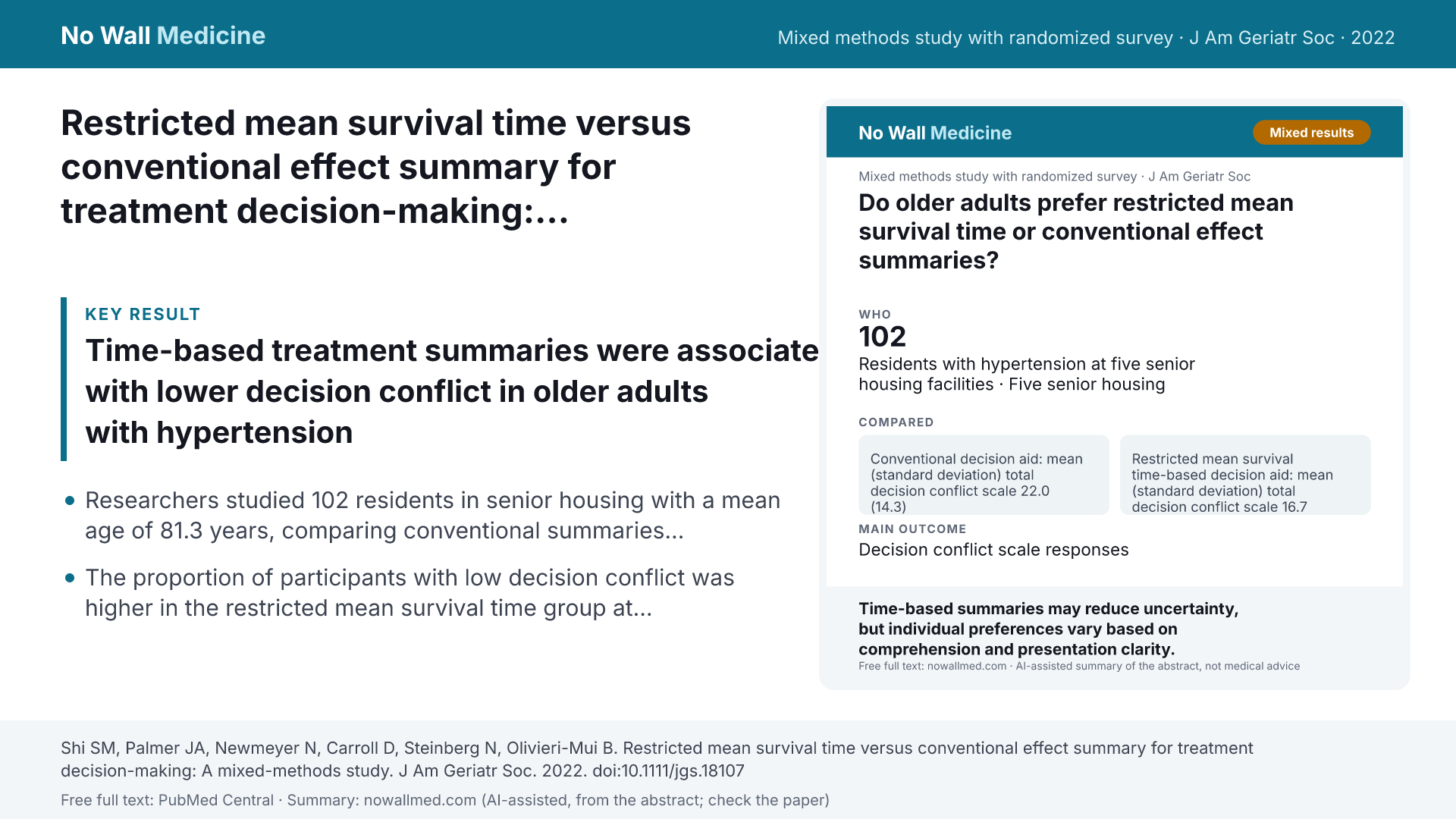
Time-based treatment summaries were associated with lower decision conflict in older adults with hypertension
Restricted mean survival time versus conventional effect summary for treatment decision-making: A mixed-methods study
Mixed methods study with randomized surveyMixed results
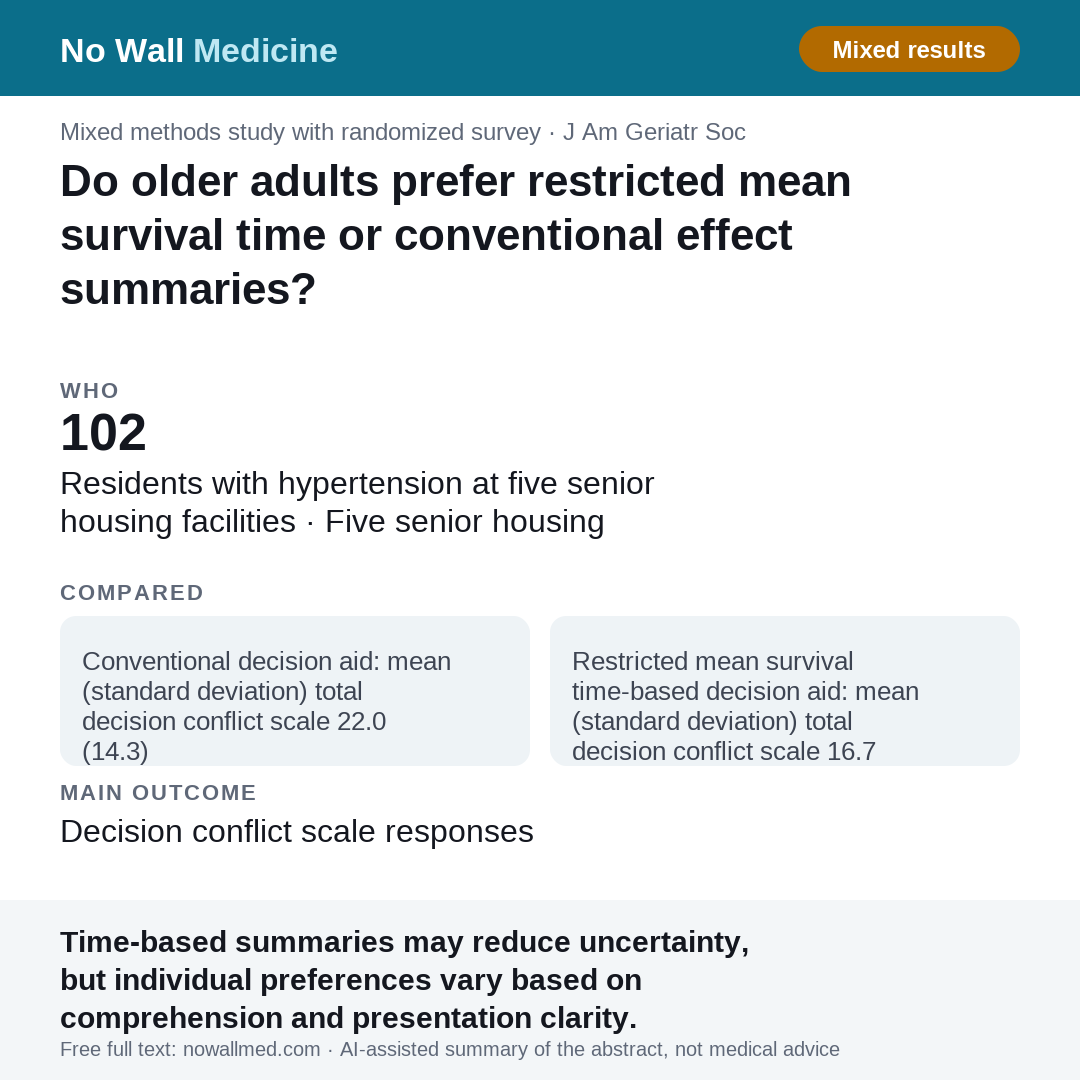
Do older adults prefer restricted mean survival time or conventional effect summaries?
Who
102
Residents with hypertension at five senior housing facilities · Five senior housing facilities
Compared
Conventional decision aid: mean (standard deviation) total decision conflict scale 22.0 (14.3)
Restricted mean survival time-based decision aid: mean (standard deviation) total decision conflict scale 16.7 (14.1)
Main outcome
Decision conflict scale responses
Result: proportion with decision conflict scale <25: 49.1% vs 69.4% (p = 0.04)
Bottom line: Time-based summaries may reduce uncertainty, but individual preferences vary based on comprehension and presentation clarity.
J Am Geriatr Soc · 2022-11-01Download image
Clinical question: Do older adults prefer restricted mean survival time or conventional effect summaries?
Why it matters: It was unknown whether older adults prefer conventional summaries like relative risk reduction or time-based summaries like restricted mean survival time when making medical decisions.
Key points
- Researchers studied 102 residents in senior housing with a mean age of 81.3 years, comparing conventional summaries to restricted mean survival time, which measures gain or loss in event-free days.
- The proportion of participants with low decision conflict was higher in the restricted mean survival time group at 49.1% compared to 69.4% in the conventional group.
- Qualitative interviews suggested that preferences for summarizing treatment effects depended on comprehension of quantitative information and the clarity of visual aids.
Headline and key points written with AI from the paper’s abstract, with every number checked against it. Read the paper before relying on them.
Was this summary helpful?
Subject terms
Cite this article
Shi SM, Palmer JA, Newmeyer N, Carroll D, Steinberg N, Olivieri-Mui B. Restricted mean survival time versus conventional effect summary for treatment decision-making: A mixed-methods study. J Am Geriatr Soc. 2022. doi:10.1111/jgs.18107
Spotted a mistake? Suggest a correction
Top studies every Monday
The week’s key trials and guidelines in your specialties, plus any topics you follow. By email, free.
Get the weekly digest