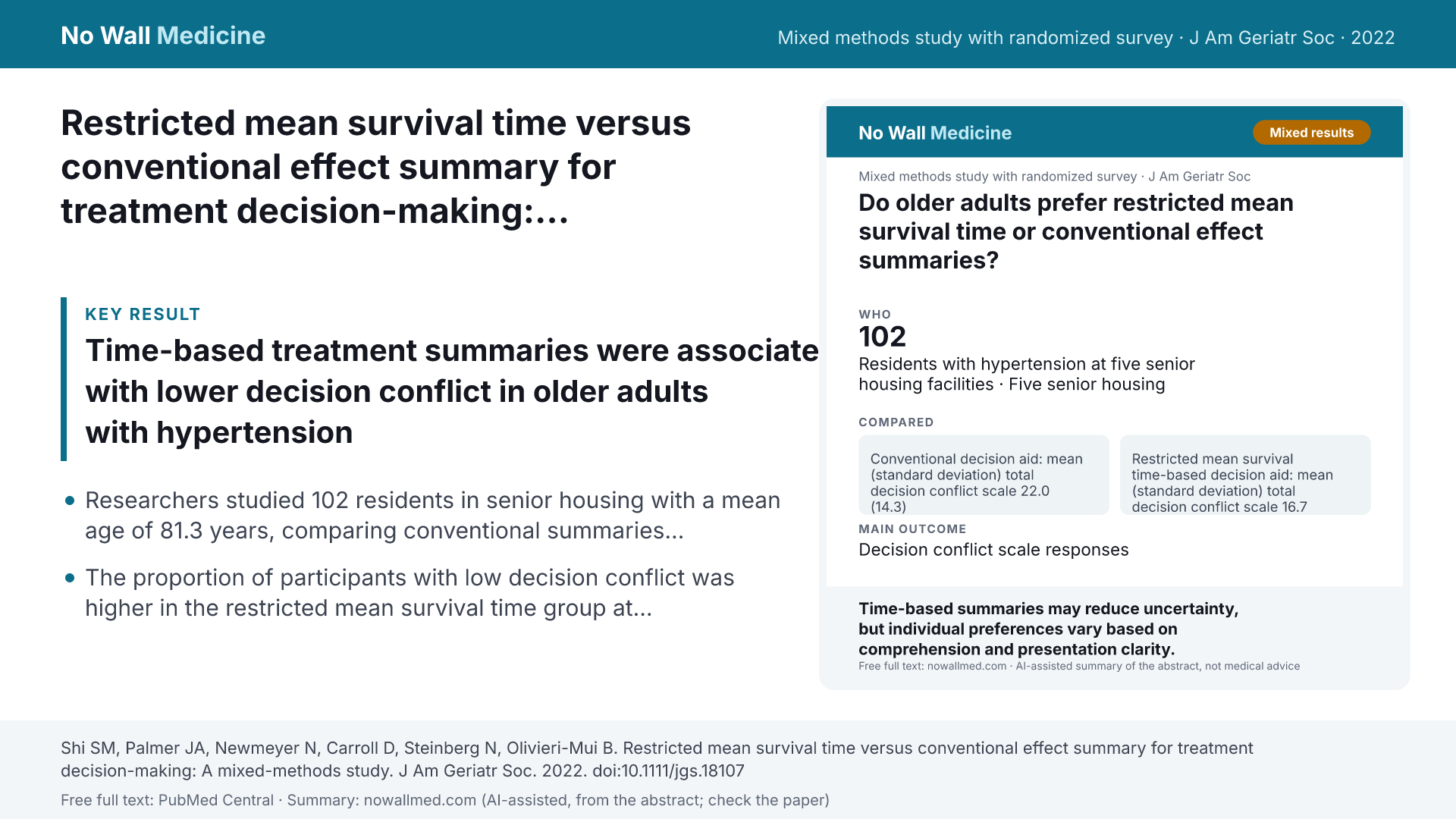
Restricted mean survival time versus conventional effect summary for treatment decision-making: A mixed-methods study
Key result: Time-based treatment summaries were associated with lower decision conflict in older adults with hypertension
Key points
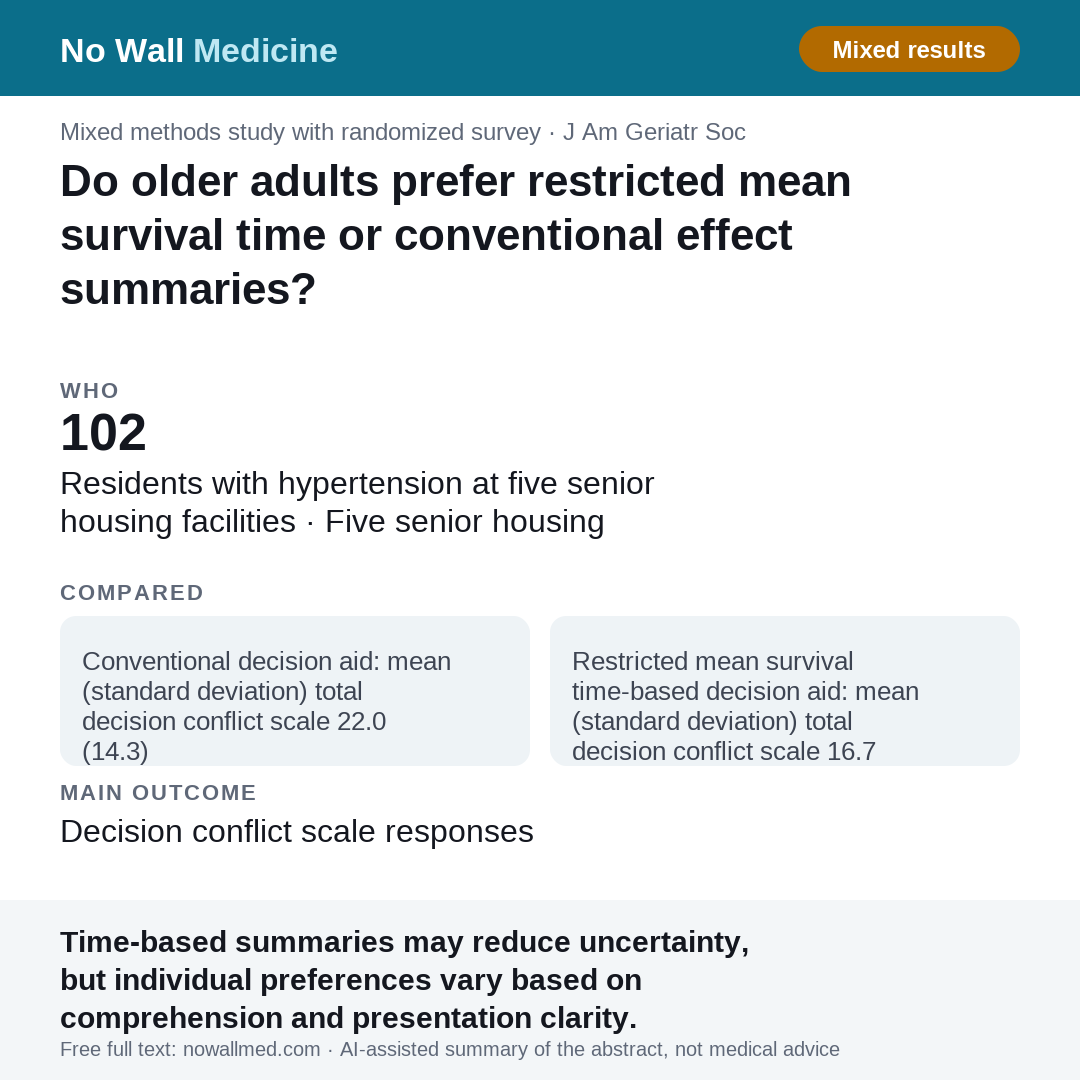
- Researchers studied 102 residents in senior housing with a mean age of 81.3 years, comparing conventional summaries to restricted mean survival time, which measures gain or loss in event-free days.
- The proportion of participants with low decision conflict was higher in the restricted mean survival time group at 49.1% compared to 69.4% in the conventional group.
- Qualitative interviews suggested that preferences for summarizing treatment effects depended on comprehension of quantitative information and the clarity of visual aids.
Why it matters: It was unknown whether older adults prefer conventional summaries like relative risk reduction or time-based summaries like restricted mean survival time when making medical decisions.
Discussion prompts
- Would these patients look like yours? Who was left out?
- Is the main outcome one that matters to patients?
- Is the difference large enough to change what you do?
Cite: Shi SM, Palmer JA, Newmeyer N, Carroll D, Steinberg N, Olivieri-Mui B. Restricted mean survival time versus conventional effect summary for treatment decision-making: A mixed-methods study. J Am Geriatr Soc. 2022. doi:10.1111/jgs.18107
Free full text: PubMed Central · Summary and visual abstract: nowallmed.com/a/restricted-mean-survival-time-versus-conventional-effect-summary-for-1xu1tzy/ (AI-assisted from the abstract; check the paper before relying on it).