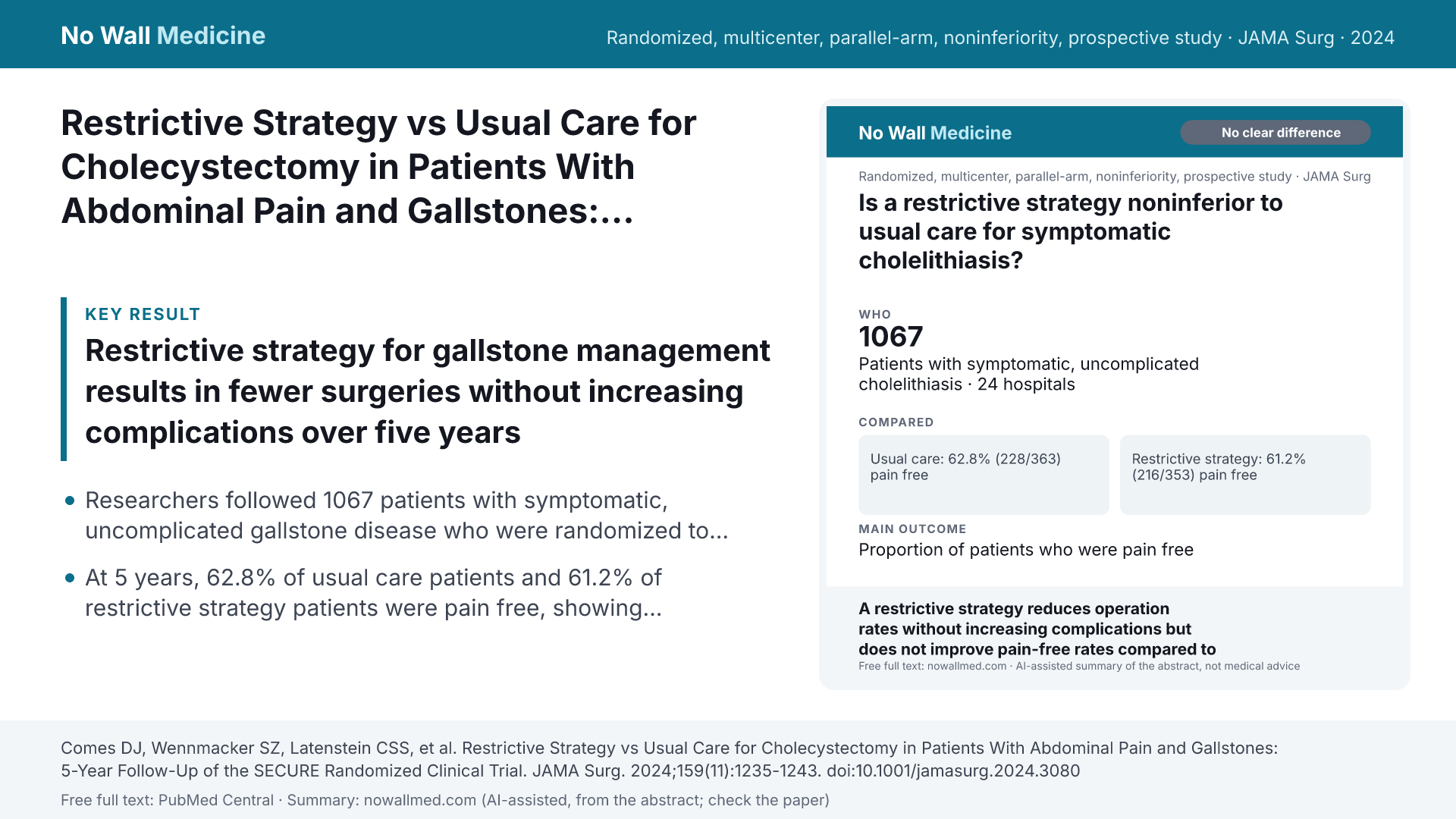
Restrictive strategy for gallstone management results in fewer surgeries without increasing complications over five years
Restrictive Strategy vs Usual Care for Cholecystectomy in Patients With Abdominal Pain and Gallstones: 5-Year Follow-Up of the SECURE Randomized Clinical Trial
Randomized, multicenter, parallel-arm, noninferiority, prospective studyNo clear difference
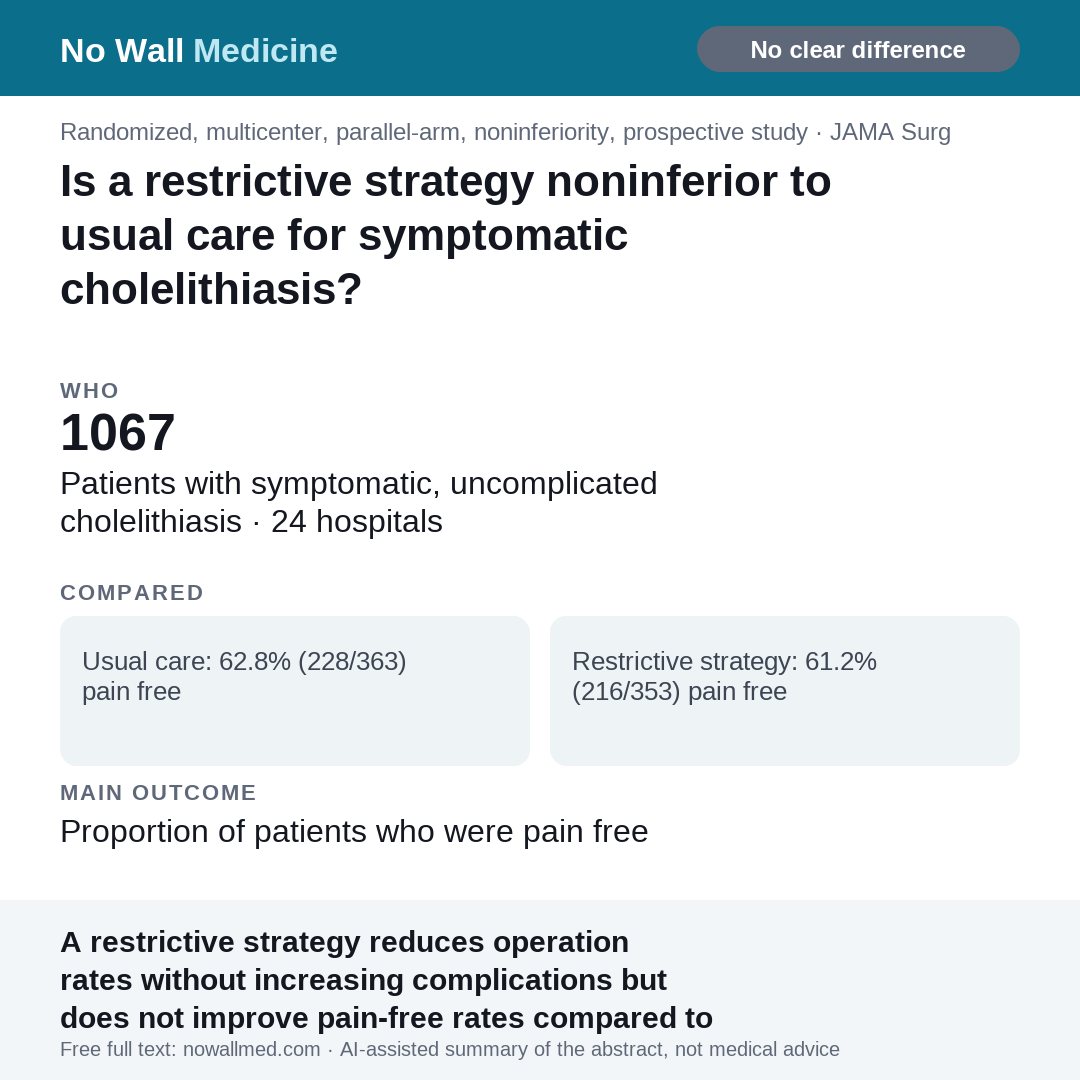
Is a restrictive strategy noninferior to usual care for symptomatic cholelithiasis?
Who
1067
Patients with symptomatic, uncomplicated cholelithiasis · 24 hospitals
Compared
Usual care: 62.8% (228/363) pain free
Restrictive strategy: 61.2% (216/353) pain free
Main outcome
Proportion of patients who were pain free
Result: difference 1.6%; 1-sided 95% lower confidence limit, -7.6%
Bottom line: A restrictive strategy reduces operation rates without increasing complications but does not improve pain-free rates compared to usual care.
JAMA Surg · 2024-08-21Download image
Clinical question: Is a restrictive strategy noninferior to usual care for symptomatic cholelithiasis?
Why it matters: It was unknown if a restrictive strategy for managing gallstones would maintain similar pain-free rates and complication levels over a long-term 5-year period.
Key points
- Researchers followed 1067 patients with symptomatic, uncomplicated gallstone disease who were randomized to either usual care or a restrictive strategy for gallbladder removal.
- At 5 years, 62.8% of usual care patients and 61.2% of restrictive strategy patients were pain free, showing no significant difference in pain relief.
- The restrictive strategy was associated with a lower gallbladder removal rate of 73.2% compared to 81.5% in the usual care group.
Headline and key points written with AI from the paper’s abstract, with every number checked against it. Read the paper before relying on them.
Was this summary helpful?
Subject terms
Cite this article
Comes DJ, Wennmacker SZ, Latenstein CSS, et al. Restrictive Strategy vs Usual Care for Cholecystectomy in Patients With Abdominal Pain and Gallstones: 5-Year Follow-Up of the SECURE Randomized Clinical Trial. JAMA Surg. 2024. doi:10.1001/jamasurg.2024.3080
Spotted a mistake? Suggest a correction