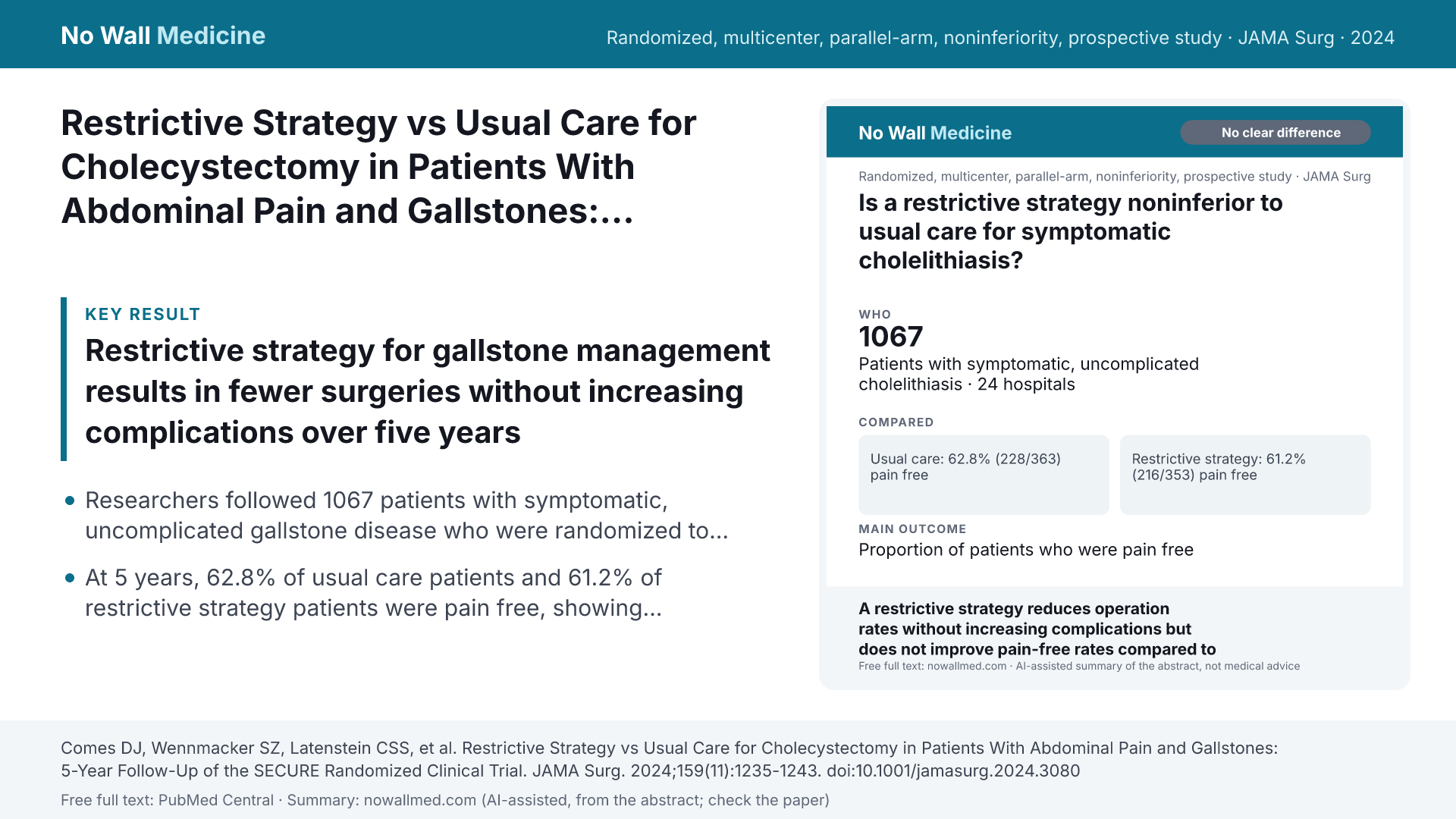
Restrictive Strategy vs Usual Care for Cholecystectomy in Patients With Abdominal Pain and Gallstones: 5-Year Follow-Up of the SECURE Randomized Clinical Trial
Key result: Restrictive strategy for gallstone management results in fewer surgeries without increasing complications over five years
Randomized, multicenter, parallel-arm, noninferiority, prospective studyNo clear difference
Is a restrictive strategy noninferior to usual care for symptomatic cholelithiasis?
Who
1067
Patients with symptomatic, uncomplicated cholelithiasis · 24 hospitals
Compared
Usual care: 62.8% (228/363) pain free
Restrictive strategy: 61.2% (216/353) pain free
Main outcome
Proportion of patients who were pain free
Result: difference 1.6%; 1-sided 95% lower confidence limit, -7.6%
Bottom line: A restrictive strategy reduces operation rates without increasing complications but does not improve pain-free rates compared to usual care.
JAMA Surg · 2024-08-21
Key points
- Researchers followed 1067 patients with symptomatic, uncomplicated gallstone disease who were randomized to either usual care or a restrictive strategy for gallbladder removal.
- At 5 years, 62.8% of usual care patients and 61.2% of restrictive strategy patients were pain free, showing no significant difference in pain relief.
- The restrictive strategy was associated with a lower gallbladder removal rate of 73.2% compared to 81.5% in the usual care group.
Discussion prompts
- Would these patients look like yours? Who was left out?
- Is the main outcome one that matters to patients?
- Is the difference large enough to change what you do?
Cite: Comes DJ, Wennmacker SZ, Latenstein CSS, et al. Restrictive Strategy vs Usual Care for Cholecystectomy in Patients With Abdominal Pain and Gallstones: 5-Year Follow-Up of the SECURE Randomized Clinical Trial. JAMA Surg. 2024;159(11):1235-1243. doi:10.1001/jamasurg.2024.3080
Free full text: PubMed Central · Summary and visual abstract: nowallmed.com/a/restrictive-strategy-vs-usual-care-for-cholecystectomy-in-patients-l4gzsq/ (AI-assisted from the abstract; check the paper before relying on it).