Free testing increased genetic testing rates among relatives of cancer survivors in a randomized trial
Results From the Genetic Information and Family Testing Study: A Cluster-Randomized Trial
Population-based cluster-randomized clinical trialMixed results
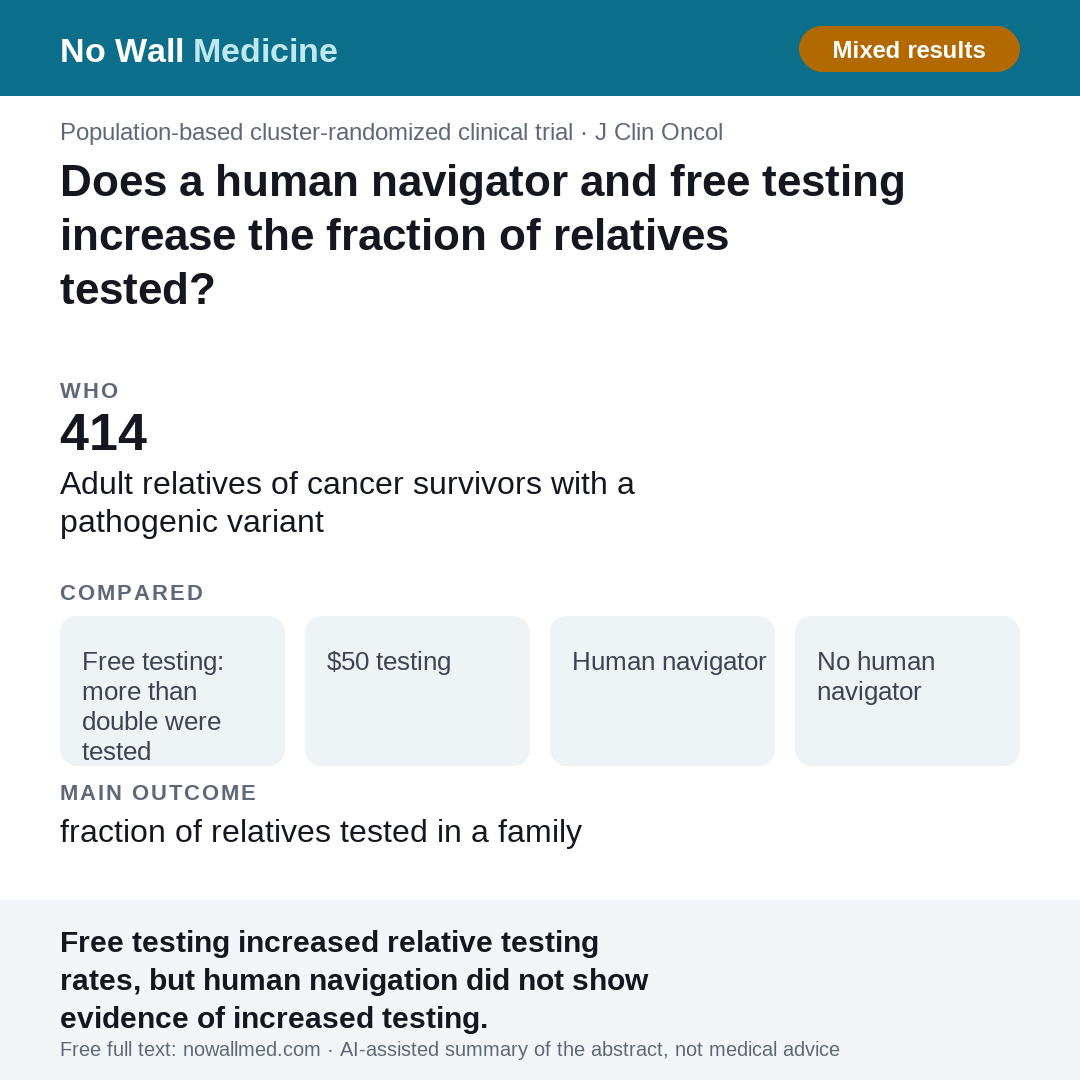
Does a human navigator and free testing increase the fraction of relatives tested?
Who
414
Adult relatives of cancer survivors with a pathogenic variant
Compared
Free testing: more than double were tested
$50 testing
Human navigator
No human navigator
Main outcome
fraction of relatives tested in a family
Result: odds ratio 2.5 (95% CI 1.6 to 3.9) for free versus $50 testing; odds ratio 1.3 (95% CI 0.8 to 2.1) for navigation
Bottom line: Free testing increased relative testing rates, but human navigation did not show evidence of increased testing.
J Clin Oncol · 2026-03-24Download image
Clinical question: Does a human navigator and free testing increase the fraction of relatives tested?
Why it matters: Testing of relatives with hereditary cancer syndromes is currently low, and researchers wanted to see if direct engagement through survivors could improve these rates.
Key points
- Researchers studied 414 cancer survivors and their 4,946 first- and second-degree relatives to test an online genetic education and testing tool.
- Free testing resulted in more than double the testing rate compared to a $50 cost, with an odds ratio of 2.5.
- The study found no evidence that assistance from a human navigator increased the rate of genetic testing among relatives.
Headline and key points written with AI from the paper’s abstract, with every number checked against it. Read the paper before relying on them.
Topics
Spotted a mistake? Suggest a correction