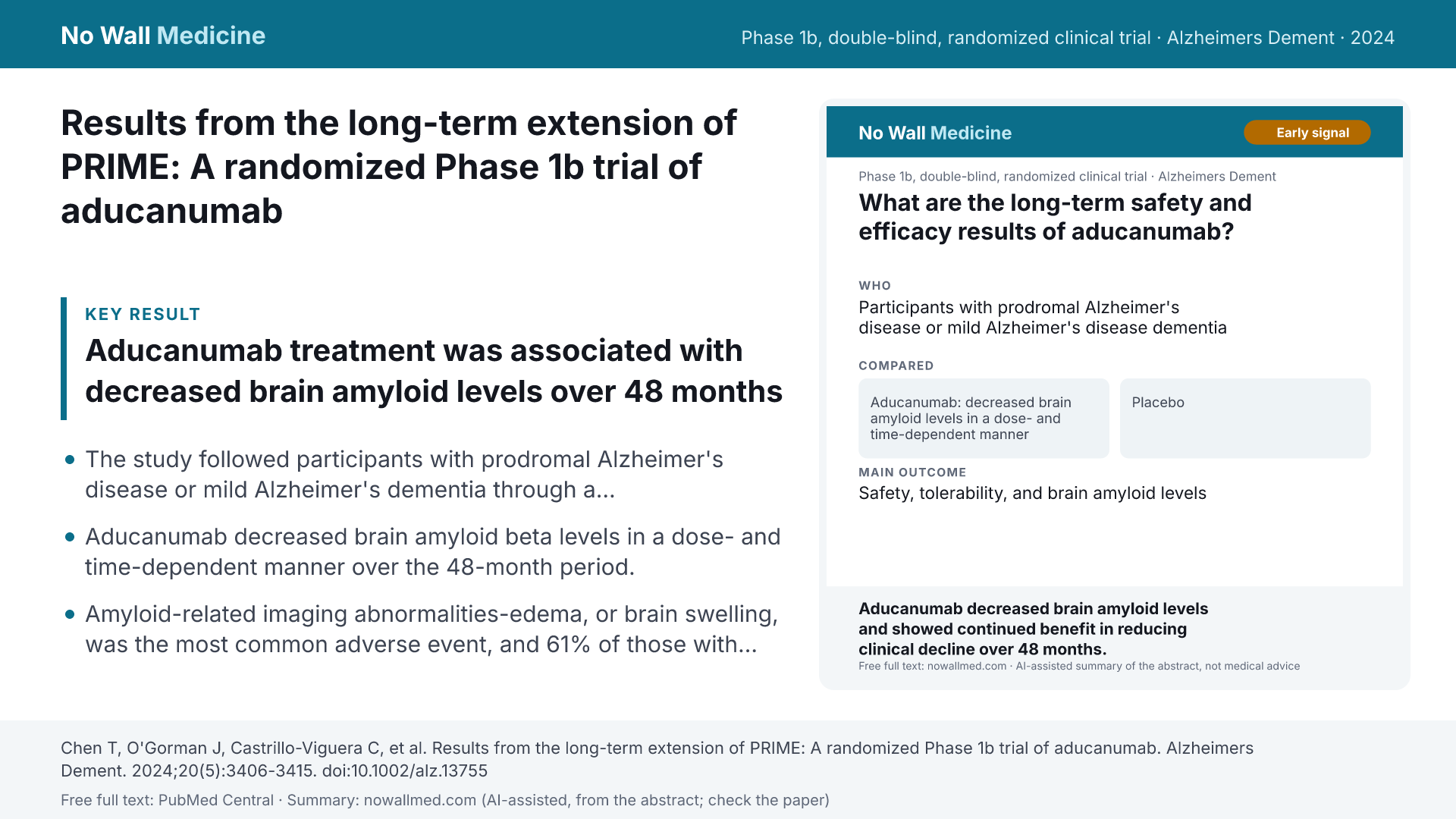
Aducanumab treatment was associated with decreased brain amyloid levels over 48 months
Results from the long-term extension of PRIME: A randomized Phase 1b trial of aducanumab
Phase 1b, double-blind, randomized clinical trialEarly signal
What are the long-term safety and efficacy results of aducanumab?
Who
Participants with prodromal Alzheimer's disease or mild Alzheimer's disease dementia
Compared
Aducanumab: decreased brain amyloid levels in a dose- and time-dependent manner
Placebo
Main outcome
Safety, tolerability, and brain amyloid levels
Bottom line: Aducanumab decreased brain amyloid levels and showed continued benefit in reducing clinical decline over 48 months.
Alzheimers Dement · 2024-04-03Download image

Clinical question: What are the long-term safety and efficacy results of aducanumab?
Why it matters: It was unknown how the safety and amyloid reduction effects of aducanumab would progress over a long-term period of 48 months.
Key points
- The study followed participants with prodromal Alzheimer's disease or mild Alzheimer's dementia through a 48-month long-term extension trial.
- Aducanumab decreased brain amyloid beta levels in a dose- and time-dependent manner over the 48-month period.
- Amyloid-related imaging abnormalities-edema, or brain swelling, was the most common adverse event, and 61% of those with this condition were asymptomatic.
Headline and key points written with AI from the paper’s abstract, with every number checked against it. Read the paper before relying on them.
Was this summary helpful?
Subject terms
Cite this article
Chen T, O'Gorman J, Castrillo-Viguera C, et al. Results from the long-term extension of PRIME: A randomized Phase 1b trial of aducanumab. Alzheimers Dement. 2024. doi:10.1002/alz.13755
Spotted a mistake? Suggest a correction