Results from the long-term extension of PRIME: A randomized Phase 1b trial of aducanumab
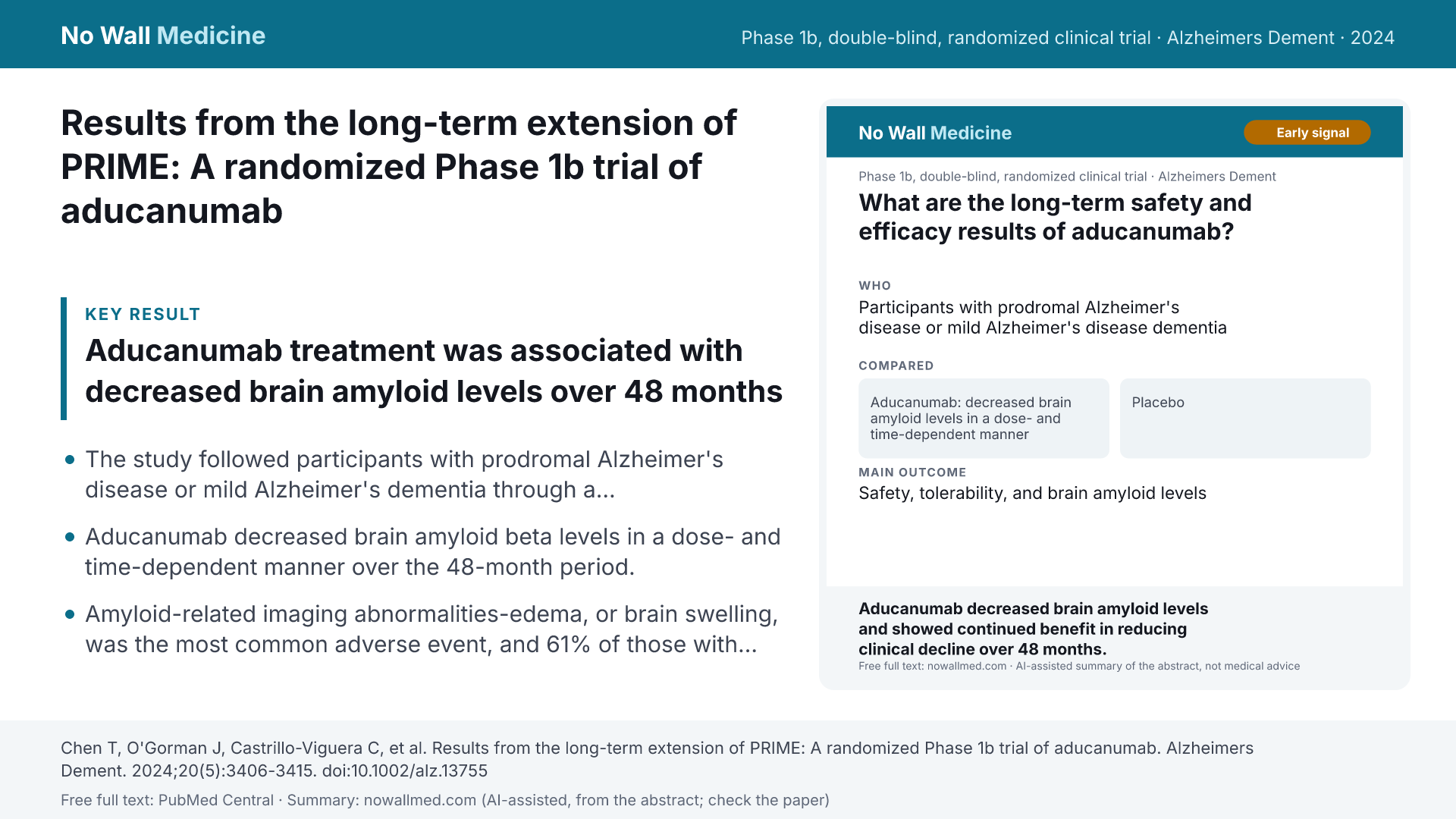
Key result: Aducanumab treatment was associated with decreased brain amyloid levels over 48 months
Phase 1b, double-blind, randomized clinical trialEarly signal
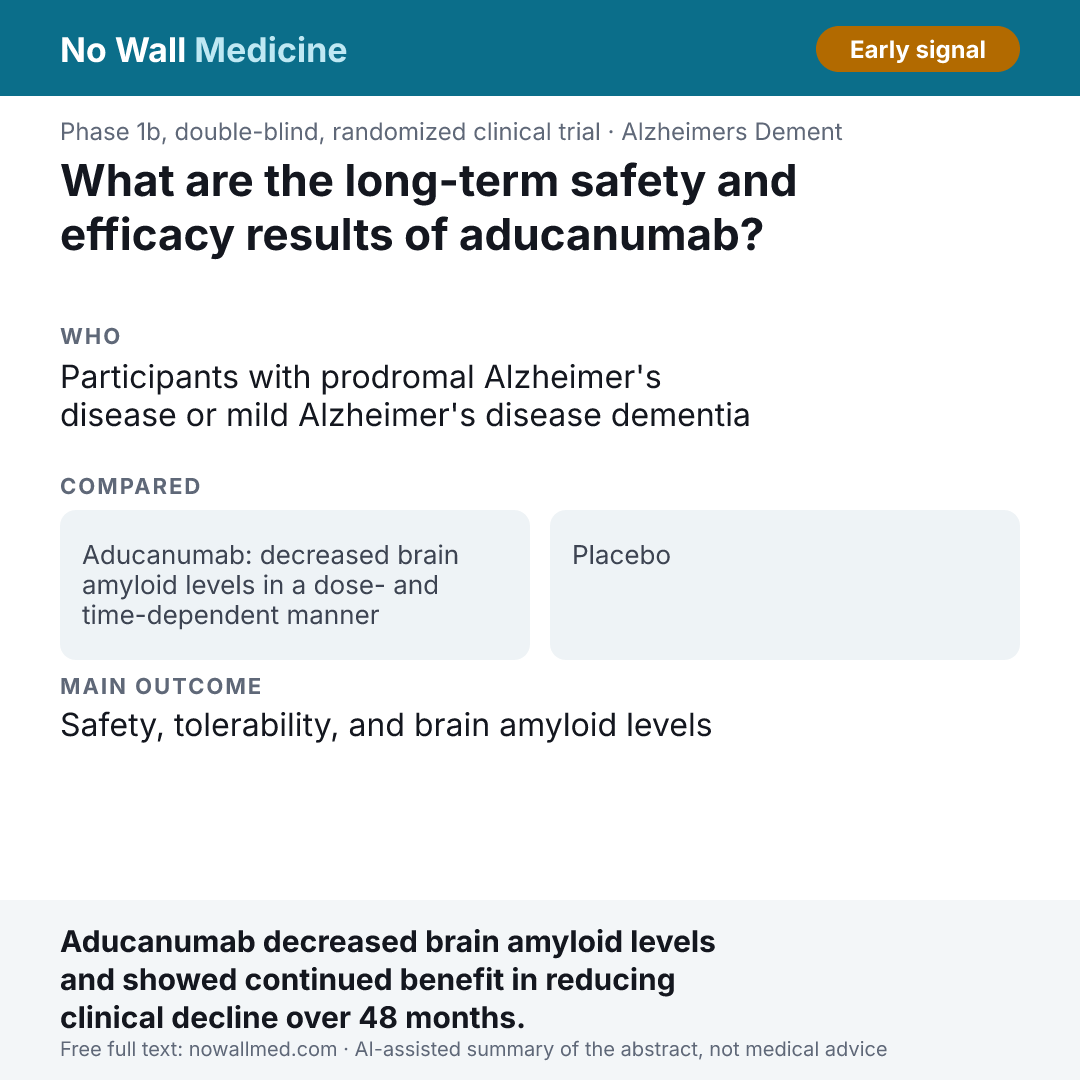
What are the long-term safety and efficacy results of aducanumab?
Who
Participants with prodromal Alzheimer's disease or mild Alzheimer's disease dementia
Compared
Aducanumab: decreased brain amyloid levels in a dose- and time-dependent manner
Placebo
Main outcome
Safety, tolerability, and brain amyloid levels
Bottom line: Aducanumab decreased brain amyloid levels and showed continued benefit in reducing clinical decline over 48 months.
Alzheimers Dement · 2024-04-03 · Save PNG
Key points
- The study followed participants with prodromal Alzheimer's disease or mild Alzheimer's dementia through a 48-month long-term extension trial.
- Aducanumab decreased brain amyloid beta levels in a dose- and time-dependent manner over the 48-month period.
- Amyloid-related imaging abnormalities-edema, or brain swelling, was the most common adverse event, and 61% of those with this condition were asymptomatic.
Discussion prompts
- Would these patients look like yours? Who was left out?
- Is the main outcome one that matters to patients?
- Is the difference large enough to change what you do?
Cite: Chen T, O'Gorman J, Castrillo-Viguera C, et al. Results from the long-term extension of PRIME: A randomized Phase 1b trial of aducanumab. Alzheimers Dement. 2024;20(5):3406-3415. doi:10.1002/alz.13755
Free full text: PubMed Central · Summary and visual abstract: nowallmed.com/a/results-from-the-long-term-extension-of-prime-a-randomized-phase-1b-1q9veqa/ (AI-assisted from the abstract; check the paper before relying on it).