Review of the Performance of Laboratory-Based Molecular Diagnostics for Chlamydia trachomatis and Neisseria gonorrhoeae
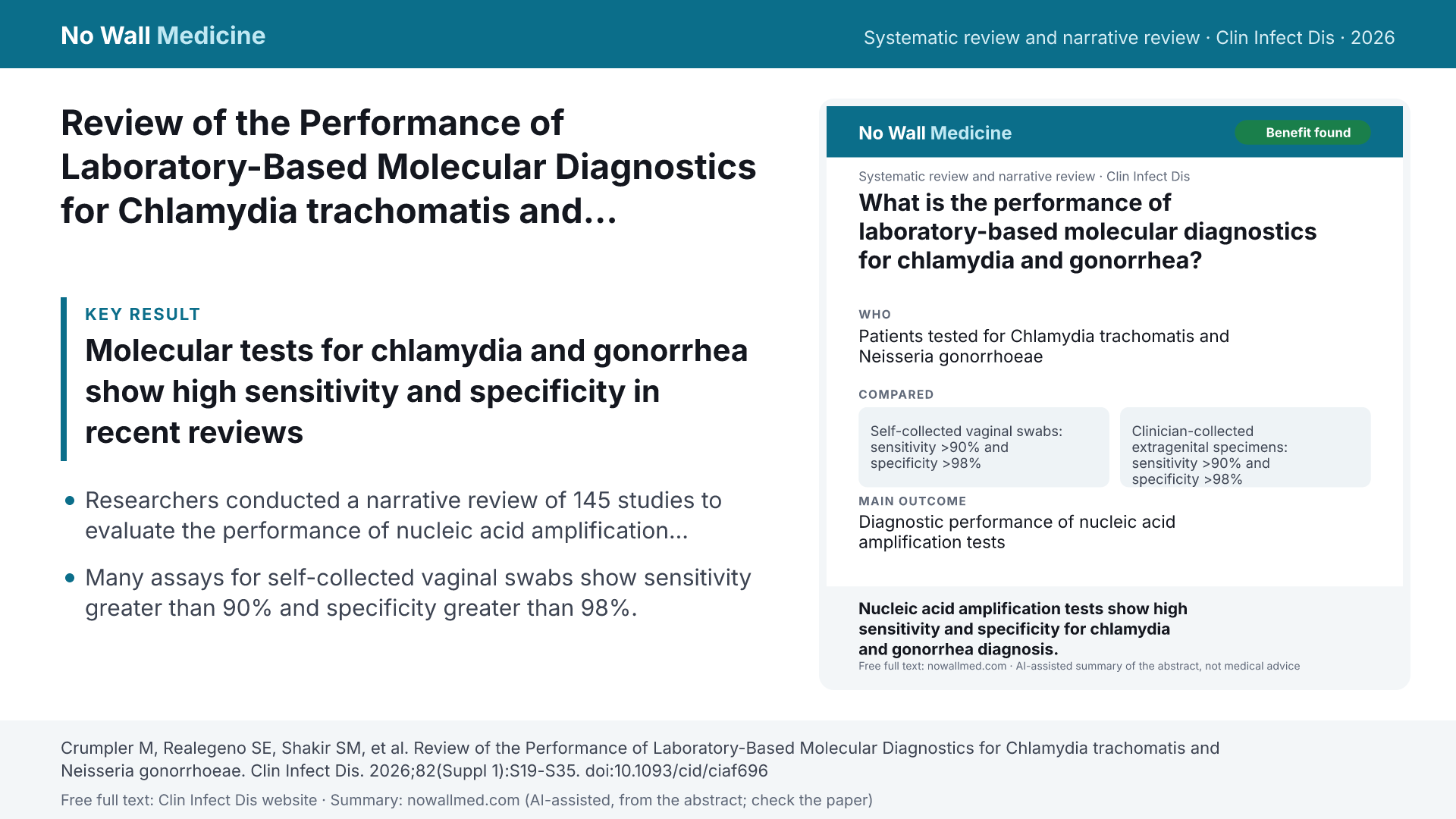
Key result: Molecular tests for chlamydia and gonorrhea show high sensitivity and specificity in recent reviews
Systematic review and narrative reviewBenefit found
What is the performance of laboratory-based molecular diagnostics for chlamydia and gonorrhea?
Who
Patients tested for Chlamydia trachomatis and Neisseria gonorrhoeae
Compared
Self-collected vaginal swabs: sensitivity >90% and specificity >98%
Clinician-collected extragenital specimens: sensitivity >90% and specificity >98%
Main outcome
Diagnostic performance of nucleic acid amplification tests
Bottom line: Nucleic acid amplification tests show high sensitivity and specificity for chlamydia and gonorrhea diagnosis.
Limitation: No nucleic acid amplification tests currently have claims for patient-collected extragenital specimens.
Clin Infect Dis · 2026-02-24
Key points
- Researchers conducted a narrative review of 145 studies to evaluate the performance of nucleic acid amplification tests, which are molecular diagnostic tools used to detect infection.
- Many assays for self-collected vaginal swabs show sensitivity greater than 90% and specificity greater than 98%.
- No nucleic acid amplification tests currently have claims for patient-collected extragenital specimens, such as samples taken from areas other than the genitals.
Discussion prompts
- Would these patients look like yours? Who was left out?
- Is the main outcome one that matters to patients?
- Is the difference large enough to change what you do?
Cite: Crumpler M, Realegeno SE, Shakir SM, et al. Review of the Performance of Laboratory-Based Molecular Diagnostics for Chlamydia trachomatis and Neisseria gonorrhoeae. Clin Infect Dis. 2026;82(Suppl 1):S19-S35. doi:10.1093/cid/ciaf696
Free full text: Clin Infect Dis website · Summary and visual abstract: nowallmed.com/a/review-of-the-performance-of-laboratory-based-molecular-diagnostics-qr6dcb/ (AI-assisted from the abstract; check the paper before relying on it).