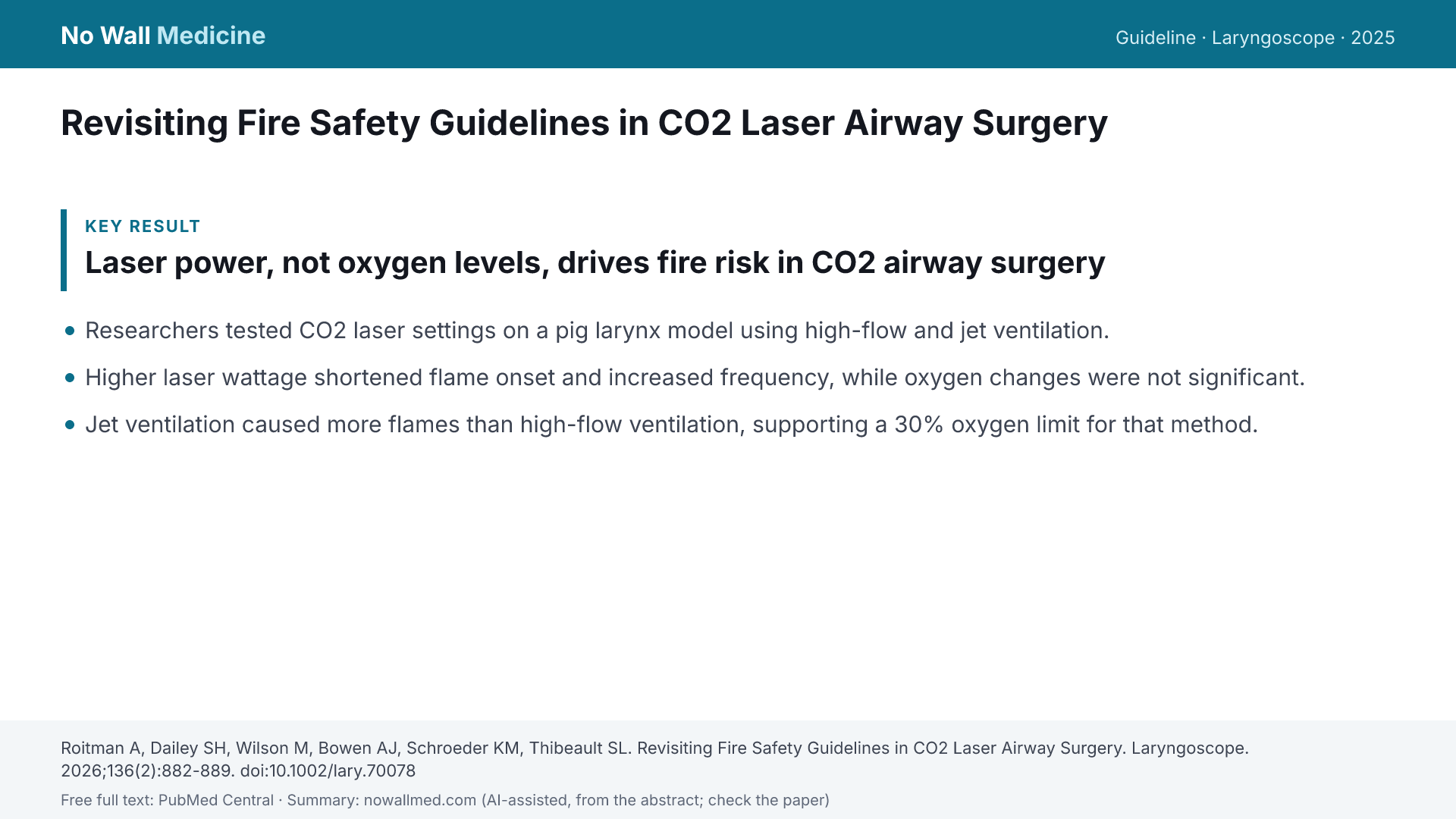
Laser wattage and ventilation method influence fire risk during CO2 laser airway surgery
Revisiting Fire Safety Guidelines in CO2 Laser Airway Surgery
Why it matters: Current practices for preventing airway fires during endoscopic laser surgery typically focus on reducing the fraction of inspired oxygen levels.
Key points
- Researchers used a porcine larynx and lung model to compare high-flow ventilation and jet ventilation during CO2 laser surgery.
- Increasing laser wattage was associated with shorter onset times and higher frequency of expansive or blowtorch flames (p < 0.05).
- Jet ventilation was associated with higher flame incidence and shorter onset times compared to high-flow ventilation (p < 0.05).
Headline and key points written with AI from the paper’s abstract, with every number checked against it. Read the paper before relying on them.
Was this summary helpful?
Subject terms
Cite this article
Roitman A, Dailey SH, Wilson M, Bowen AJ, Schroeder KM, Thibeault SL. Revisiting Fire Safety Guidelines in CO2 Laser Airway Surgery. Laryngoscope. 2025. doi:10.1002/lary.70078
Spotted a mistake? Suggest a correction
Top studies every Monday
The week’s key trials and guidelines in your specialties, plus any topics you follow. By email, free.
Get the weekly digest