Revisiting Fire Safety Guidelines in CO2 Laser Airway Surgery
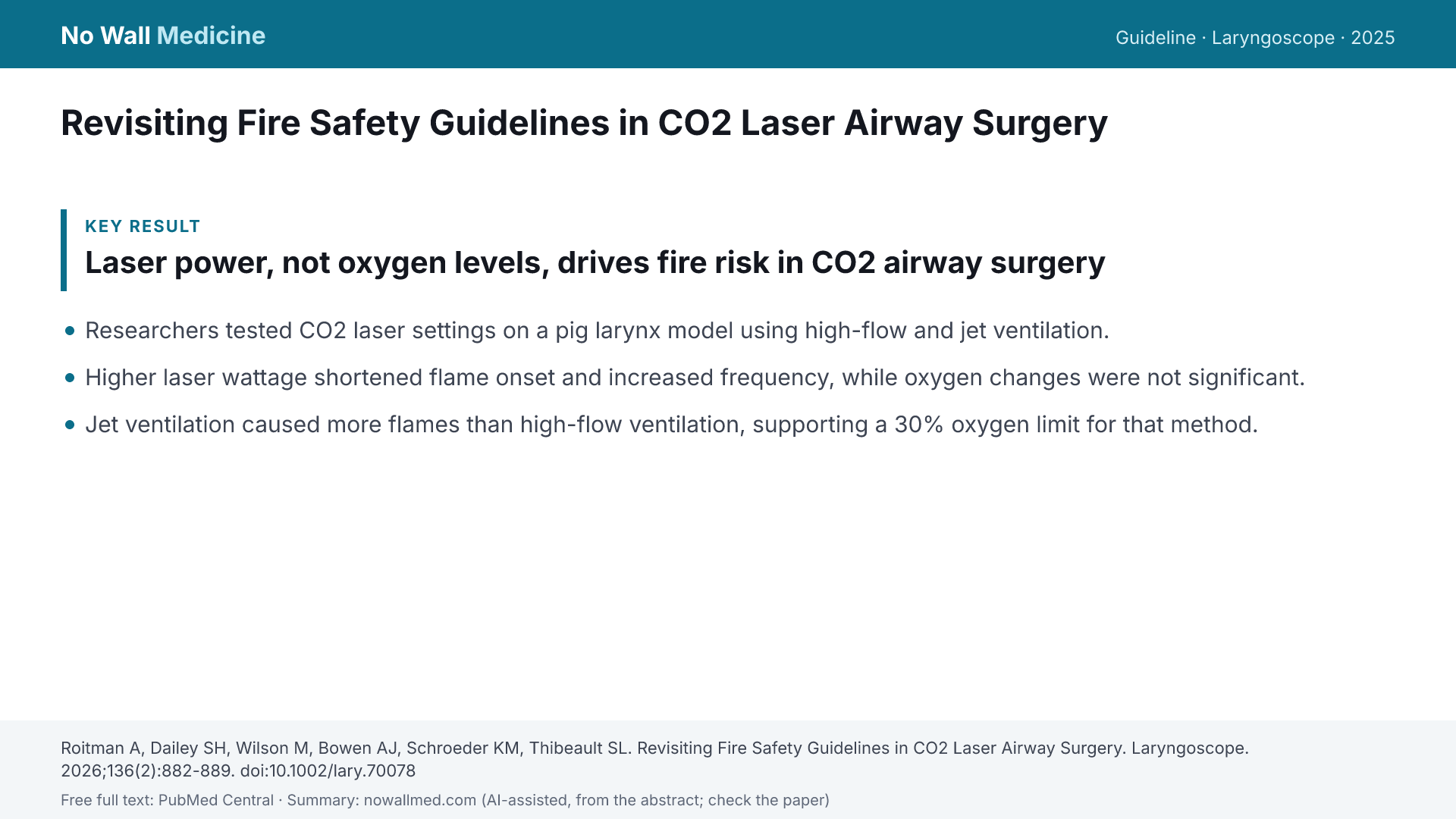
Key result: Laser power, not oxygen levels, drives fire risk in CO2 airway surgery
Key points
- Researchers tested CO2 laser settings on a pig larynx model using high-flow and jet ventilation.
- Higher laser wattage shortened flame onset and increased frequency, while oxygen changes were not significant.
- Jet ventilation caused more flames than high-flow ventilation, supporting a 30% oxygen limit for that method.
Why it matters: Standard guidelines focus on lowering oxygen levels, but it was unclear how laser power affects fire risk in tubeless airway surgery.
Discussion prompts
- Would these patients look like yours? Who was left out?
- Is the main outcome one that matters to patients?
- Is the difference large enough to change what you do?
Cite: Roitman A, Dailey SH, Wilson M, Bowen AJ, Schroeder KM, Thibeault SL. Revisiting Fire Safety Guidelines in CO2 Laser Airway Surgery. Laryngoscope. 2026;136(2):882-889. doi:10.1002/lary.70078
Free full text: PubMed Central · Summary and visual abstract: nowallmed.com/a/revisiting-fire-safety-guidelines-in-co2-laser-airway-x6h8ng/ (AI-assisted from the abstract; check the paper before relying on it).