Revisiting the Evidence Base That Informs the Use of Adjunctive Therapy for Enterococcus faecalis Endocarditis: A Systematic Review and Meta-Analysis
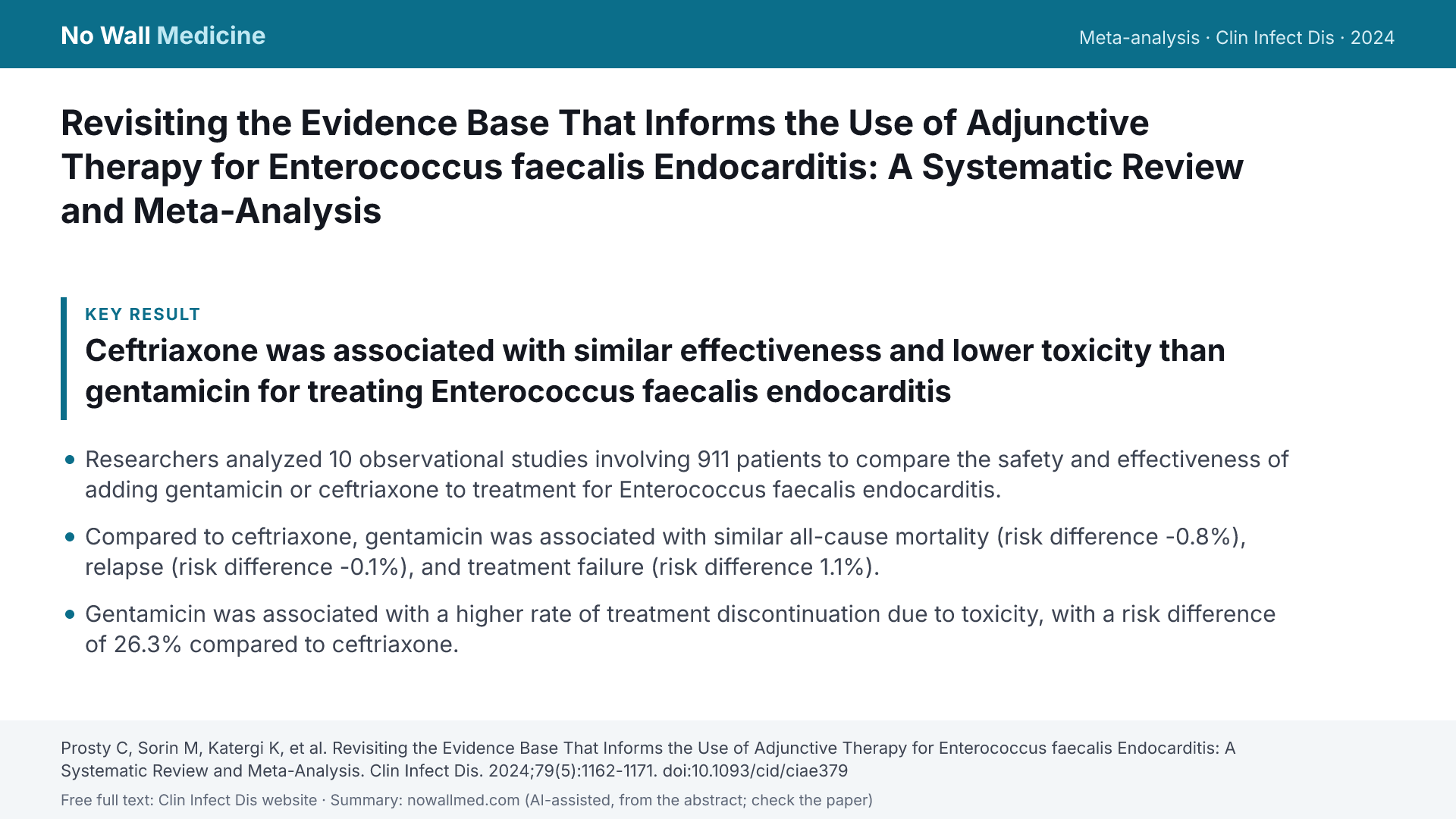
Key result: Ceftriaxone was associated with similar effectiveness and lower toxicity than gentamicin for treating Enterococcus faecalis endocarditis
Key points
- Researchers analyzed 10 observational studies involving 911 patients to compare the safety and effectiveness of adding gentamicin or ceftriaxone to treatment for Enterococcus faecalis endocarditis.
- Compared to ceftriaxone, gentamicin was associated with similar all-cause mortality (risk difference -0.8%), relapse (risk difference -0.1%), and treatment failure (risk difference 1.1%).
- Gentamicin was associated with a higher rate of treatment discontinuation due to toxicity, with a risk difference of 26.3% compared to ceftriaxone.
Why it matters: Current guidelines recommend adding gentamicin to treatment for Enterococcus faecalis endocarditis despite potential risks of toxicity.
Limitation the authors note: The meta-analysis was limited to 10 observational studies at high risk of bias.
Discussion prompts
- Would these patients look like yours? Who was left out?
- Is the main outcome one that matters to patients?
- Is the difference large enough to change what you do?
Cite: Prosty C, Sorin M, Katergi K, et al. Revisiting the Evidence Base That Informs the Use of Adjunctive Therapy for Enterococcus faecalis Endocarditis: A Systematic Review and Meta-Analysis. Clin Infect Dis. 2024;79(5):1162-1171. doi:10.1093/cid/ciae379
Free full text: Clin Infect Dis website · Summary and visual abstract: nowallmed.com/a/revisiting-the-evidence-base-that-informs-the-use-of-adjunctive-dg8v9c/ (AI-assisted from the abstract; check the paper before relying on it).