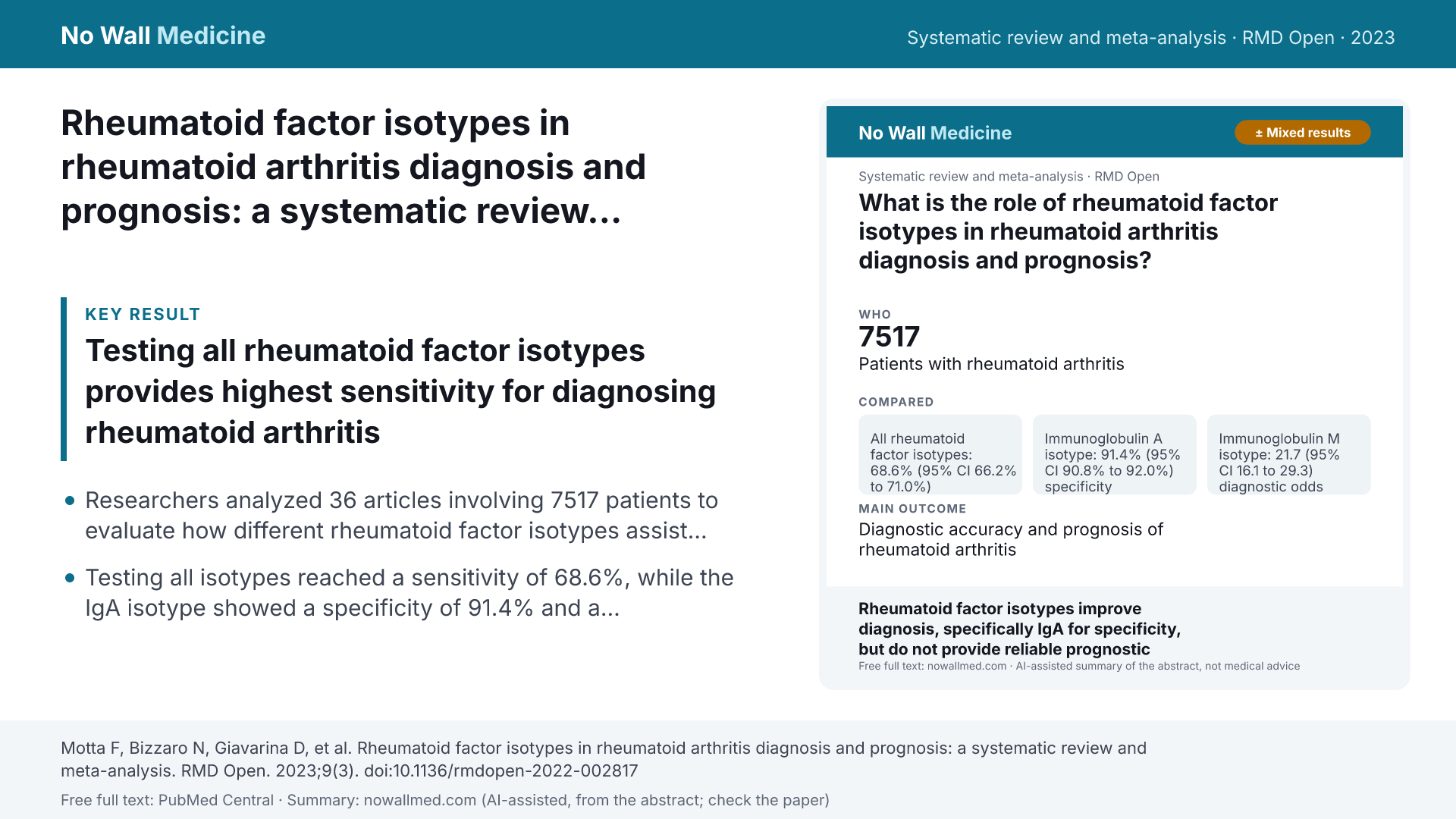
Testing all rheumatoid factor isotypes provides highest sensitivity for diagnosing rheumatoid arthritis
Rheumatoid factor isotypes in rheumatoid arthritis diagnosis and prognosis: a systematic review and meta-analysis
Systematic review and meta-analysisMixed results
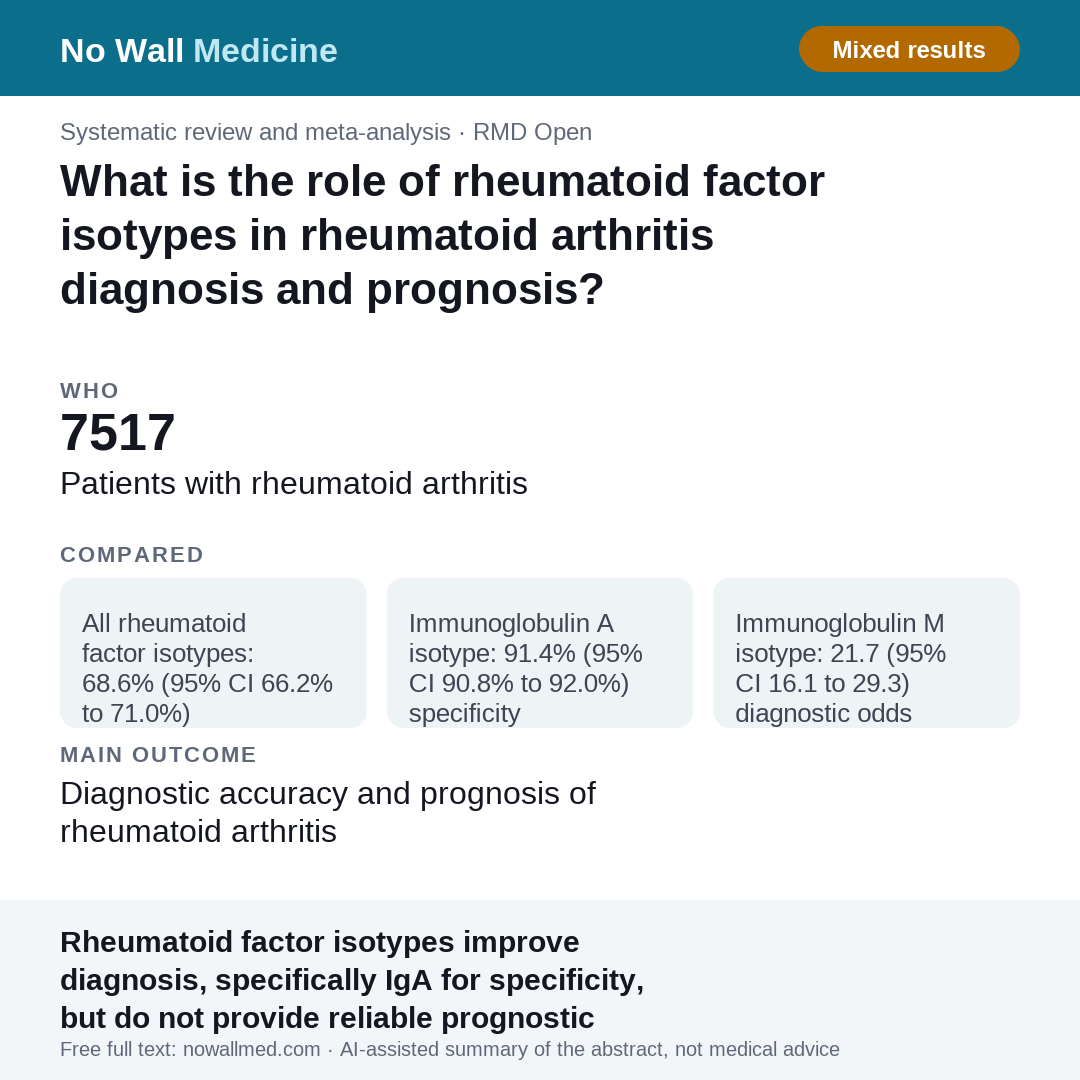
What is the role of rheumatoid factor isotypes in rheumatoid arthritis diagnosis and prognosis?
Who
7517
Patients with rheumatoid arthritis
Compared
All rheumatoid factor isotypes: 68.6% (95% CI 66.2% to 71.0%) sensitivity
Immunoglobulin A isotype: 91.4% (95% CI 90.8% to 92.0%) specificity
Immunoglobulin M isotype: 21.7 (95% CI 16.1 to 29.3) diagnostic odds ratio
Main outcome
Diagnostic accuracy and prognosis of rheumatoid arthritis
Bottom line: Rheumatoid factor isotypes improve diagnosis, specifically IgA for specificity, but do not provide reliable prognostic information.
Limitation: Data for prognostic information are limited and heterogeneous.
RMD Open · 2023-08-05Download image
Clinical question: What is the role of rheumatoid factor isotypes in rheumatoid arthritis diagnosis and prognosis?
Key points
- Researchers analyzed 36 articles involving 7517 patients to evaluate how different rheumatoid factor isotypes assist in diagnosing and predicting rheumatoid arthritis outcomes.
- Testing all isotypes reached a sensitivity of 68.6%, while the IgA isotype showed a specificity of 91.4% and a positive likelihood ratio of 7.7.
- The IgM isotype was associated with a diagnostic odds ratio of 21.7, but rheumatoid factor isotypes were not linked to reliable prognostic information.
Limitation the authors note: The data regarding prognosis were limited and heterogeneous.
Headline and key points written with AI from the paper’s abstract, with every number checked against it. Read the paper before relying on them.
Was this summary helpful?
Abstract
Objective
The first biomarker associated with the rheumatoid arthritis is rheumatoid factor (RF) and since the earliest reports a role has been proposed in the diagnosis and in the prediction of clinical features and outcome. The study of RF isotypes has further attempted to improve diagnostic accuracy and identify specific subgroups of patients. The main objective of this study is to provide an analysis of the literature on the role of RF isotypes in the diagnosis and prognosis of rheumatoid arthritis (RA). Methods
We performed a systematic literature review and meta-analysis on the role of RF isotypes in RA (only in English, from PubMed, search terms: "rheumatoid factor isotypes", "diagnosis", "prognosis" and "rheumatoid arthritis", last search 31 July 2022, two independent assessment of quality and biases, results included in tables and in the meta-analysis). Results
Thirty-six articles were examined (7517 patients). Testing all RF isotypes with latex test or nephelometry allows for the highest sensitivity (68.6%, 95% CI 66.2% to 71.0%); nonetheless, the determination of IgA isotype provides the highest specificity (91.4%, 95% CI 90.8% to 92.0%) and the highest positive likelihood ratio (7.7, 95% CI 5.7 to 10.4). When testing IgM isotype the highest diagnostic OR (21.7, 95% CI 16.1 to 29.3) is reached. When analysing anti-citrullinated protein antibodies, RF isotype determination increases diagnostic accuracy. On the other hand, these do not provide relevant prognostic information, as results are conflicting. Conclusions
Testing RF allows the highest sensitivity, while IgA isotype the highest specificity and positive likelihood ratio for RA diagnosis. On the other hand, determination of RF isotypes dose not allow prognostic information, as data are limited and heterogeneous.
Abstract reproduced under the article’s CC BY NC licence.
Subject terms
Cite this article
Motta F, Bizzaro N, Giavarina D, et al. Rheumatoid factor isotypes in rheumatoid arthritis diagnosis and prognosis: a systematic review and meta-analysis. RMD Open. 2023. doi:10.1136/rmdopen-2022-002817
Spotted a mistake? Suggest a correction