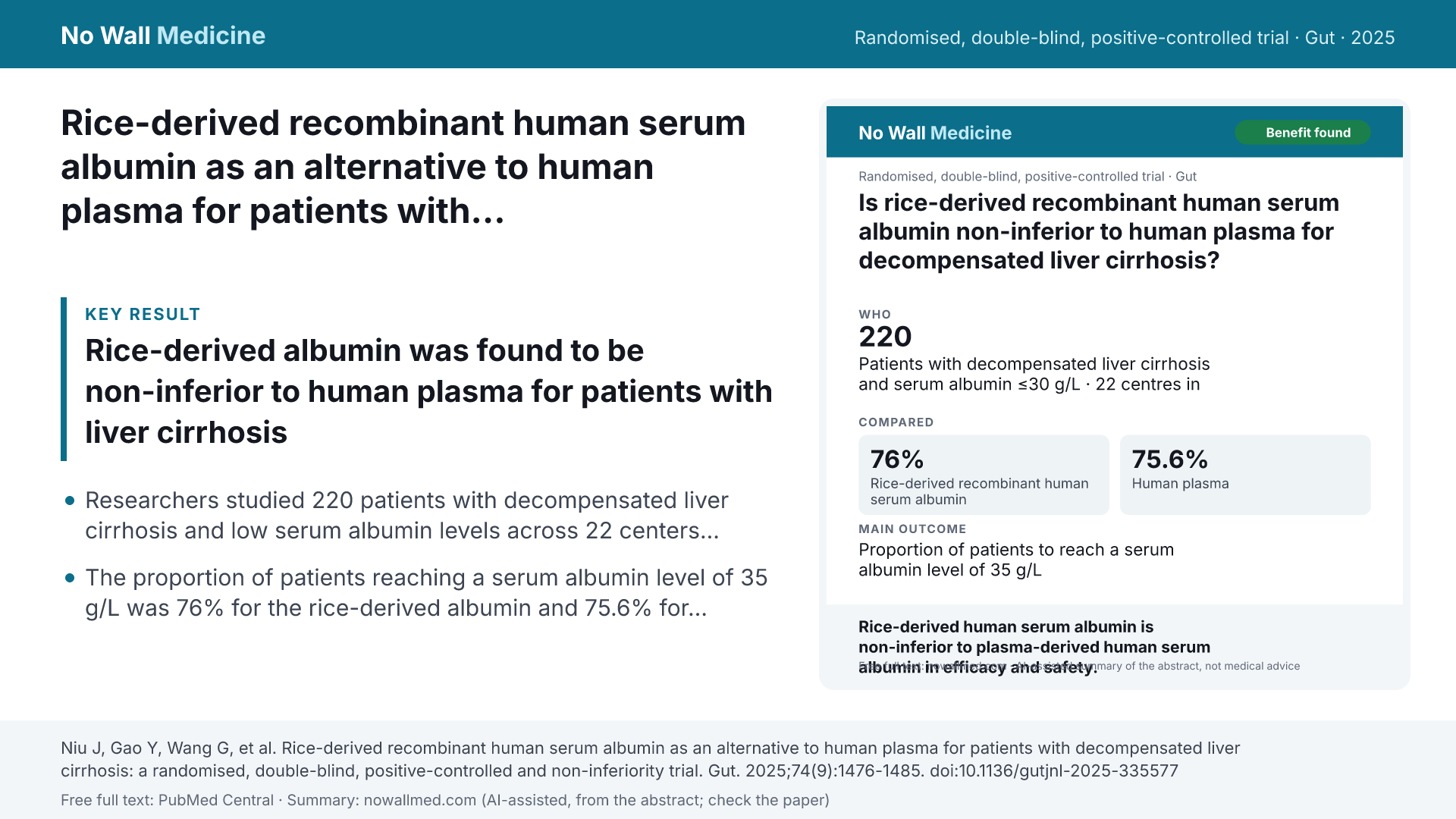
Rice-derived albumin was found to be non-inferior to human plasma for patients with liver cirrhosis
Rice-derived recombinant human serum albumin as an alternative to human plasma for patients with decompensated liver cirrhosis: a randomised, double-blind, positive-controlled and non-inferiority trial
Randomised, double-blind, positive-controlled trialBenefit found
Is rice-derived recombinant human serum albumin non-inferior to human plasma for decompensated liver cirrhosis?
Who
220
Patients with decompensated liver cirrhosis and serum albumin ≤30 g/L · 22 centres in China
Compared
76%Rice-derived recombinant human serum albumin (130/171)
75.6%Human plasma (34/45)
Main outcome
Proportion of patients to reach a serum albumin level of 35 g/L
Result: difference=0.5%; lower limit of 97.5% CI=-0.119
Bottom line: Rice-derived human serum albumin is non-inferior to plasma-derived human serum albumin in efficacy and safety.
Gut · 2025-08-07 · Save PNG
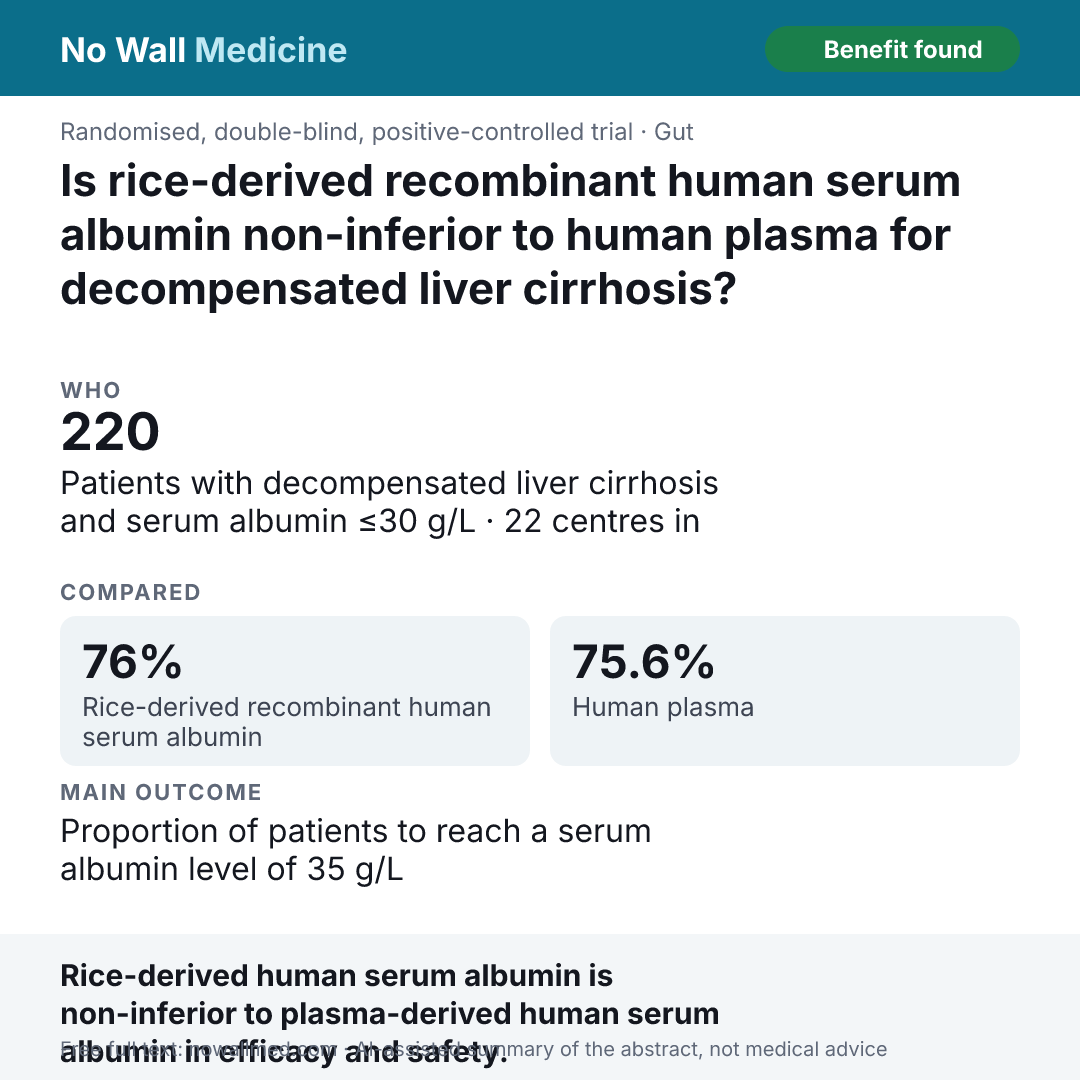
Clinical question: Is rice-derived recombinant human serum albumin non-inferior to human plasma for decompensated liver cirrhosis?
Why it matters: Human plasma is the only current source for intravenous albumin administration despite supply shortages and potential contamination risks.
Key points
- Researchers studied 220 patients with decompensated liver cirrhosis and low serum albumin levels across 22 centers in China.
- The proportion of patients reaching a serum albumin level of 35 g/L was 76% for the rice-derived albumin and 75.6% for the human plasma.
- No significant differences were found between the two groups for secondary outcomes, and there were no drug-related serious adverse events.
Headline and key points written with AI from the paper’s abstract, with every number checked against it. Read the paper before relying on them.
Was this summary helpful?
Abstract
Background
Despite inadequate supply and potential contamination risk, human plasma has remained the only source for human serum albumin (pHSA) intravenous administration since the 1940s. Objective
We sought to establish the safety and efficacy of OsrHSA, a recombinant HSA from bioengineered Oryza sativa (rice). Design
In this multicentre, randomised, double-blind and positive-controlled study, patients with decompensated liver cirrhosis and serum albumin ≤30 g/L were recruited from 22 centres in China. The patients were randomly assigned to OsrHSA or pHSA (4:1) to once-daily intravenous injection (10 g or 20 g) until their serum albumin level reached 35 g/L, for a maximum of 2 weeks, with 2 weeks of follow-up. The primary outcome was the proportion of patients to reach a serum albumin level of 35 g/L (non-inferiority margin <-0.20). Outcomes were evaluated in patients who received the study drug and had at least one post-baseline serum albumin value (full analysis set, FAS). Safety was evaluated in all patients who received the study drug. Results
Between 22 March 2021 and 2 June 2022, 220 patients received OsrHSA (n=175) or pHSA (n=45). 216 patients were included in the FAS (OsrHSA, n=171; pHSA, n=45). Primary outcome of OsrHSA (130/171, 76%) was non-inferior to pHSA (34/45, 75.6%) (difference=0.5%; lower limit of 97.5% CI=-0.119). There was no significant difference between all secondary outcomes of OsrHSA and pHSA. There were no drug-related serious adverse events. Conclusions
Rice-derived HSA is non-inferior to plasma-derived HSA in efficacy and safety. This finding should be confirmed in phase 3 trial. Trial registration number
NCT04835480.
Abstract reproduced under the article’s CC BY NC licence.
Subject terms
Headline, design, result, key points, caveat and citation as plain text.
Cite this article
Niu J, Gao Y, Wang G, et al. Rice-derived recombinant human serum albumin as an alternative to human plasma for patients with decompensated liver cirrhosis: a randomised, double-blind, positive-controlled and non-inferiority trial. Gut. 2025;74(9):1476-1485. doi:10.1136/gutjnl-2025-335577
Spotted a mistake? Suggest a correction