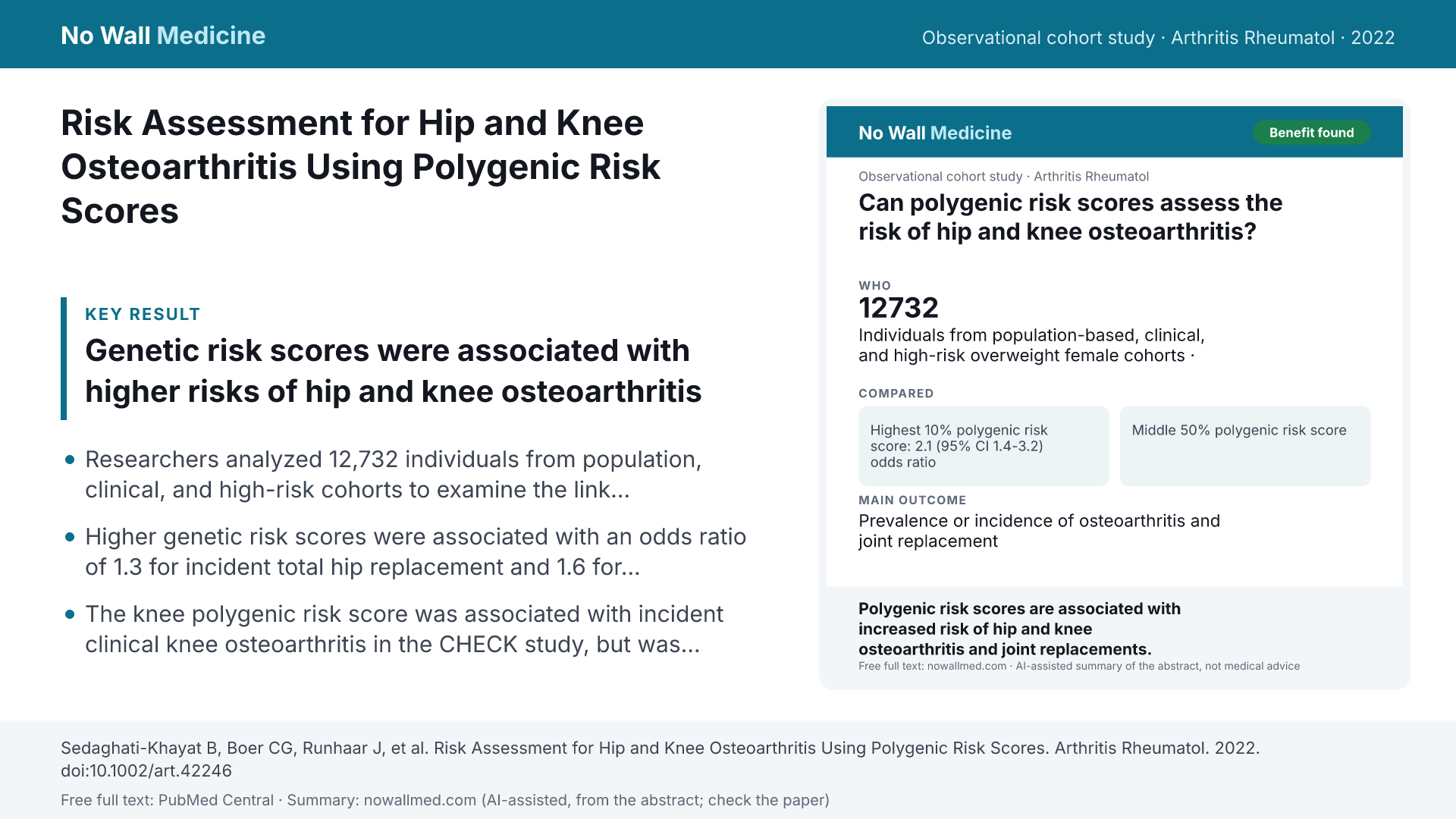
Risk Assessment for Hip and Knee Osteoarthritis Using Polygenic Risk Scores
Key result: Genetic risk scores were associated with higher risks of hip and knee osteoarthritis
Observational cohort studyBenefit found
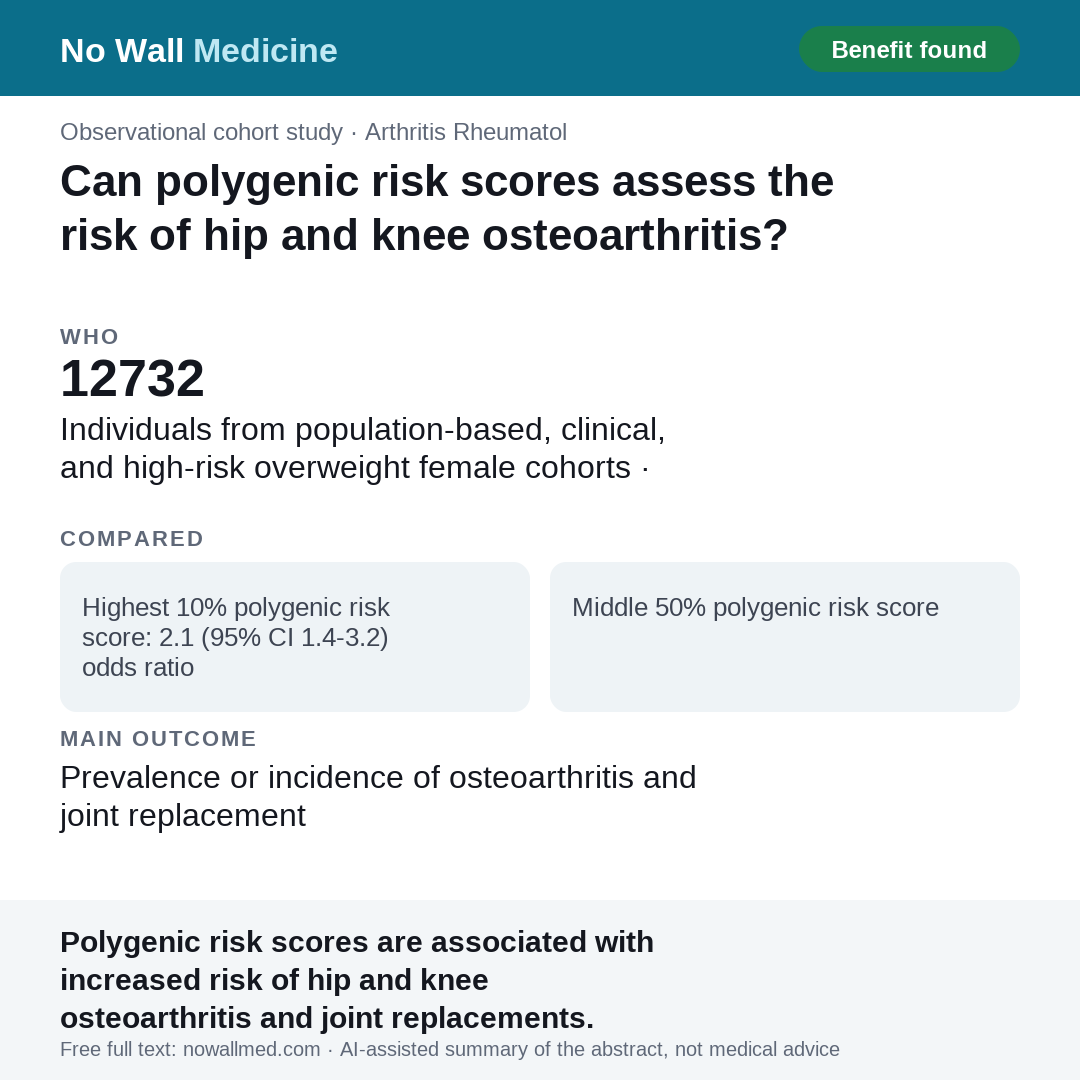
Can polygenic risk scores assess the risk of hip and knee osteoarthritis?
Who
12732
Individuals from population-based, clinical, and high-risk overweight female cohorts · Rotterdam Study, Cohort Hip and Cohort Knee, and PROOF study
Compared
Highest 10% polygenic risk score: 2.1 (95% CI 1.4-3.2) odds ratio
Middle 50% polygenic risk score
Main outcome
Prevalence or incidence of osteoarthritis and joint replacement
Result: odds ratio 2.1 (95% CI 1.4-3.2) for highest 10% vs middle 50%
Bottom line: Polygenic risk scores are associated with increased risk of hip and knee osteoarthritis and joint replacements.
Limitation: The utility of polygenic risk scores is dependent on the setting.
Arthritis Rheumatol · 2022-08-02Download image
Key points
- Researchers analyzed 12,732 individuals from population, clinical, and high-risk cohorts to examine the link between polygenic risk scores and osteoarthritis.
- Higher genetic risk scores were associated with an odds ratio of 1.3 for incident total hip replacement and 1.6 for incident total knee replacement in the Rotterdam Study.
- The knee polygenic risk score was associated with incident clinical knee osteoarthritis in the CHECK study, but was not associated with it in the PROOF study.
Why it matters: It is unknown if polygenic risk scores, which use common genetic variations, can effectively stratify the risk of hip and knee osteoarthritis.
Discussion prompts
- Would these patients look like yours? Who was left out?
- Is the main outcome one that matters to patients?
- Is the difference large enough to change what you do?
Cite: Sedaghati-Khayat B, Boer CG, Runhaar J, et al. Risk Assessment for Hip and Knee Osteoarthritis Using Polygenic Risk Scores. Arthritis Rheumatol. 2022. doi:10.1002/art.42246
Free full text: PubMed Central · Summary and visual abstract: nowallmed.com/a/risk-assessment-for-hip-and-knee-osteoarthritis-using-polygenic-risk-y91xcb/ (AI-assisted from the abstract; check the paper before relying on it).