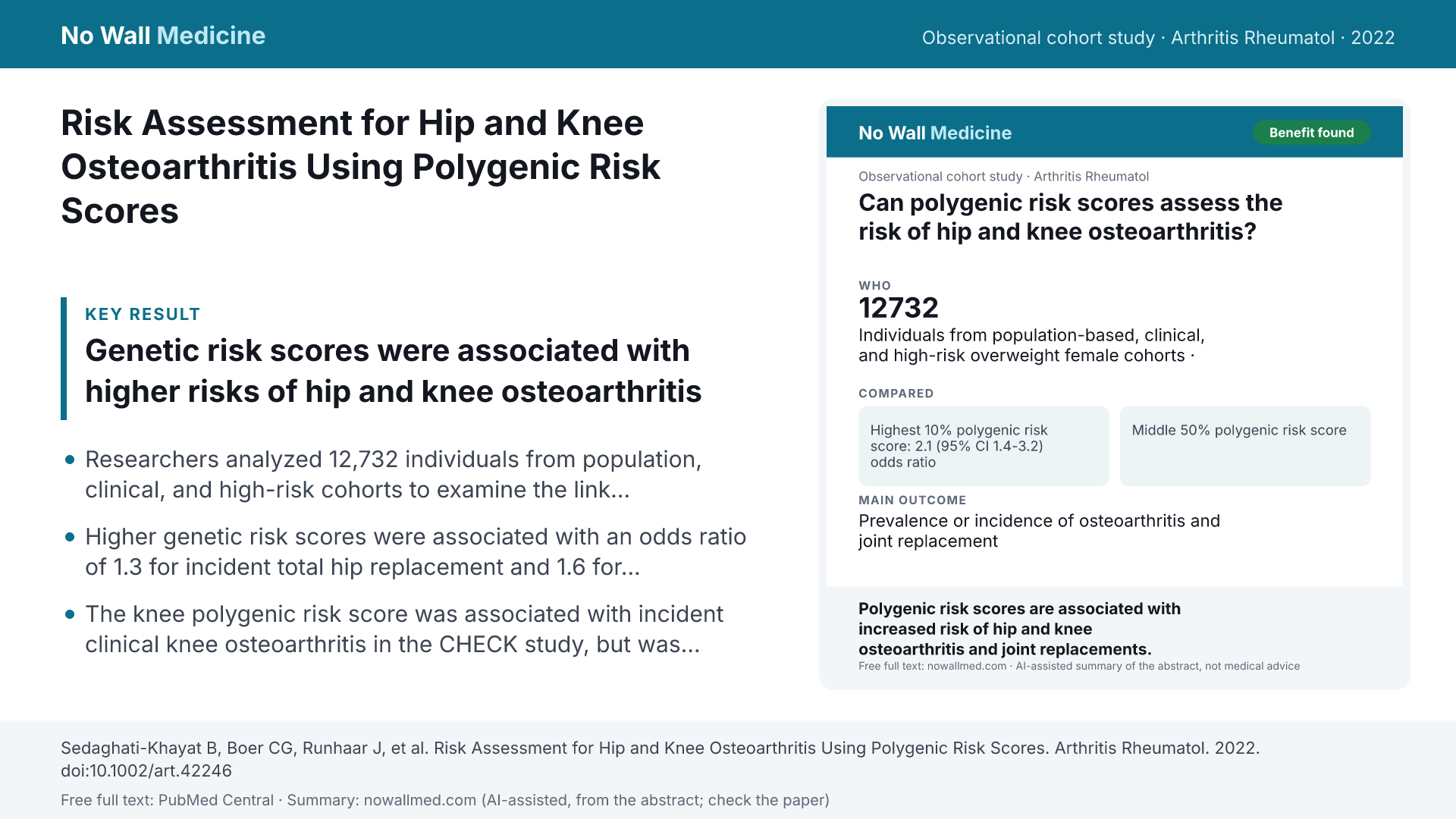
Genetic risk scores were associated with higher risks of hip and knee osteoarthritis
Risk Assessment for Hip and Knee Osteoarthritis Using Polygenic Risk Scores
Observational cohort studyBenefit found
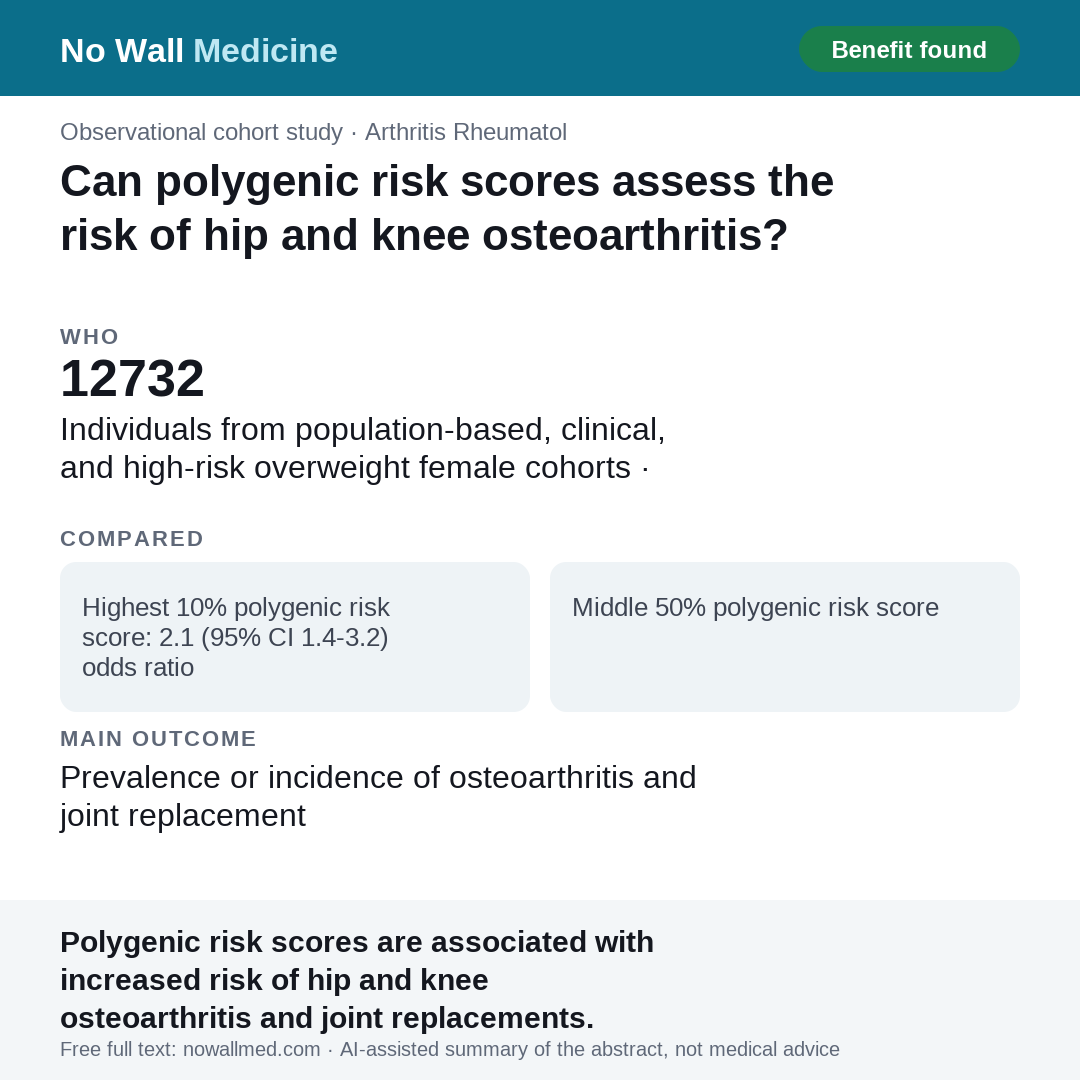
Can polygenic risk scores assess the risk of hip and knee osteoarthritis?
Who
12732
Individuals from population-based, clinical, and high-risk overweight female cohorts · Rotterdam Study, Cohort Hip and Cohort Knee, and PROOF study
Compared
Highest 10% polygenic risk score: 2.1 (95% CI 1.4-3.2) odds ratio
Middle 50% polygenic risk score
Main outcome
Prevalence or incidence of osteoarthritis and joint replacement
Result: odds ratio 2.1 (95% CI 1.4-3.2) for highest 10% vs middle 50%
Bottom line: Polygenic risk scores are associated with increased risk of hip and knee osteoarthritis and joint replacements.
Limitation: The utility of polygenic risk scores is dependent on the setting.
Arthritis Rheumatol · 2022-08-02Download image
Clinical question: Can polygenic risk scores assess the risk of hip and knee osteoarthritis?
Why it matters: It is unknown if polygenic risk scores, which use common genetic variations, can effectively stratify the risk of hip and knee osteoarthritis.
Key points
- Researchers analyzed 12,732 individuals from population, clinical, and high-risk cohorts to examine the link between polygenic risk scores and osteoarthritis.
- Higher genetic risk scores were associated with an odds ratio of 1.3 for incident total hip replacement and 1.6 for incident total knee replacement in the Rotterdam Study.
- The knee polygenic risk score was associated with incident clinical knee osteoarthritis in the CHECK study, but was not associated with it in the PROOF study.
Headline and key points written with AI from the paper’s abstract, with every number checked against it. Read the paper before relying on them.
Was this summary helpful?
Subject terms
Cite this article
Sedaghati-Khayat B, Boer CG, Runhaar J, et al. Risk Assessment for Hip and Knee Osteoarthritis Using Polygenic Risk Scores. Arthritis Rheumatol. 2022. doi:10.1002/art.42246
Spotted a mistake? Suggest a correction