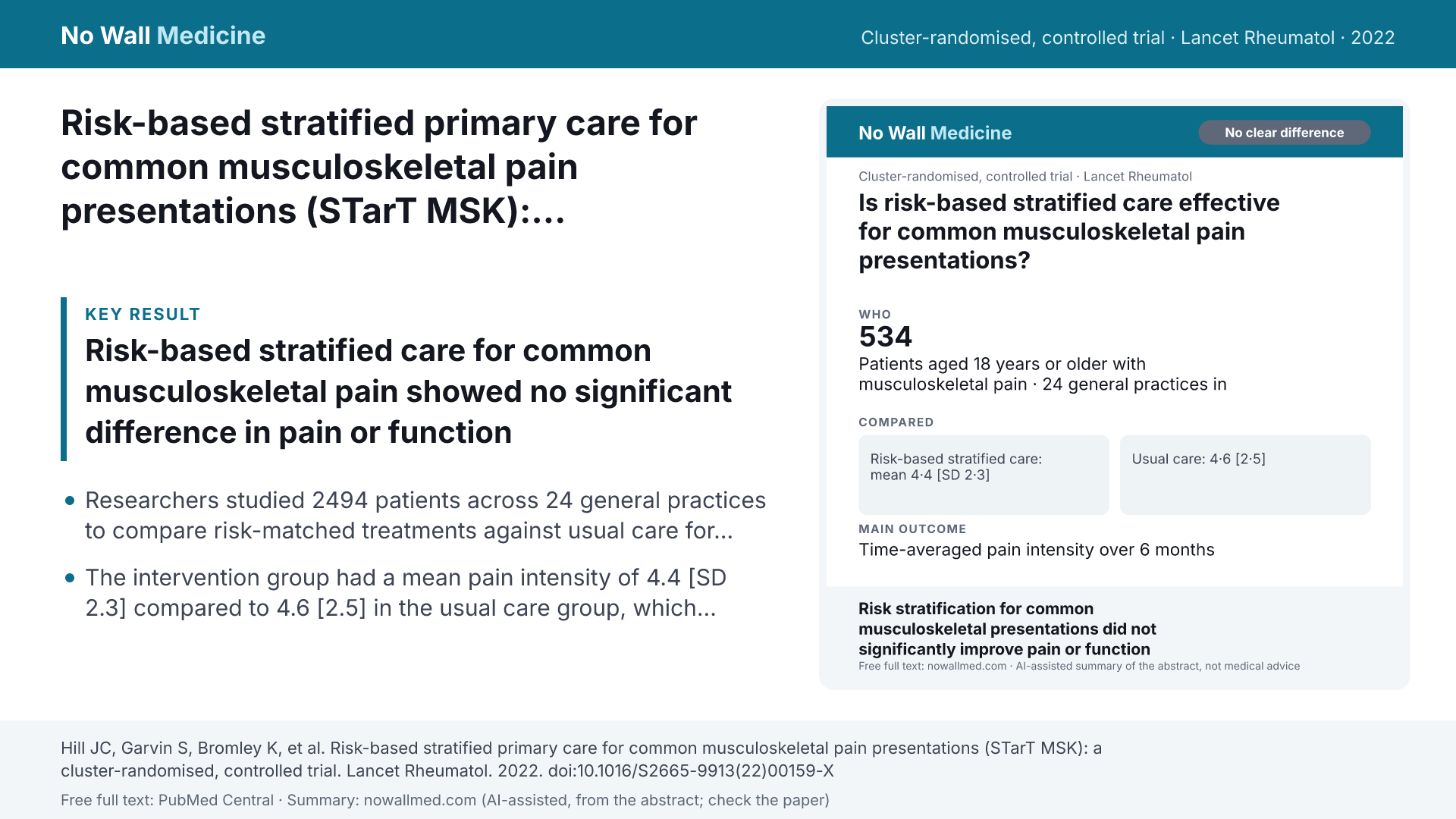
Risk-based stratified care for common musculoskeletal pain showed no significant difference in pain or function
Risk-based stratified primary care for common musculoskeletal pain presentations (STarT MSK): a cluster-randomised, controlled trial
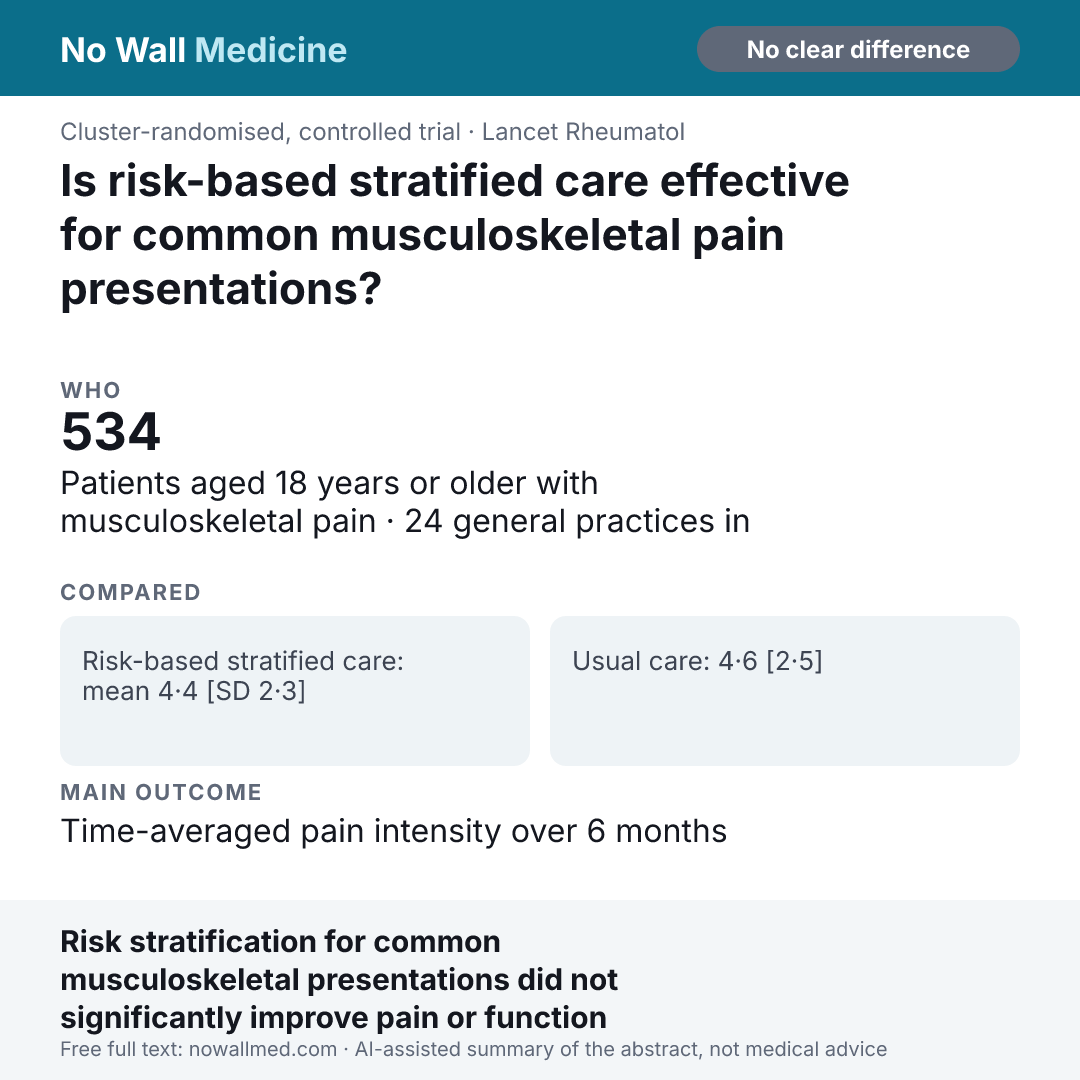
Cluster-randomised, controlled trialNo clear difference
Is risk-based stratified care effective for common musculoskeletal pain presentations?
Who
534
Patients aged 18 years or older with musculoskeletal pain · 24 general practices in West Midlands, England
Compared
Risk-based stratified care: mean 4·4 [SD 2·3]
Usual care: 4·6 [2·5]
Main outcome
Time-averaged pain intensity over 6 months
Result: adjusted mean difference -0·16, 95% CI -0·65 to 0·34
Bottom line: Risk stratification for common musculoskeletal presentations did not significantly improve pain or function compared to usual care.
Funded by: National Institute for Health Research
Lancet Rheumatol · 2022-07-15 · Save PNG
Same trial (ISRCTN15366334)
Papers we list that report this registered trial, oldest first. Read a secondary analysis alongside the main results.
- Main results No clear difference
This paper Lancet Rheumatol 2022-07 - Related analysis No clear difference
Clinicians and patients reported changes in decision-making during risk-based stratified care for musculoskeletal pain BMC Prim Care 2022-12
Clinical question: Is risk-based stratified care effective for common musculoskeletal pain presentations?
Key points
- Researchers studied 2494 patients across 24 general practices to compare risk-matched treatments against usual care for back, neck, knee, shoulder, and multi-site pain.
- The intervention group had a mean pain intensity of 4.4 [SD 2.3] compared to 4.6 [2.5] in the usual care group, which was not a significant difference.
- There was no significant difference in standardized function scores between the intervention group (mean -0.06 [SD 0.94]) and the usual care group (mean 0.05 [SD 1.04]).
Headline and key points written with AI from the paper’s abstract, with every number checked against it. Read the paper before relying on them.
Was this summary helpful?
Abstract
Background
Risk-based stratified care shows clinical effectiveness and cost-effectiveness versus usual primary care for non-specific low back pain but is untested for other common musculoskeletal disorders. We aimed to test the clinical effectiveness and cost-effectiveness of point-of-care risk stratification (using Keele's STarT MSK Tool and risk-matched treatments) versus usual care for the five most common musculoskeletal presentations (back, neck, knee, shoulder, and multi-site pain). Methods
In this cluster-randomised, controlled trial in UK primary care with embedded qualitative and health economic studies we recruited patients from 24 general practices in the West Midlands region of England. Eligible patients were those aged 18 years or older whose general practitioner (GP) confirmed a consultation for a musculoskeletal presentation. General practices that consented to participate via a representative of the cluster were randomly assigned (1:1) to intervention or usual care, using stratified block randomisation. Researchers involved in data collection, outcome data entry, and statistical analysis were masked at both the cluster and individual participant level. Participating patients were told the study was examining GP treatment of common aches and pains and were not aware they were in a randomised trial. GPs in practices allocated to the intervention group were supported to deliver risk-based stratified care using a bespoke computer-based template, including the risk-stratification tool, and risk-matched treatment options for patients at low, medium, or high risk of poor disability or pain outcomes. There were 15 risk-matched treatment options. In the usual care group, patients with musculoskeletal pain consulting their GP received treatment as usual, typically including advice and education, medication, referral for investigations or tests, or referral to other services. The primary outcome was time-averaged pain intensity over 6 months. All analyses were done by intention to treat. The trial is registered with ISRCTN, ISRCTN15366334. Results
Between May 1, 2018, and April 30, 2019, 104 GPs from 24 practices (12 per study group) identified 2494 patients with musculoskeletal pain. 1211 (49%) participants consented to questionnaires (534 in the intervention group and 677 in the usual care group), with 1070 (88%) completing the follow-up questionnaire at 6 months. We found no significant difference in time-averaged pain intensity (mean(SD) mean 4·4 [SD 2·3] in the intervention group vs 4·6 [2·5] in the control group; adjusted mean difference -0·16, 95% CI -0·65 to 0·34) or in standardised function score (mean -0·06 [SD 0·94] in the intervention group vs 0·05 [1·04]; adjusted mean difference -0·07, 95% CI -0·22 to 0·08). No serious adverse events or adverse events were reported. Risk stratification received positive patient and clinician feedback. Interpretation
Risk stratification for patients in primary care with common musculoskeletal presentations did not lead to significant improvements in pain or function, although some aspects of GP decision making were affected, and GP and patients had positive experiences. The costs of risk-based stratified care were similar to usual care, and such a strategy only offers marginal changes in cost-effectiveness outcomes. The clinical implications from this trial are largely inconclusive. Funding
National Institute for Health Research.
Abstract reproduced under the article’s CC BY licence.
Headline, design, result, key points, caveat and citation as plain text.
Cite this article
Hill JC, Garvin S, Bromley K, et al. Risk-based stratified primary care for common musculoskeletal pain presentations (STarT MSK): a cluster-randomised, controlled trial. Lancet Rheumatol. 2022. doi:10.1016/S2665-9913(22)00159-X
Spotted a mistake? Suggest a correction