Risk factors and predictive models for fat necrosis in DIEP flap breast reconstruction: A systematic review
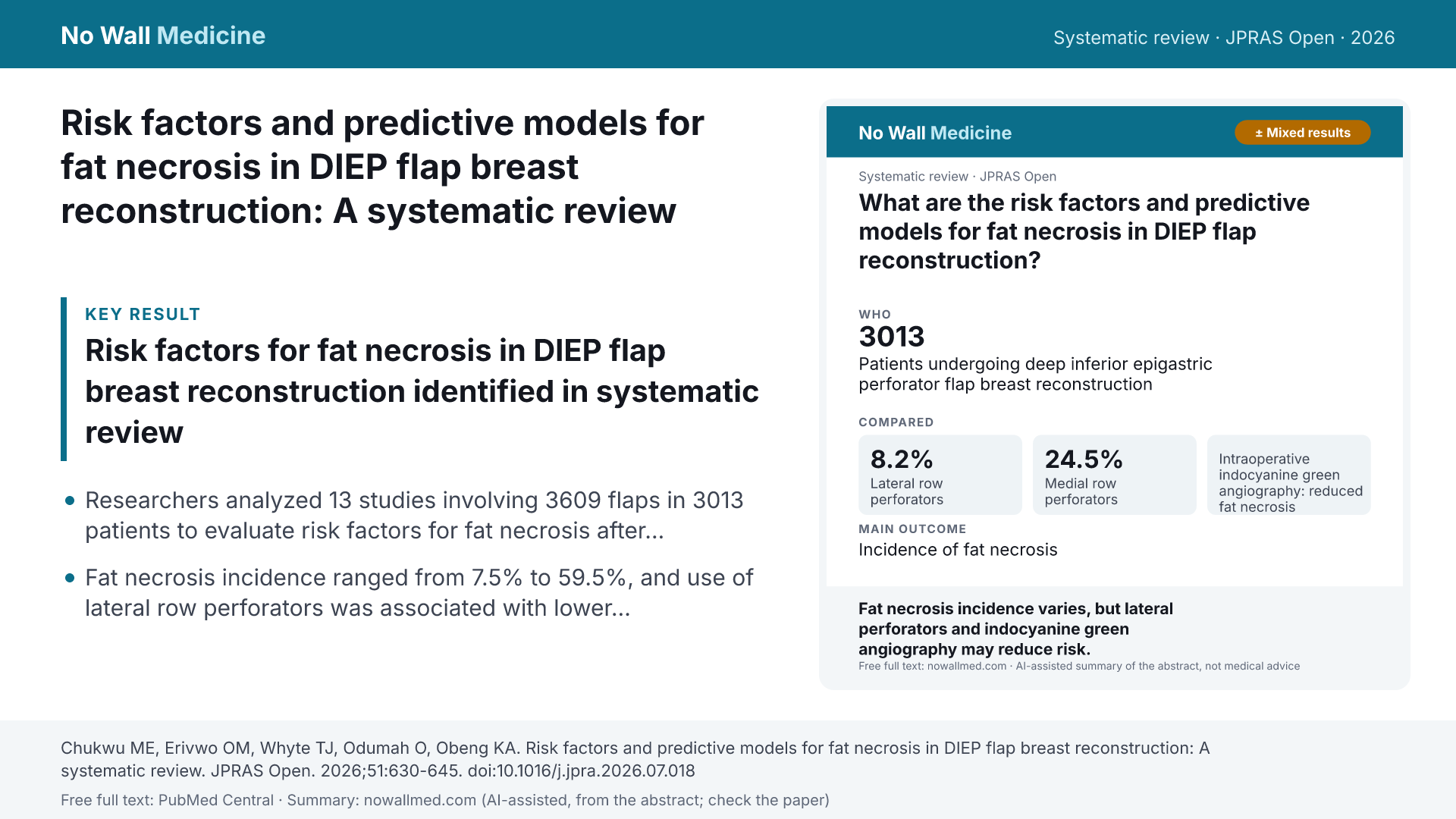
Key result: Risk factors for fat necrosis in DIEP flap breast reconstruction identified in systematic review
Systematic reviewMixed results
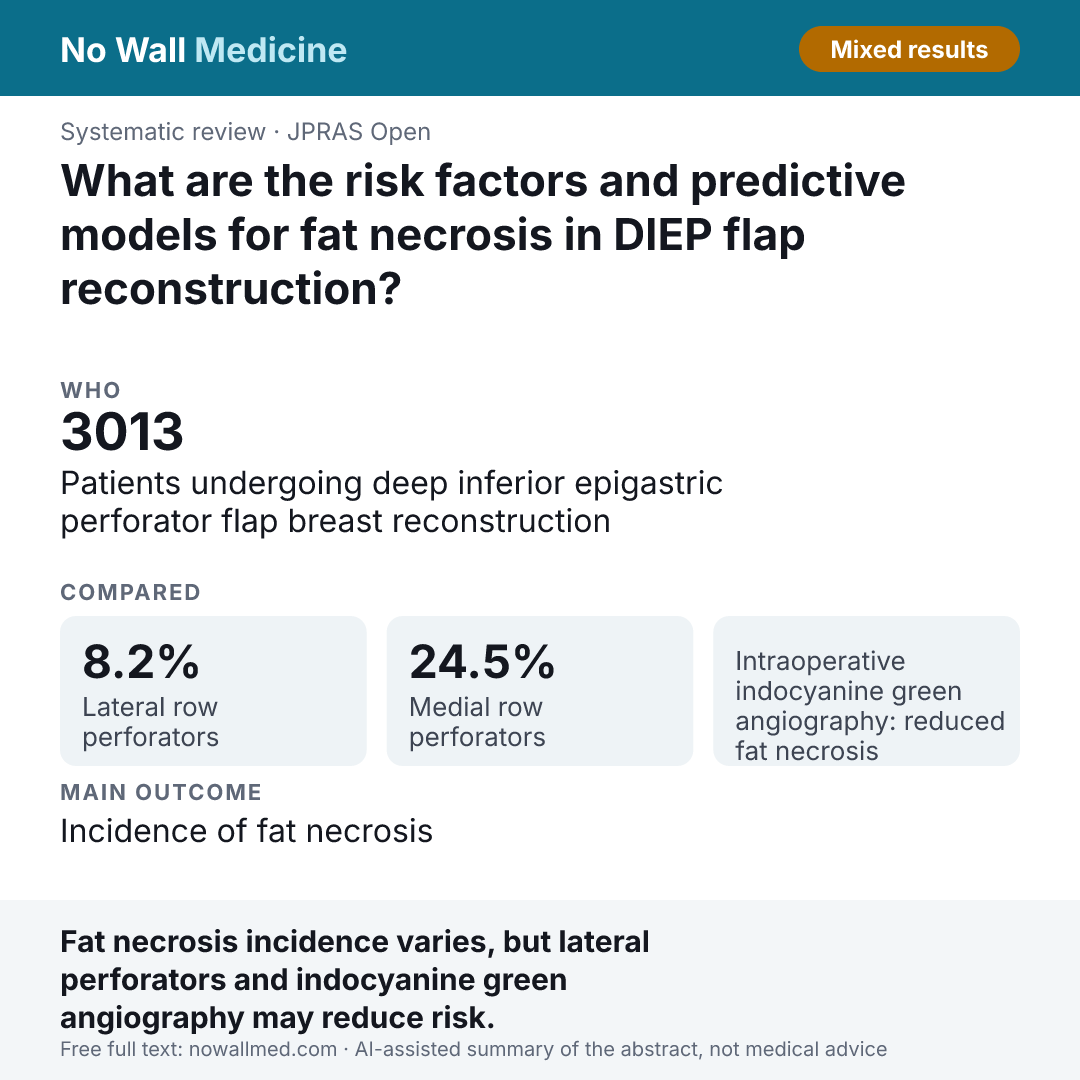
What are the risk factors and predictive models for fat necrosis in DIEP flap reconstruction?
Who
3013
Patients undergoing deep inferior epigastric perforator flap breast reconstruction
Compared
8.2%Lateral row perforators
24.5%Medial row perforators
Intraoperative indocyanine green angiography: reduced fat necrosis
Main outcome
Incidence of fat necrosis
Result: RR 0.49 (95% CI 0.25-0.97)
Bottom line: Fat necrosis incidence varies, but lateral perforators and indocyanine green angiography may reduce risk.
JPRAS Open · 2026-07-18 · Save PNG
Key points
- Researchers analyzed 13 studies involving 3609 flaps in 3013 patients to evaluate risk factors for fat necrosis after DIEP flap breast reconstruction.
- Fat necrosis incidence ranged from 7.5% to 59.5%, and use of lateral row perforators was associated with lower rates compared to medial row perforators (8.2% vs. 24.5%).
- Higher flap weight and a body mass index greater than 30 kg/m² were consistent predictors of fat necrosis.
Why it matters: Fat necrosis is a common complication of DIEP flap breast reconstruction that can affect aesthetic outcomes and reconstructive durability.
Discussion prompts
- Would these patients look like yours? Who was left out?
- Is the main outcome one that matters to patients?
- Is the difference large enough to change what you do?
Cite: Chukwu ME, Erivwo OM, Whyte TJ, Odumah O, Obeng KA. Risk factors and predictive models for fat necrosis in DIEP flap breast reconstruction: A systematic review. JPRAS Open. 2026;51:630-645. doi:10.1016/j.jpra.2026.07.018
Free full text: PubMed Central · Summary and visual abstract: nowallmed.com/a/risk-factors-and-predictive-models-for-fat-necrosis-in-diep-flap-8fic4y/ (AI-assisted from the abstract; check the paper before relying on it).