Antibiotics and blood transfusions were associated with higher risk of invasive Candida infection
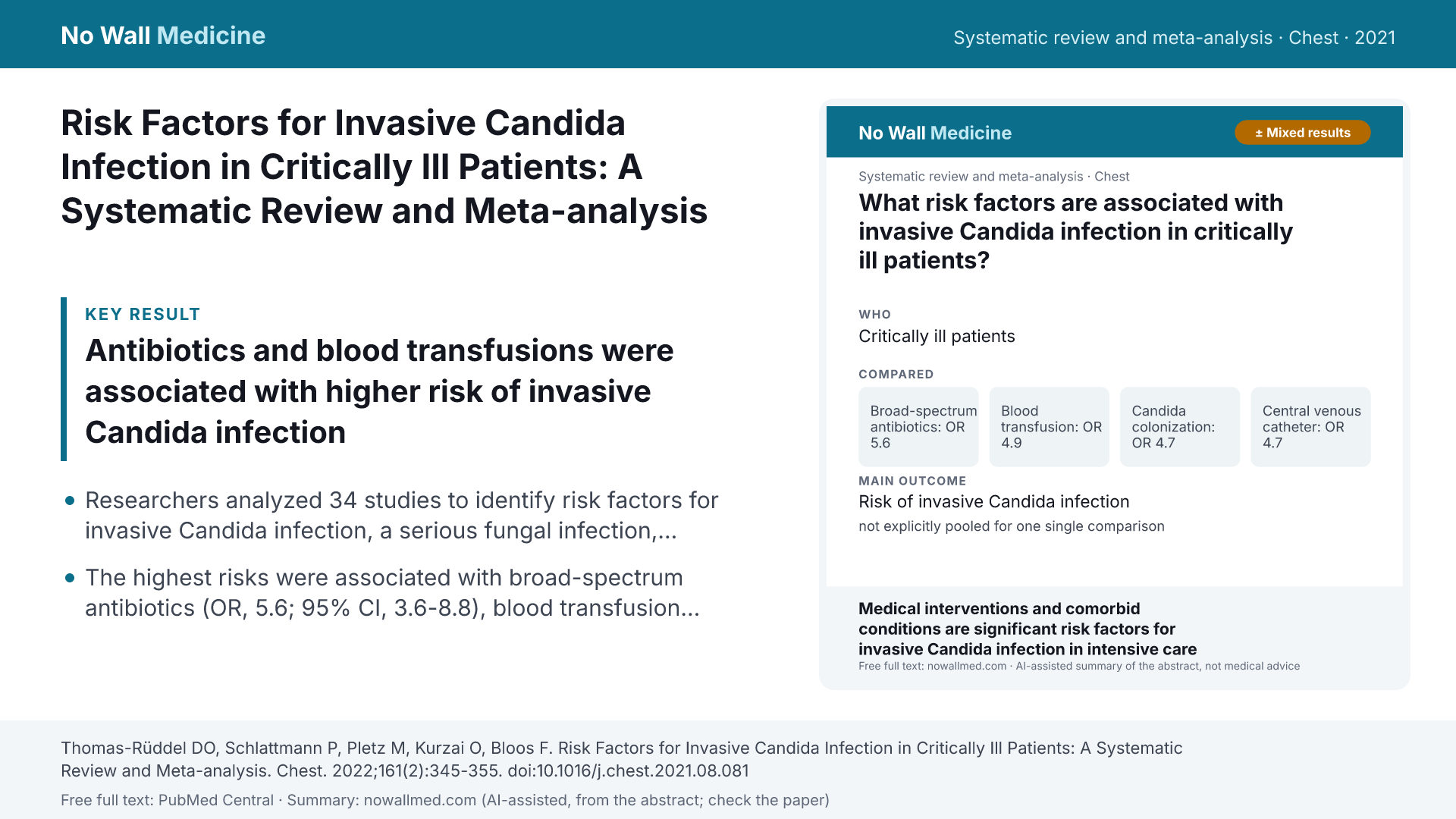
Risk Factors for Invasive Candida Infection in Critically Ill Patients: A Systematic Review and Meta-analysis
Systematic review and meta-analysisMixed results
What risk factors are associated with invasive Candida infection in critically ill patients?
Who
Critically ill patients
Compared
Broad-spectrum antibiotics: OR 5.6
Blood transfusion: OR 4.9
Candida colonization: OR 4.7
Central venous catheter: OR 4.7
Main outcome
Risk of invasive Candida infection
Result: not explicitly pooled for one single comparison
Bottom line: Medical interventions and comorbid conditions are significant risk factors for invasive Candida infection in intensive care units.
Limitation: Dependence between the various risk factors is probably high.
Chest · 2021-10-18Download image
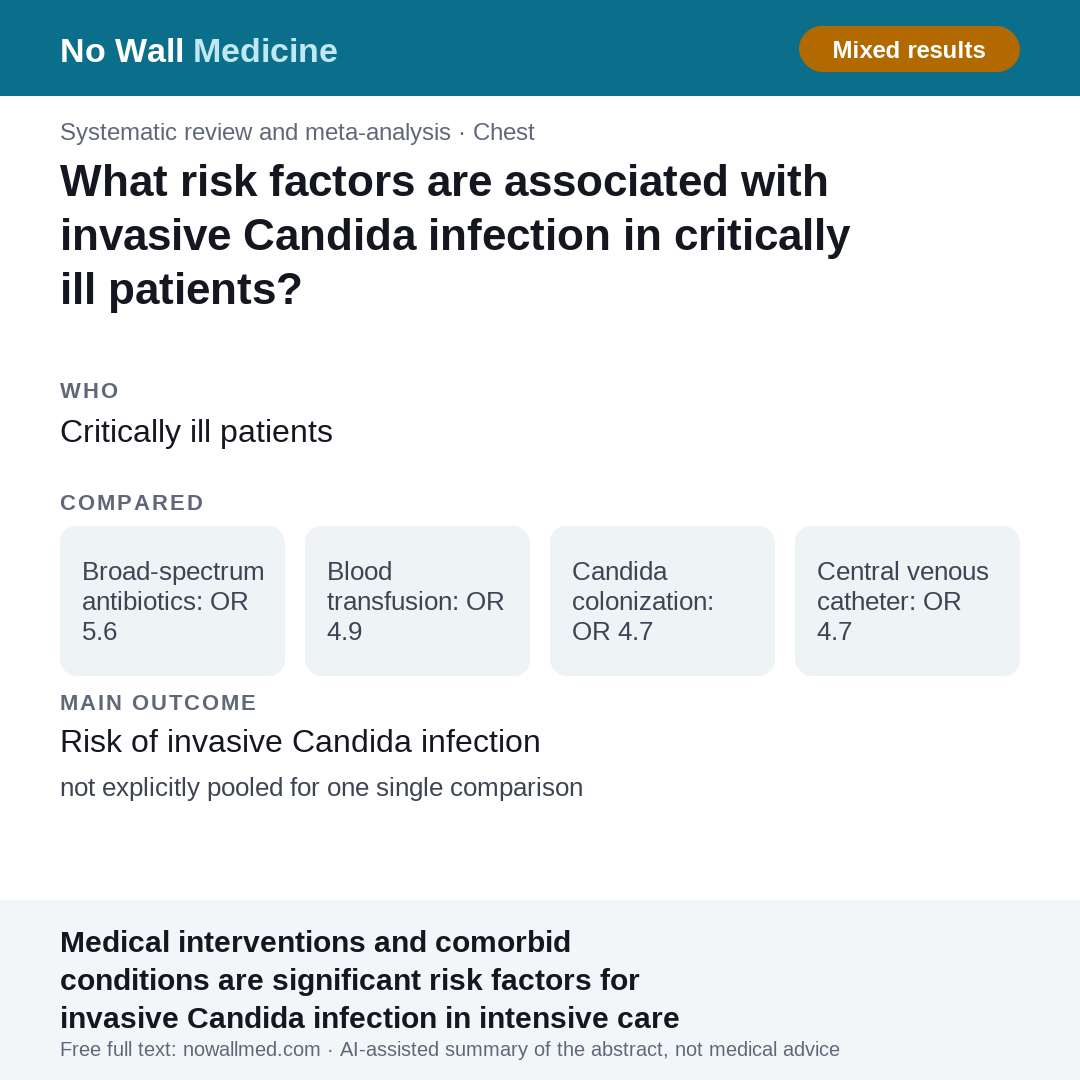
Clinical question: What risk factors are associated with invasive Candida infection in critically ill patients?
Why it matters: Current guidelines for starting antifungal therapy in sepsis patients are difficult to apply because many different risk factors lack specificity.
Key points
- Researchers analyzed 34 studies to identify risk factors for invasive Candida infection, a serious fungal infection, in critically ill patients.
- The highest risks were associated with broad-spectrum antibiotics (OR, 5.6; 95% CI, 3.6-8.8), blood transfusion (OR, 4.9; 95% CI, 1.5-16.3), and Candida colonization (OR, 4.7; 95% CI, 1.6-14.3).
- Other associated factors included central venous catheter use (OR, 4.7; 95% CI, 2.7-8.1) and total parenteral nutrition (OR, 4.6; 95% CI, 3.3-6.3).
Headline and key points written with AI from the paper’s abstract, with every number checked against it. Read the paper before relying on them.
Was this summary helpful?
Subject terms
Cite this article
Thomas-Rüddel DO, Schlattmann P, Pletz M, Kurzai O, Bloos F. Risk Factors for Invasive Candida Infection in Critically Ill Patients: A Systematic Review and Meta-analysis. Chest. 2021. doi:10.1016/j.chest.2021.08.081
Spotted a mistake? Suggest a correction