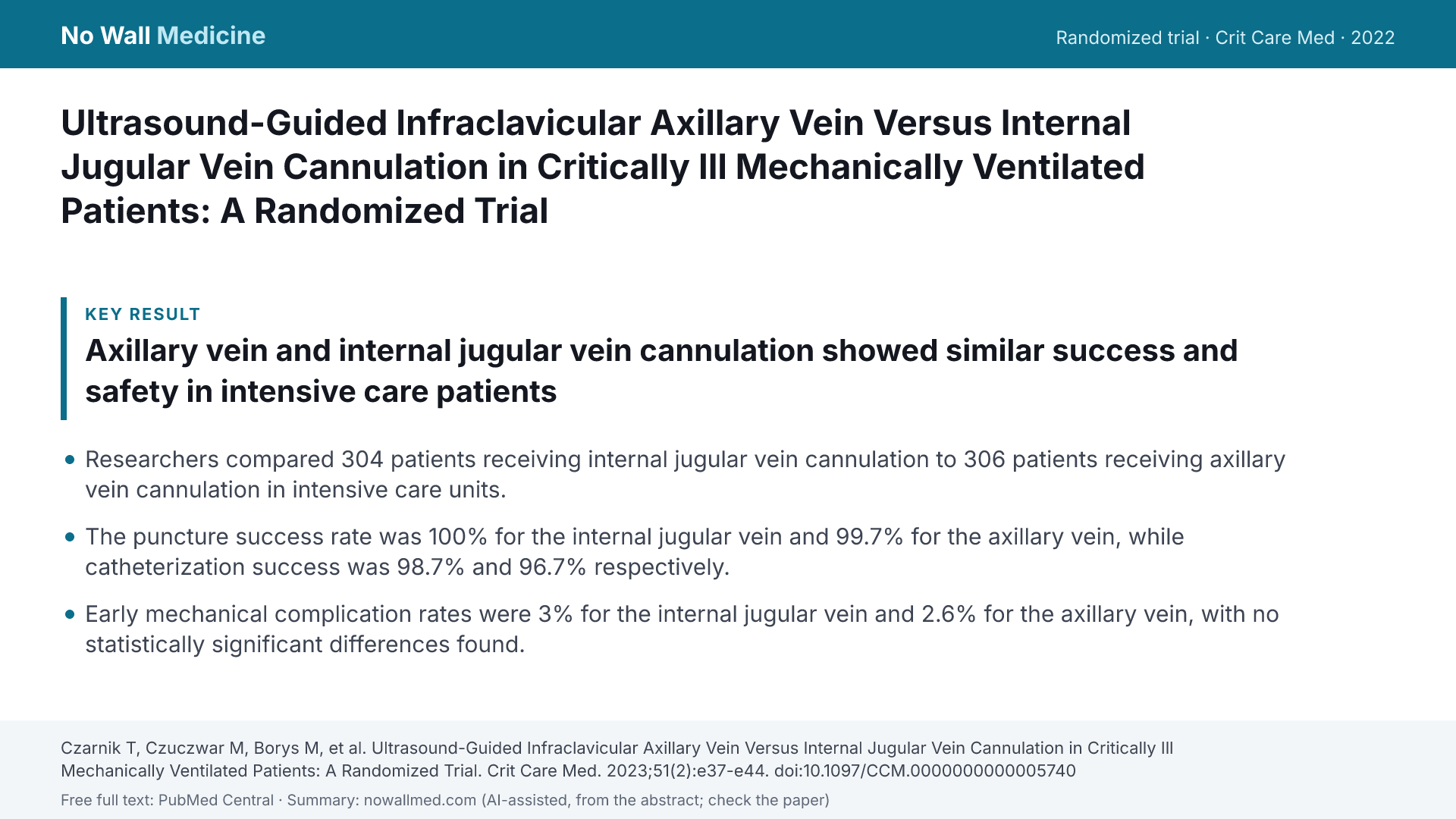
Axillary vein and internal jugular vein cannulation showed similar success and safety in intensive care patients
Ultrasound-Guided Infraclavicular Axillary Vein Versus Internal Jugular Vein Cannulation in Critically Ill Mechanically Ventilated Patients: A Randomized Trial
Key points
- Researchers compared 304 patients receiving internal jugular vein cannulation to 306 patients receiving axillary vein cannulation in intensive care units.
- The puncture success rate was 100% for the internal jugular vein and 99.7% for the axillary vein, while catheterization success was 98.7% and 96.7% respectively.
- Early mechanical complication rates were 3% for the internal jugular vein and 2.6% for the axillary vein, with no statistically significant differences found.
Headline and key points written with AI from the paper’s abstract, with every number checked against it. Read the paper before relying on them.
Was this summary helpful?
Subject terms
Headline, design, result, key points, caveat and citation as plain text.
Cite this article
Czarnik T, Czuczwar M, Borys M, et al. Ultrasound-Guided Infraclavicular Axillary Vein Versus Internal Jugular Vein Cannulation in Critically Ill Mechanically Ventilated Patients: A Randomized Trial. Crit Care Med. 2023;51(2):e37-e44. doi:10.1097/CCM.0000000000005740
Spotted a mistake? Suggest a correction