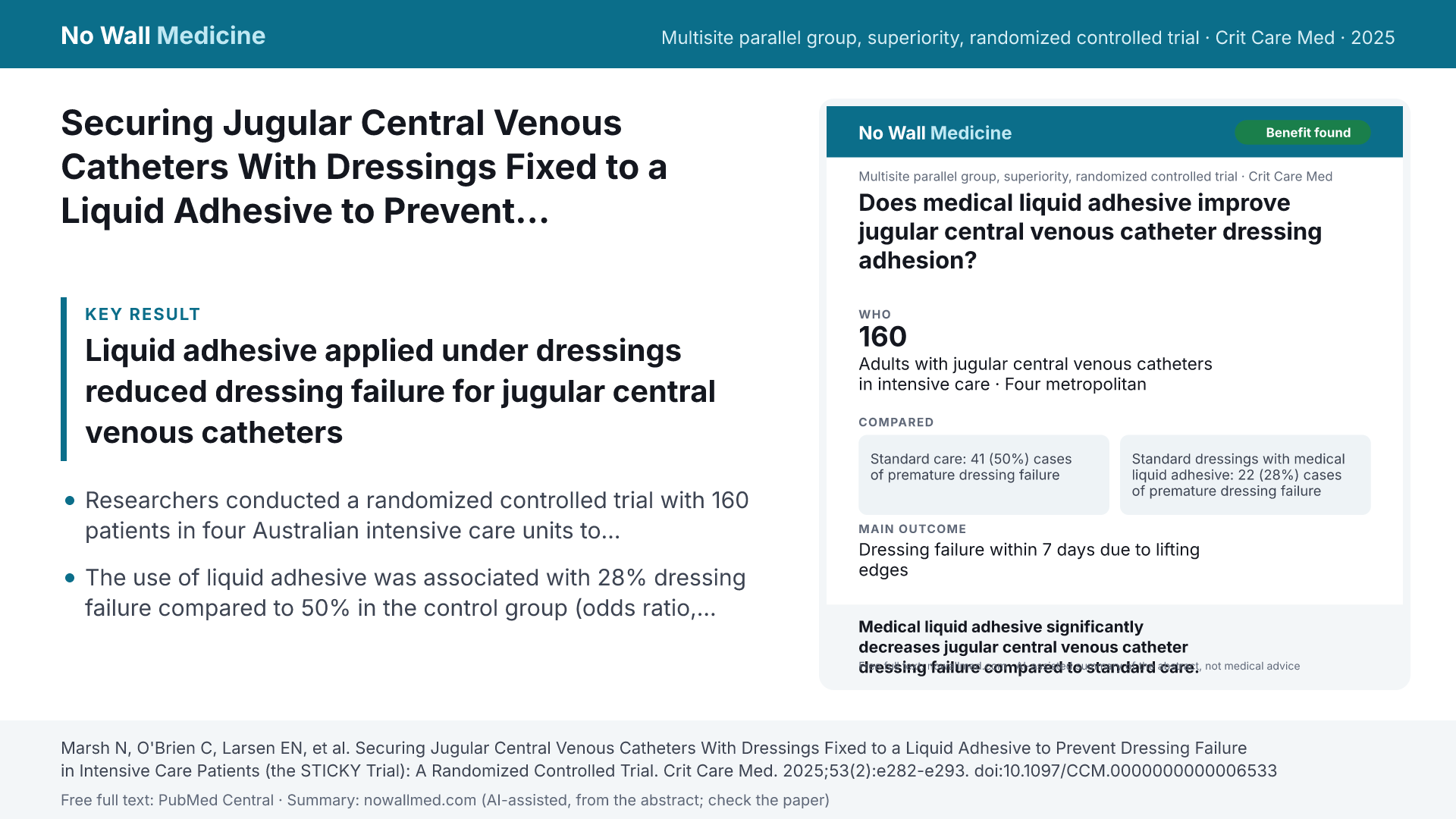
Liquid adhesive applied under dressings reduced dressing failure for jugular central venous catheters
Securing Jugular Central Venous Catheters With Dressings Fixed to a Liquid Adhesive to Prevent Dressing Failure in Intensive Care Patients (the STICKY Trial): A Randomized Controlled Trial
Multisite parallel group, superiority, randomized controlled trialBenefit found
Does medical liquid adhesive improve jugular central venous catheter dressing adhesion?
Who
160
Adults with jugular central venous catheters in intensive care · Four metropolitan Australian intensive care units
Compared
Standard care: 41 (50%) cases of premature dressing failure
Standard dressings with medical liquid adhesive: 22 (28%) cases of premature dressing failure
Main outcome
Dressing failure within 7 days due to lifting edges
Result: odds ratio, 0.39; 95% CI, 0.20-0.76
Bottom line: Medical liquid adhesive significantly decreases jugular central venous catheter dressing failure compared to standard care.
Crit Care Med · 2025-02-21 · Save PNG
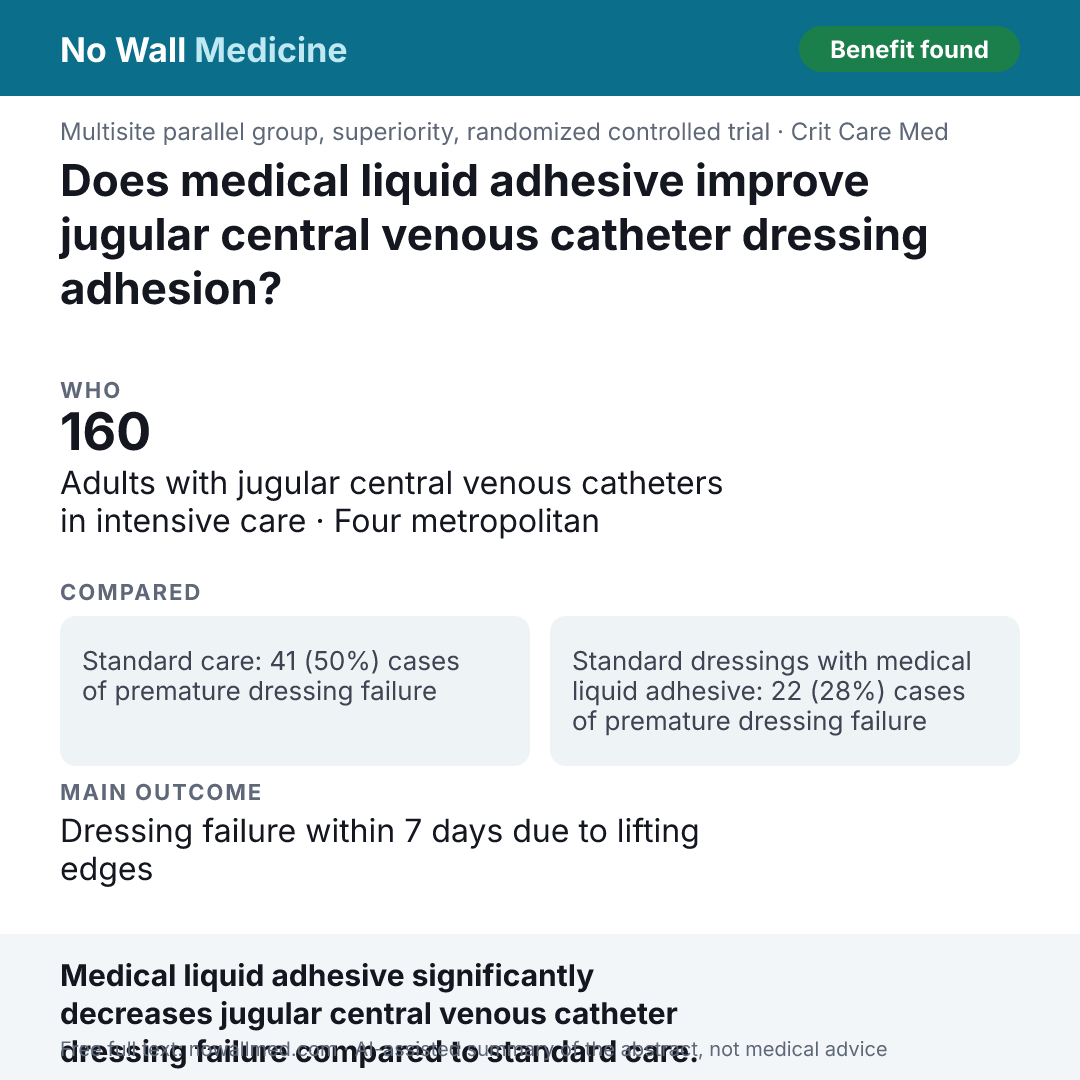
Clinical question: Does medical liquid adhesive improve jugular central venous catheter dressing adhesion?
Why it matters: Jugular central venous catheters are highly vulnerable to pullout forces, and poor securement to the skin contributes to catheter failure.
Key points
- Researchers conducted a randomized controlled trial with 160 patients in four Australian intensive care units to compare standard dressings with dressings using medical liquid adhesive.
- The use of liquid adhesive was associated with 28% dressing failure compared to 50% in the control group (odds ratio, 0.39; 95% CI, 0.20-0.76; p = 0.005).
- The intervention group had fewer dressing changes (incidence rate ratio, 0.74; 95% CI, 0.55-0.99), though time to failure and all-cause catheter failure did not differ between groups.
Headline and key points written with AI from the paper’s abstract, with every number checked against it. Read the paper before relying on them.
Was this summary helpful?
Subject terms
Headline, design, result, key points, caveat and citation as plain text.
Cite this article
Marsh N, O'Brien C, Larsen EN, et al. Securing Jugular Central Venous Catheters With Dressings Fixed to a Liquid Adhesive to Prevent Dressing Failure in Intensive Care Patients (the STICKY Trial): A Randomized Controlled Trial. Crit Care Med. 2025;53(2):e282-e293. doi:10.1097/CCM.0000000000006533
Spotted a mistake? Suggest a correction