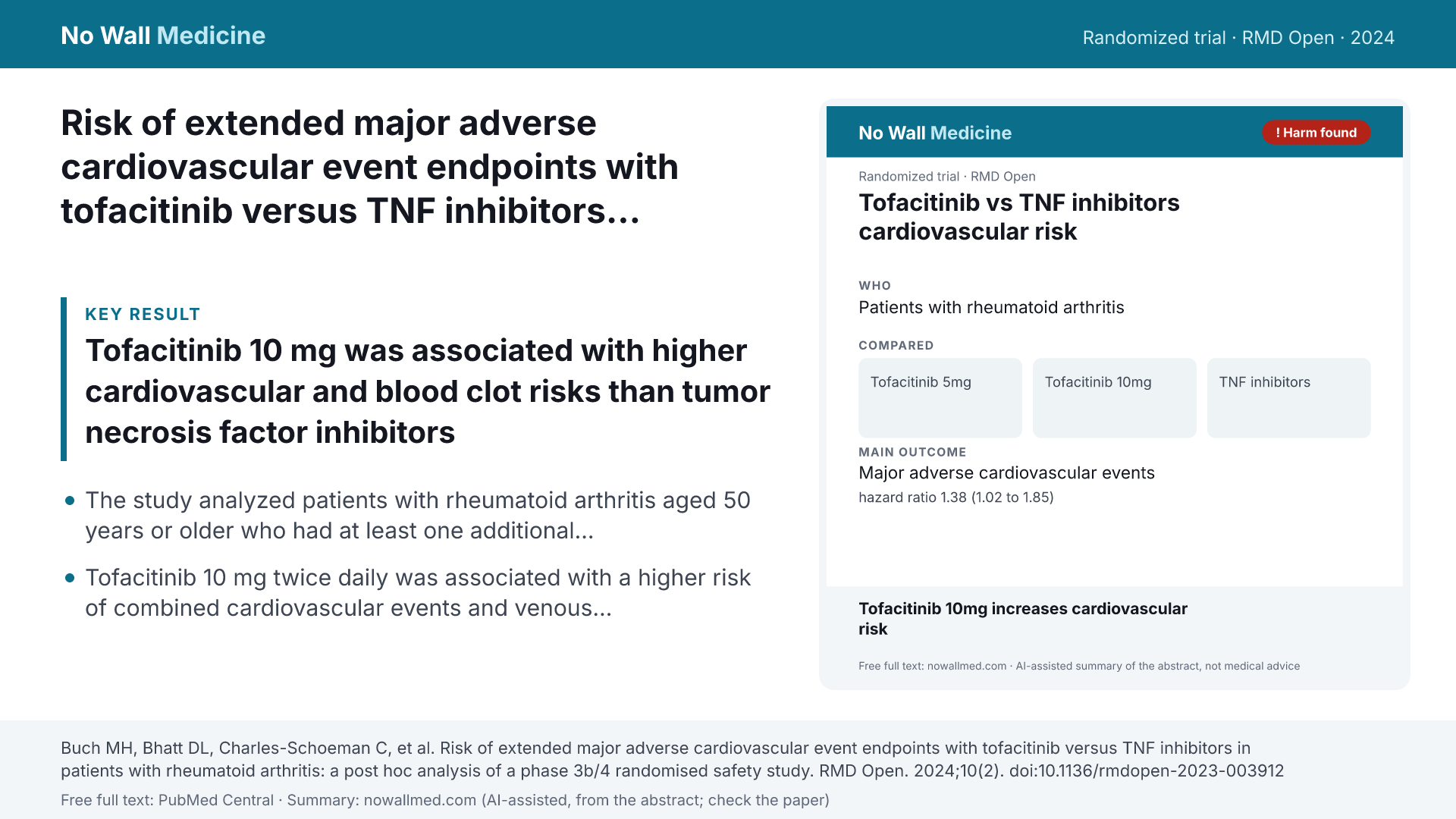
Tofacitinib 10 mg was associated with higher cardiovascular and blood clot risks than tumor necrosis factor inhibitors
Risk of extended major adverse cardiovascular event endpoints with tofacitinib versus TNF inhibitors in patients with rheumatoid arthritis: a post hoc analysis of a phase 3b/4 randomised safety study
Randomized trialHarm found
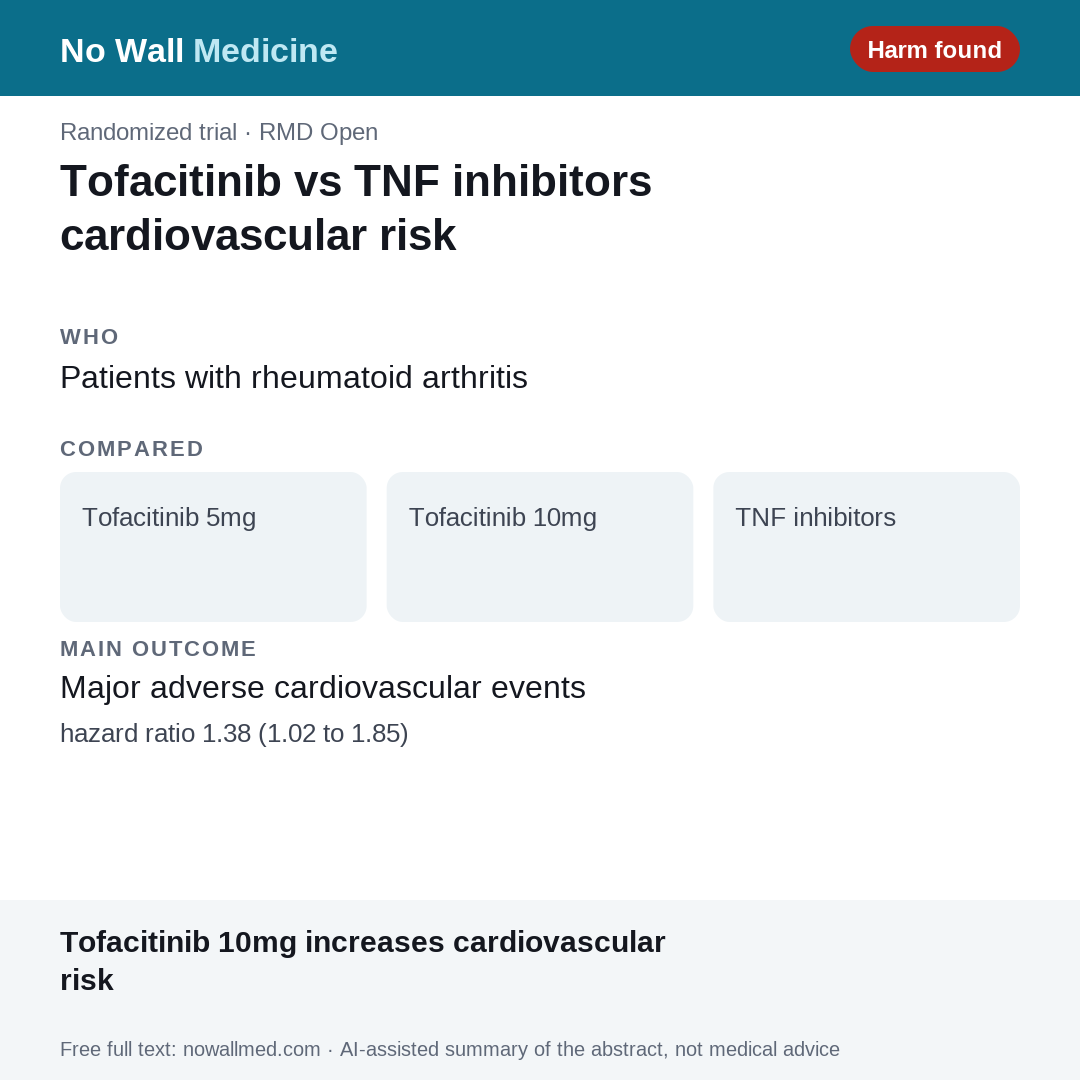
Tofacitinib vs TNF inhibitors cardiovascular risk
Who
Patients with rheumatoid arthritis
Compared
Tofacitinib 5mg
Tofacitinib 10mg
TNF inhibitors
Main outcome
Major adverse cardiovascular events
Result: hazard ratio 1.38 (1.02 to 1.85)
Bottom line: Tofacitinib 10mg increases cardiovascular risk
RMD Open · 2024-04-12Download image
Why it matters: It was unknown if tofacitinib carried a higher risk of extended cardiovascular and blood clot events compared to tumor necrosis factor inhibitors in patients with rheumatoid arthritis.
Key points
- The study analyzed patients with rheumatoid arthritis aged 50 years or older who had at least one additional cardiovascular risk factor.
- Tofacitinib 10 mg twice daily was associated with a higher risk of combined cardiovascular events and venous thromboembolism compared to tumor necrosis factor inhibitors (HR 1.38 (1.02 to 1.85)).
- The risk of non-fatal myocardial infarction was higher with tofacitinib, but other individual cardiovascular event risks were not suggested to be different.
Headline and key points written with AI from the paper’s abstract, with every number checked against it. Read the paper before relying on them.
Was this summary helpful?
Abstract
Objectives
Compare the risk of extended major adverse cardiovascular (CV) event (MACE) composite outcomes and component events in patients with rheumatoid arthritis (RA) treated with tofacitinib versus tumour necrosis factor inhibitors (TNFi) in Oral Rheumatoid Arthritis Trial (ORAL) Surveillance. Methods
Patients with RA aged ≥50 years and with ≥1 additional CV risk factor received tofacitinib 5 mg or 10 mg two times per day or TNFi. MACE (non-fatal myocardial infarction (MI), non-fatal stroke or CV death (MACE-3)) was extended by sequential addition of CV events (hospitalisation for unstable angina (MACE-4), coronary revascularisation (MACE-5), transient ischaemic attack (MACE-6), peripheral vascular disease (MACE-7)), heart failure (HF) hospitalisation (MACE-8) and venous thromboembolism (VTE; (MACE-8 plus VTE)). HRs (tofacitinib vs TNFi) were evaluated for MACE and individual components. Results
HRs for MACE-4 to MACE-8 with combined and individual tofacitinib doses versus TNFi were similar. Risk of MACE-8 plus VTE appeared similar with tofacitinib 5 mg two times per day versus TNFi (HR 1.12 (0.82 to 1.52)), but higher with tofacitinib 10 mg two times per day versus TNFi (HR 1.38 (1.02 to 1.85)). Risk of MI was higher with tofacitinib versus TNFi, but difference in risk of other individual CV events was not suggested. Across extended MACE definitions, risk appeared higher with tofacitinib versus TNFi in those with atherosclerotic CV disease or age ≥65 years. Conclusion
In ORAL Surveillance, risk of composite CV endpoints combining all ischaemic CV events and HF did not appear different with tofacitinib versus TNFi. The totality of CV risk was higher with tofacitinib 10 mg two times per day versus TNFi, driven by an increase in VTE. Trial registration number
NCT02092467.
Abstract reproduced under the article’s CC BY licence.
Heart failureMyocardial infarction and acute coronary syndromeVenous thromboembolism and pulmonary embolismRheumatoid arthritis
Subject terms
Cite this article
Buch MH, Bhatt DL, Charles-Schoeman C, et al. Risk of extended major adverse cardiovascular event endpoints with tofacitinib versus TNF inhibitors in patients with rheumatoid arthritis: a post hoc analysis of a phase 3b/4 randomised safety study. RMD Open. 2024. doi:10.1136/rmdopen-2023-003912
Spotted a mistake? Suggest a correction