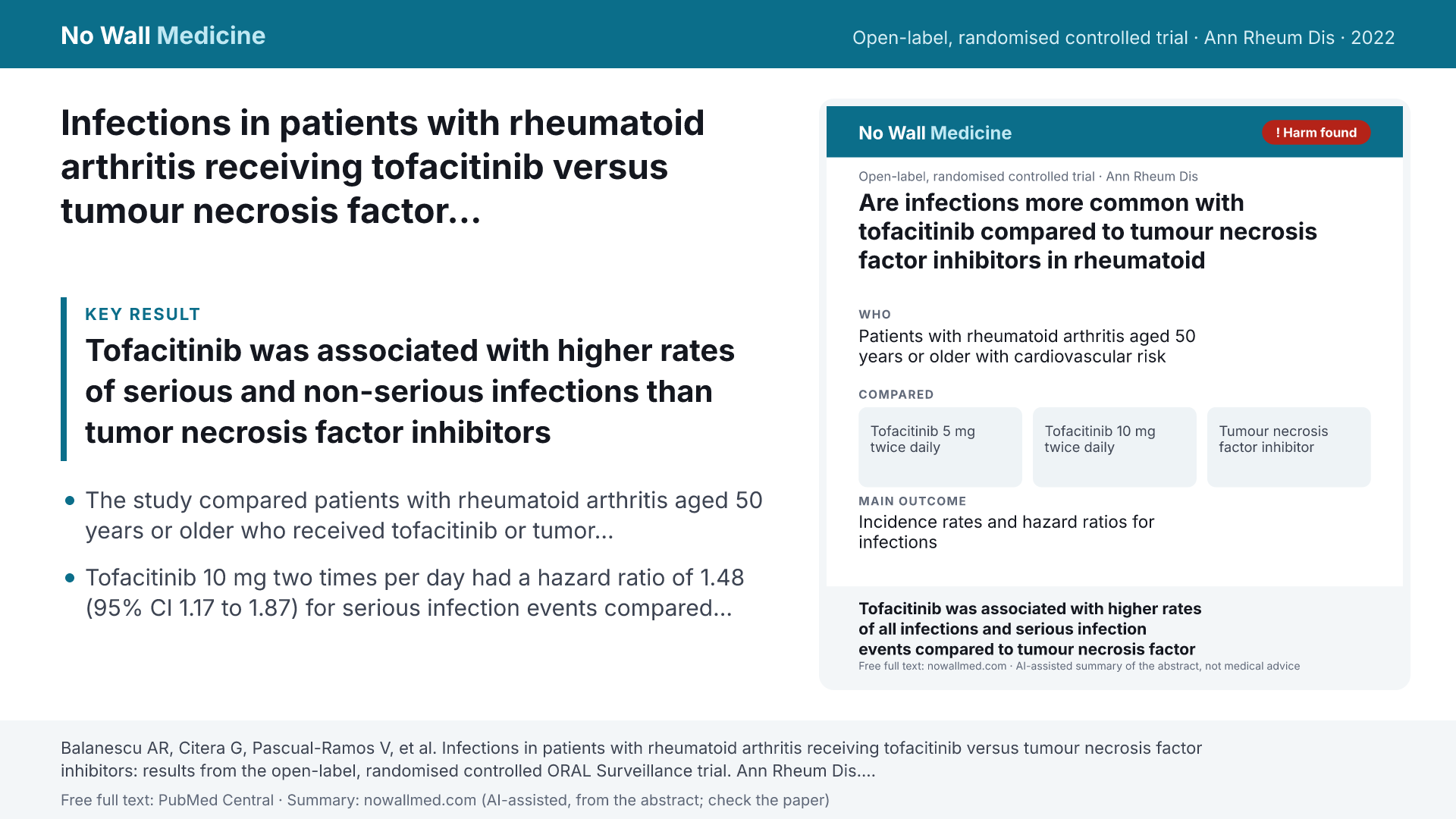
Tofacitinib was associated with higher rates of serious and non-serious infections than tumor necrosis factor inhibitors
Infections in patients with rheumatoid arthritis receiving tofacitinib versus tumour necrosis factor inhibitors: results from the open-label, randomised controlled ORAL Surveillance trial
Open-label, randomised controlled trialHarm found
Are infections more common with tofacitinib compared to tumour necrosis factor inhibitors in rheumatoid arthritis?
Who
Patients with rheumatoid arthritis aged 50 years or older with cardiovascular risk factors
Compared
Tofacitinib 5 mg twice daily
Tofacitinib 10 mg twice daily
Tumour necrosis factor inhibitor
Main outcome
Incidence rates and hazard ratios for infections
Result: hazard ratio 1.17 (95% CI 0.92 to 1.50) for 5 mg and 1.48 (95% CI 1.17 to 1.87) for 10 mg
Bottom line: Tofacitinib was associated with higher rates of all infections and serious infection events compared to tumour necrosis factor inhibitors.
Ann Rheum Dis · 2022-08-03Download image
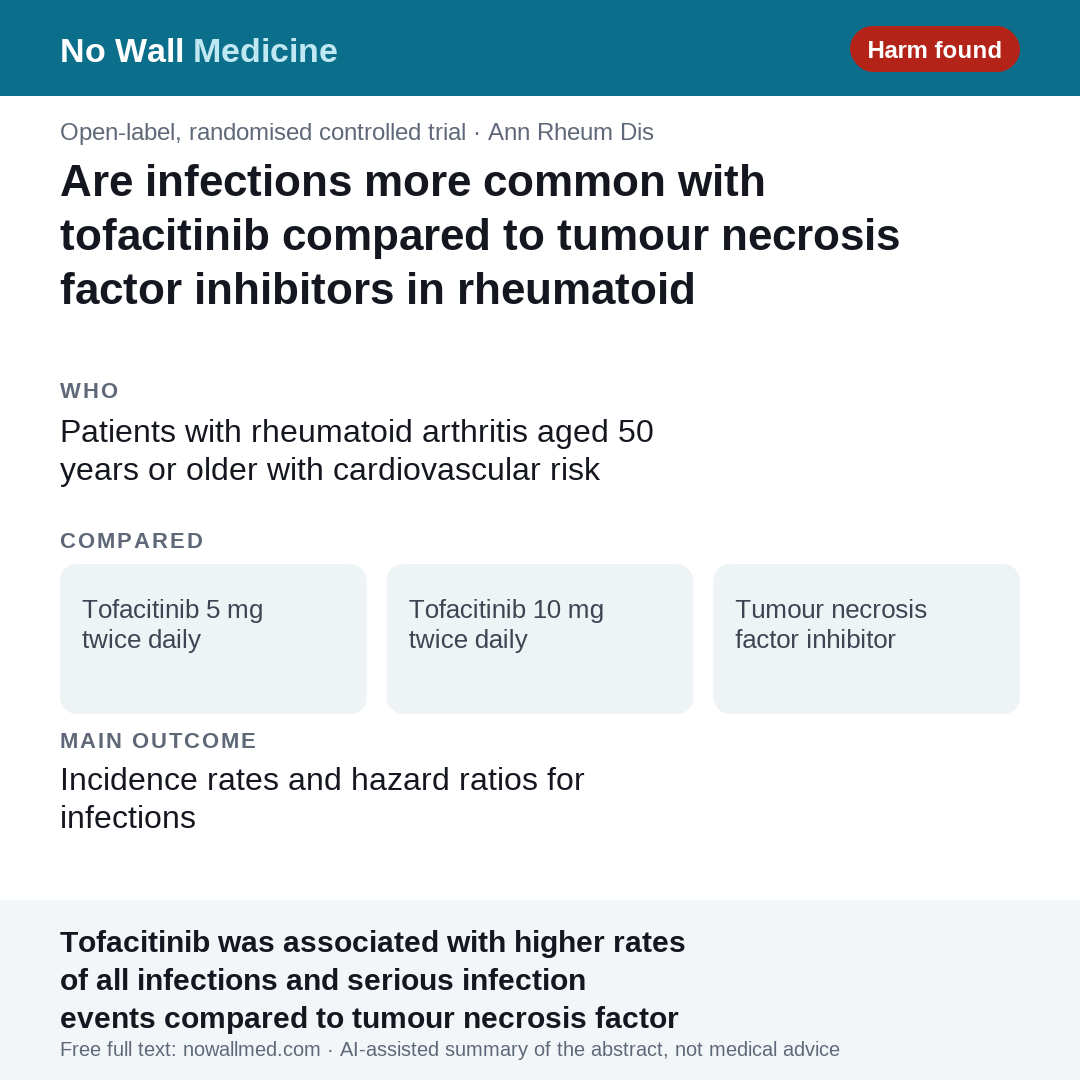
Clinical question: Are infections more common with tofacitinib compared to tumour necrosis factor inhibitors in rheumatoid arthritis?
Why it matters: The specific risks of infections associated with tofacitinib compared to tumor necrosis factor inhibitors in older patients with cardiovascular risk factors were not fully characterized.
Key points
- The study compared patients with rheumatoid arthritis aged 50 years or older who received tofacitinib or tumor necrosis factor inhibitors, which are biologic drugs used to treat inflammation.
- Tofacitinib 10 mg two times per day had a hazard ratio of 1.48 (95% CI 1.17 to 1.87) for serious infection events compared to tumor necrosis factor inhibitors.
- Increased infection rates for both tofacitinib doses were more pronounced in patients aged 65 years or older compared to those aged 50 to <65 years.
Headline and key points written with AI from the paper’s abstract, with every number checked against it. Read the paper before relying on them.
Was this summary helpful?
Abstract
Objectives
To characterise infections in patients with rheumatoid arthritis (RA) in ORAL Surveillance. Methods
In this open-label, randomised controlled trial, patients with RA aged≥50 years with ≥1 additional cardiovascular risk factor received tofacitinib 5 or 10 mg two times per day or a tumour necrosis factor inhibitor (TNFi). Incidence rates (IRs; patients with first events/100 patient-years) and hazard ratios (HRs) were calculated for infections, overall and by age (50-<65 years; ≥65 years). Probabilities of infections were obtained (Kaplan-Meier estimates). Cox modelling identified infection risk factors. Results
IRs/HRs for all infections, serious infection events (SIEs) and non-serious infections (NSIs) were higher with tofacitinib (10>5 mg two times per day) versus TNFi. For SIEs, HR (95% CI) for tofacitinib 5 and 10 mg two times per day versus TNFi, respectively, were 1.17 (0.92 to 1.50) and 1.48 (1.17 to 1.87). Increased IRs/HRs for all infections and SIEs with tofacitinib 10 mg two times per day versus TNFi were more pronounced in patients aged≥65 vs 50-<65 years. SIE probability increased from month 18 and before month 6 with tofacitinib 5 and 10 mg two times per day versus TNFi, respectively. NSI probability increased before month 6 with both tofacitinib doses versus TNFi. Across treatments, the most predictive risk factors for SIEs were increasing age, baseline opioid use, history of chronic lung disease and time-dependent oral corticosteroid use, and, for NSIs, female sex, history of chronic lung disease/infections, past smoking and time-dependent Disease Activity Score in 28 joints, C-reactive protein. Conclusions
Infections were higher with tofacitinib versus TNFi. Findings may inform future treatment decisions. Trial registration number
NCT02092467.
Abstract reproduced under the article’s CC BY NC licence.
Subject terms
Cite this article
Balanescu AR, Citera G, Pascual-Ramos V, et al. Infections in patients with rheumatoid arthritis receiving tofacitinib versus tumour necrosis factor inhibitors: results from the open-label, randomised controlled ORAL Surveillance trial. Ann Rheum Dis. 2022. doi:10.1136/ard-2022-222405
Spotted a mistake? Suggest a correction