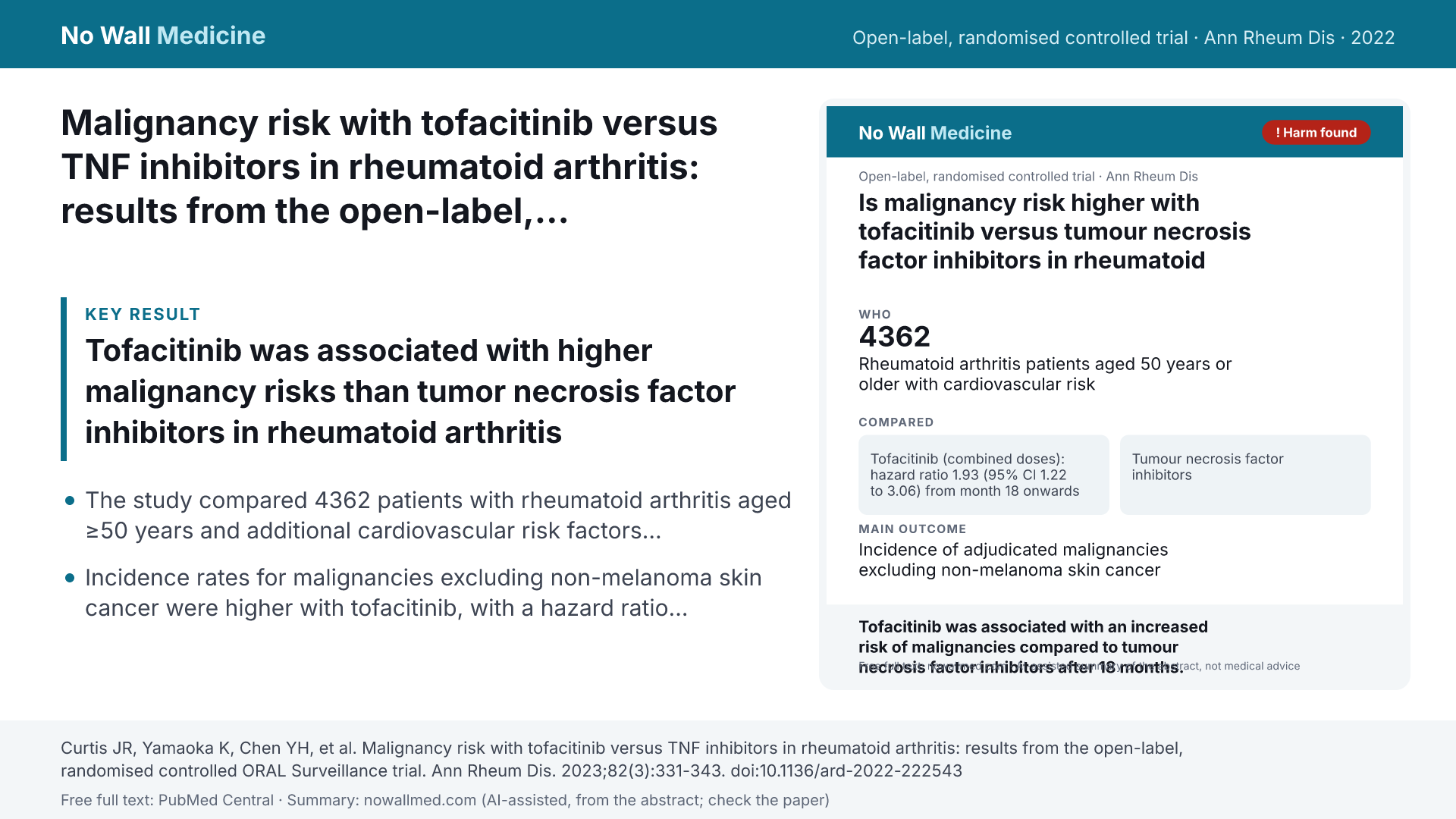
Tofacitinib was associated with higher malignancy risks than tumor necrosis factor inhibitors in rheumatoid arthritis
Malignancy risk with tofacitinib versus TNF inhibitors in rheumatoid arthritis: results from the open-label, randomised controlled ORAL Surveillance trial
Open-label, randomised controlled trialHarm found
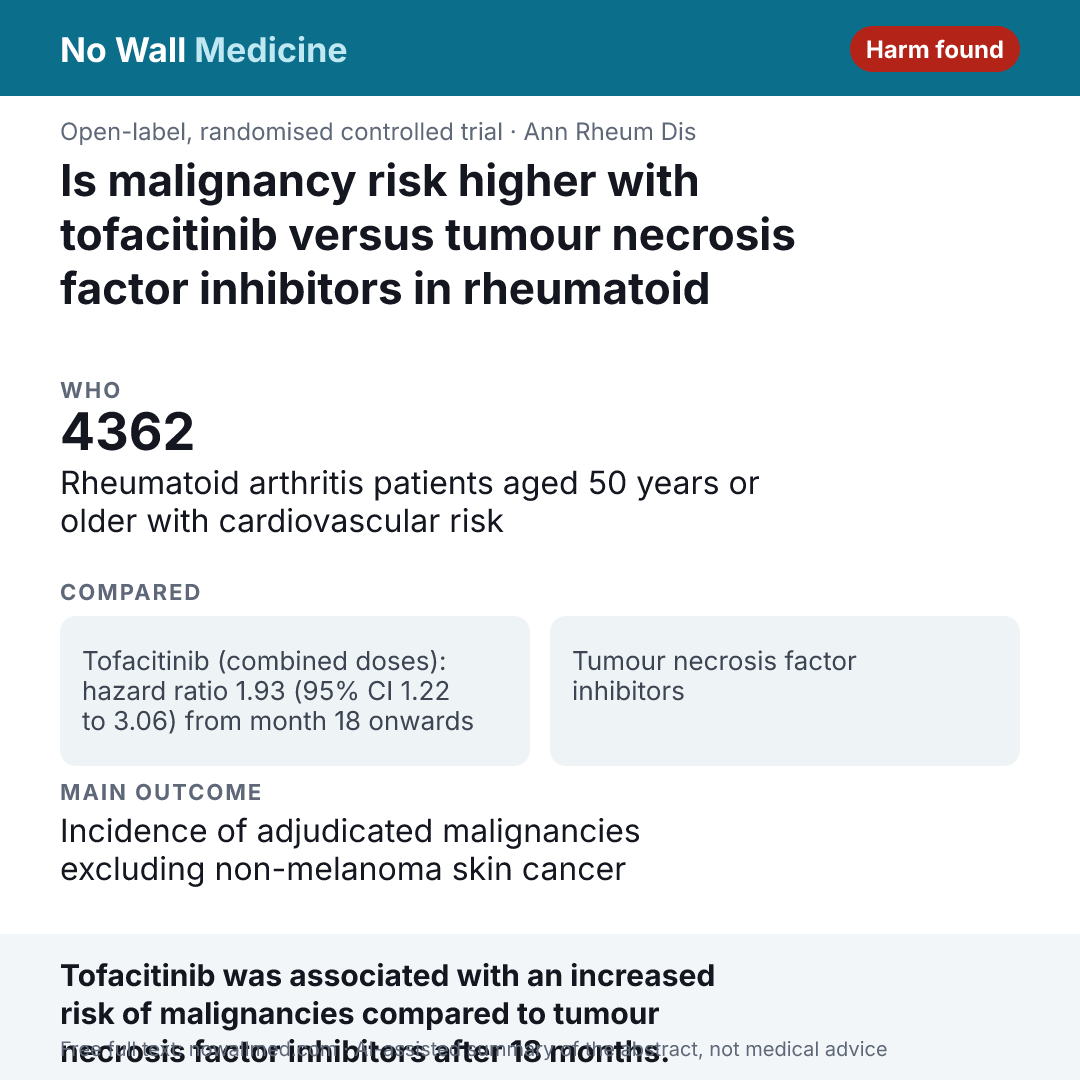
Is malignancy risk higher with tofacitinib versus tumour necrosis factor inhibitors in rheumatoid arthritis?
Who
4362
Rheumatoid arthritis patients aged 50 years or older with cardiovascular risk
Compared
Tofacitinib (combined doses): hazard ratio 1.93 (95% CI 1.22 to 3.06) from month 18 onwards
Tumour necrosis factor inhibitors
Main outcome
Incidence of adjudicated malignancies excluding non-melanoma skin cancer
Result: hazard ratio 1.93 (95% CI 1.22 to 3.06) from month 18 onwards
Bottom line: Tofacitinib was associated with an increased risk of malignancies compared to tumour necrosis factor inhibitors after 18 months.
Ann Rheum Dis · 2022-12-05 · Save PNG
Same trial (NCT02092467, NCT01262118)
Papers we list that report this registered trial, oldest first. Read a secondary analysis alongside the main results.
- Main results Harm found
Tofacitinib was associated with higher rates of serious and non-serious infections than tumor necrosis factor inhibitors Ann Rheum Dis 2022-08 - Secondary analysis Harm found
Tofacitinib was associated with higher cardiovascular event risks than tumor necrosis factor inhibitors in rheumatoid arthritis patients Ann Rheum Dis 2022-09 - Secondary analysis No clear difference
No biomarkers identified that explain increased venous thromboembolism risk with tofacitinib versus tumor necrosis factor inhibitors RMD Open 2022-11 - Related analysis Harm found
This paper Ann Rheum Dis 2022-12 - Secondary analysis Mixed results
Tofacitinib risk varies between older smokers and younger non-smokers with rheumatoid arthritis Ann Rheum Dis 2023-03 - Secondary analysis Harm found
Tofacitinib 10 mg was associated with higher cardiovascular and blood clot risks than tumor necrosis factor inhibitors RMD Open 2024-04
Clinical question: Is malignancy risk higher with tofacitinib versus tumour necrosis factor inhibitors in rheumatoid arthritis?
Key points
- The study compared 4362 patients with rheumatoid arthritis aged ≥50 years and additional cardiovascular risk factors receiving tofacitinib or tumor necrosis factor inhibitors.
- Incidence rates for malignancies excluding non-melanoma skin cancer were higher with tofacitinib, with a hazard ratio of 1.93 (95% CI 1.22 to 3.06) from month 18 onwards.
- A history of atherosclerotic cardiovascular disease or increasing cardiovascular risk scores was associated with higher malignancy incidence rates across all treatment groups.
Headline and key points written with AI from the paper’s abstract, with every number checked against it. Read the paper before relying on them.
Was this summary helpful?
Abstract
Objectives
To evaluate malignancies and their associations with baseline risk factors and cardiovascular risk scores with tofacitinib versus tumour necrosis factor inhibitors (TNFi) in patients with rheumatoid arthritis (RA). Methods
In an open-label, randomised controlled trial (ORAL Surveillance; NCT02092467), 4362 patients with RA aged ≥50 years with ≥1 additional cardiovascular risk factor received tofacitinib 5 (N=1455) or 10 mg two times per day (N=1456) or TNFi (N=1451). Incidence rates (IRs; patients with first events/100 patient-years) and HRs were calculated for adjudicated malignancies excluding non-melanoma skin cancer (NMSC), NMSC and subtypes. Post hoc analyses for malignancies excluding NMSC, lung cancer and NMSC included risk factors identified via simple/multivariable Cox models and IRs/HRs categorised by baseline risk factors, history of atherosclerotic cardiovascular disease (HxASCVD) and cardiovascular risk scores. Results
IRs for malignancies excluding NMSC and NMSC were higher with tofacitinib (combined and individual doses) versus TNFi. Risk of lung cancer (most common subtype with tofacitinib) was higher with tofacitinib 10 mg two times per day versus TNFi. In the overall study population, the risk of malignancies excluding NMSC was similar between both tofacitinib doses and TNFi until month 18 and diverged from month 18 onwards (HR (95% CIs) for combined tofacitinib doses: 0.93 (0.53 to 1.62) from baseline to month 18 vs 1.93 (1.22 to 3.06) from month 18 onwards, interaction p=0.0469). Cox analyses identified baseline risk factors across treatment groups for malignancies excluding NMSC, lung cancer and NMSC; interaction analyses generally did not show statistical evidence of interaction between treatment groups and risk factors. HxASCVD or increasing cardiovascular risk scores were associated with higher malignancy IRs across treatments. Conclusions
Risk of malignancies was increased with tofacitinib versus TNFi, and incidence was highest in patients with HxASCVD or increasing cardiovascular risk. This may be due to shared risk factors for cardiovascular risk and cancer. Trial registration numbers
NCT02092467, NCT01262118, NCT01484561, NCT00147498, NCT00413660, NCT00550446, NCT00603512, NCT00687193, NCT01164579, NCT00976599, NCT01059864, NCT01359150, NCT02147587, NCT00960440, NCT00847613, NCT00814307, NCT00856544, NCT00853385, NCT01039688, NCT02281552, NCT02187055, NCT02831855, NCT00413699, NCT00661661.
Abstract reproduced under the article’s CC BY NC licence.
Subject terms
Headline, design, result, key points, caveat and citation as plain text.
Cite this article
Curtis JR, Yamaoka K, Chen YH, et al. Malignancy risk with tofacitinib versus TNF inhibitors in rheumatoid arthritis: results from the open-label, randomised controlled ORAL Surveillance trial. Ann Rheum Dis. 2023;82(3):331-343. doi:10.1136/ard-2022-222543
Spotted a mistake? Suggest a correction