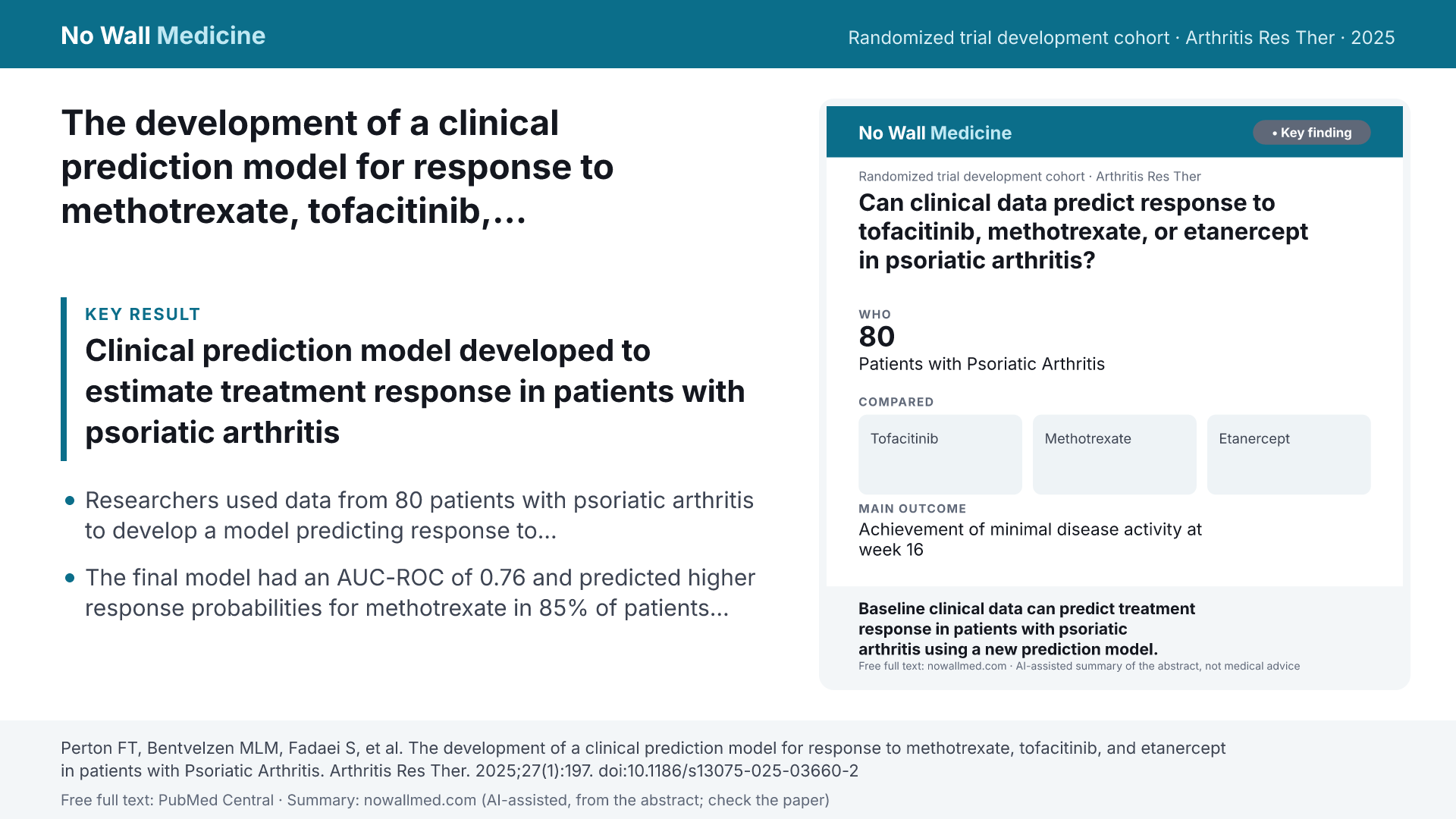
Clinical prediction model developed to estimate treatment response in patients with psoriatic arthritis
The development of a clinical prediction model for response to methotrexate, tofacitinib, and etanercept in patients with Psoriatic Arthritis
Randomized trial development cohortBenefit found
Can clinical data predict response to tofacitinib, methotrexate, or etanercept in psoriatic arthritis?
Who
80
Patients with Psoriatic Arthritis
Compared
Tofacitinib
Methotrexate
Etanercept
Main outcome
Achievement of minimal disease activity at week 16
Result: AUC-ROC of 0.76
Bottom line: Baseline clinical data can predict treatment response in patients with psoriatic arthritis using a new prediction model.
Arthritis Res Ther · 2025-10-27Download image
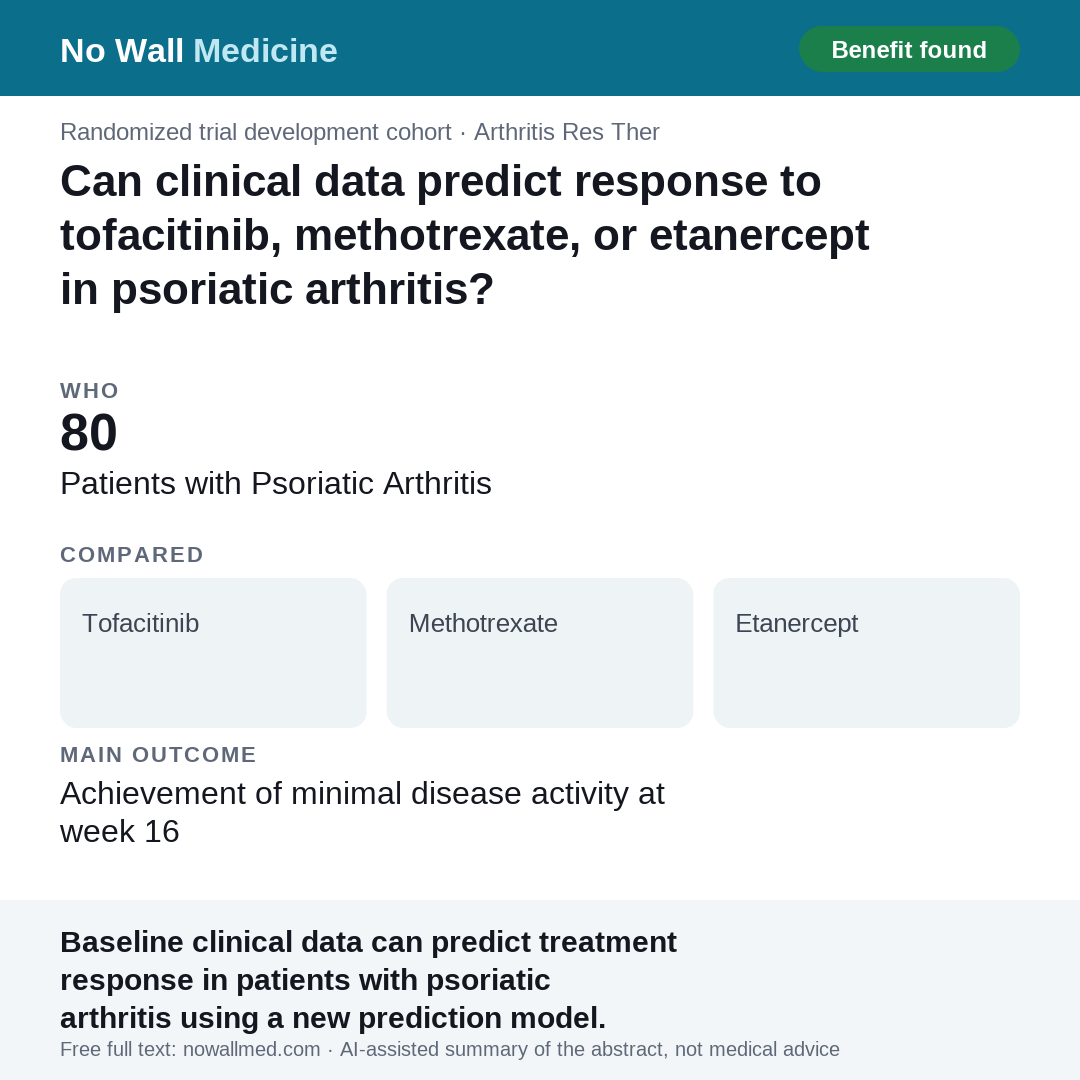
Clinical question: Can clinical data predict response to tofacitinib, methotrexate, or etanercept in psoriatic arthritis?
Why it matters: Clinicians need tools to predict how individual patients with psoriatic arthritis will respond to different disease-modifying antirheumatic drugs.
Key points
- Researchers used data from 80 patients with psoriatic arthritis to develop a model predicting response to tofacitinib, methotrexate, or etanercept.
- The final model had an AUC-ROC of 0.76 and predicted higher response probabilities for methotrexate in 85% of patients new to disease-modifying antirheumatic drugs.
- In patients who failed conventional synthetic disease-modifying antirheumatic drugs, the model predicted a higher probability of response to etanercept than to tofacitinib.
Headline and key points written with AI from the paper’s abstract, with every number checked against it. Read the paper before relying on them.
Was this summary helpful?
Subject terms
Cite this article
Perton FT, Bentvelzen MLM, Fadaei S, Pouw JN, Spierings J, Vonkeman HE. The development of a clinical prediction model for response to methotrexate, tofacitinib, and etanercept in patients with Psoriatic Arthritis. Arthritis Res Ther. 2025. doi:10.1186/s13075-025-03660-2
Spotted a mistake? Suggest a correction
Top studies every Monday
The week’s key trials and guidelines in your specialties, plus any topics you follow. By email, free.
Get the weekly digest