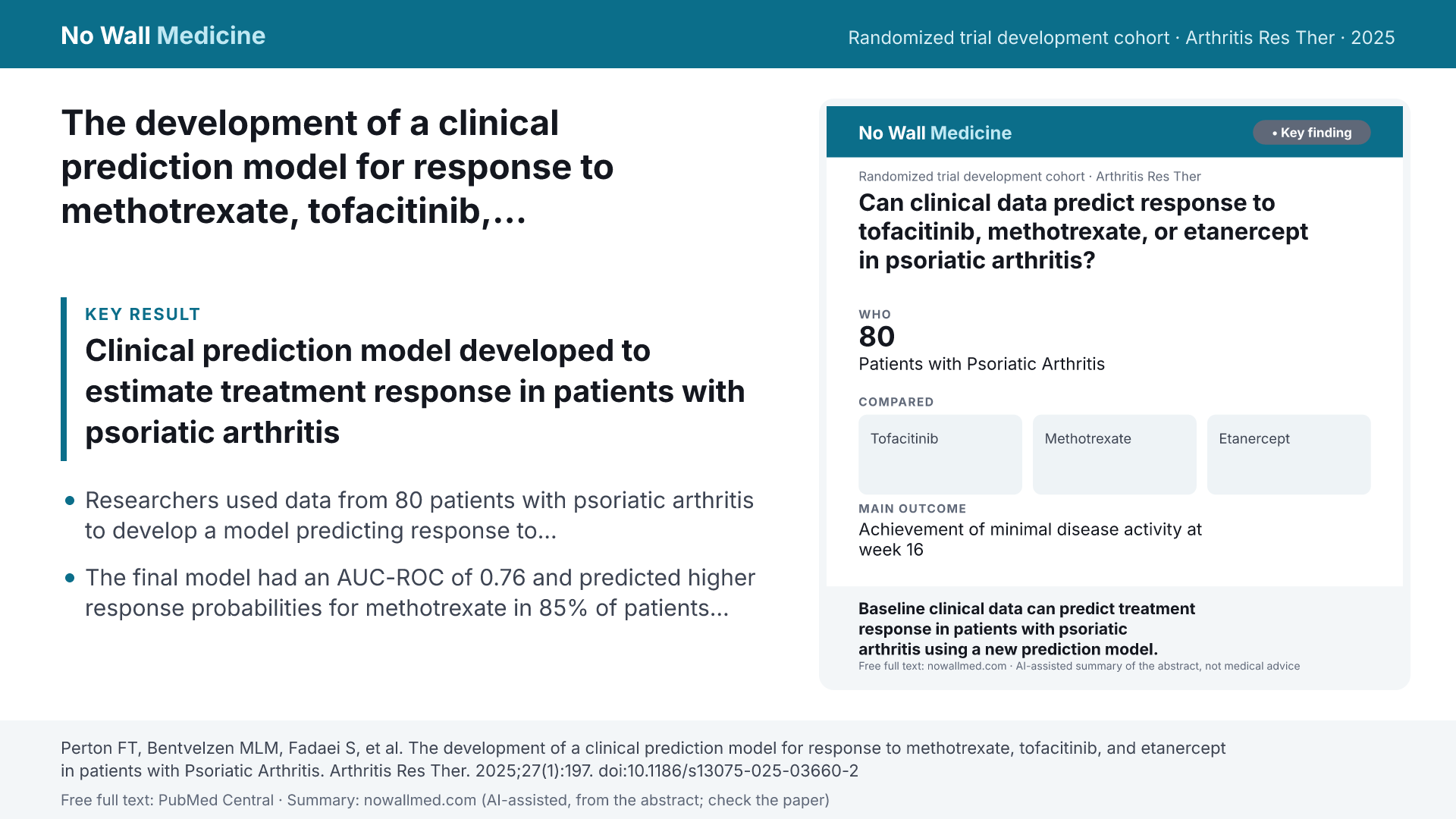
The development of a clinical prediction model for response to methotrexate, tofacitinib, and etanercept in patients with Psoriatic Arthritis
Key result: Clinical prediction model developed to estimate treatment response in patients with psoriatic arthritis

Key points
- Researchers used data from 80 patients with psoriatic arthritis to develop a model predicting response to tofacitinib, methotrexate, or etanercept.
- The final model had an AUC-ROC of 0.76 and predicted higher response probabilities for methotrexate in 85% of patients new to disease-modifying antirheumatic drugs.
- In patients who failed conventional synthetic disease-modifying antirheumatic drugs, the model predicted a higher probability of response to etanercept than to tofacitinib.
Why it matters: Clinicians need tools to predict how individual patients with psoriatic arthritis will respond to different disease-modifying antirheumatic drugs.
Discussion prompts
- Would these patients look like yours? Who was left out?
- Is the main outcome one that matters to patients?
- Is the difference large enough to change what you do?
Cite: Perton FT, Bentvelzen MLM, Fadaei S, et al. The development of a clinical prediction model for response to methotrexate, tofacitinib, and etanercept in patients with Psoriatic Arthritis. Arthritis Res Ther. 2025;27(1):197. doi:10.1186/s13075-025-03660-2
Free full text: PubMed Central · Summary and visual abstract: nowallmed.com/a/the-development-of-a-clinical-prediction-model-for-response-to-1h7dzml/ (AI-assisted from the abstract; check the paper before relying on it).