Visual abstractsVisuals
Meta-analysisJHEP Reports · Aug 22, 2026

Current models for predicting hepatic encephalopathy post TIPS procedure are unreliable

Risk prediction models for hepatic encephalopathy post-transjugular intrahepatic portosystemic shunt: A systematic review and critical appraisal

de Reus S, Wang W, Bramer WM, Garcia-Pagan JC, Baiges A, Hansen BE, et al
Gastroenterology & HepatologyPediatric
Systematic review and critical appraisalUnclear result
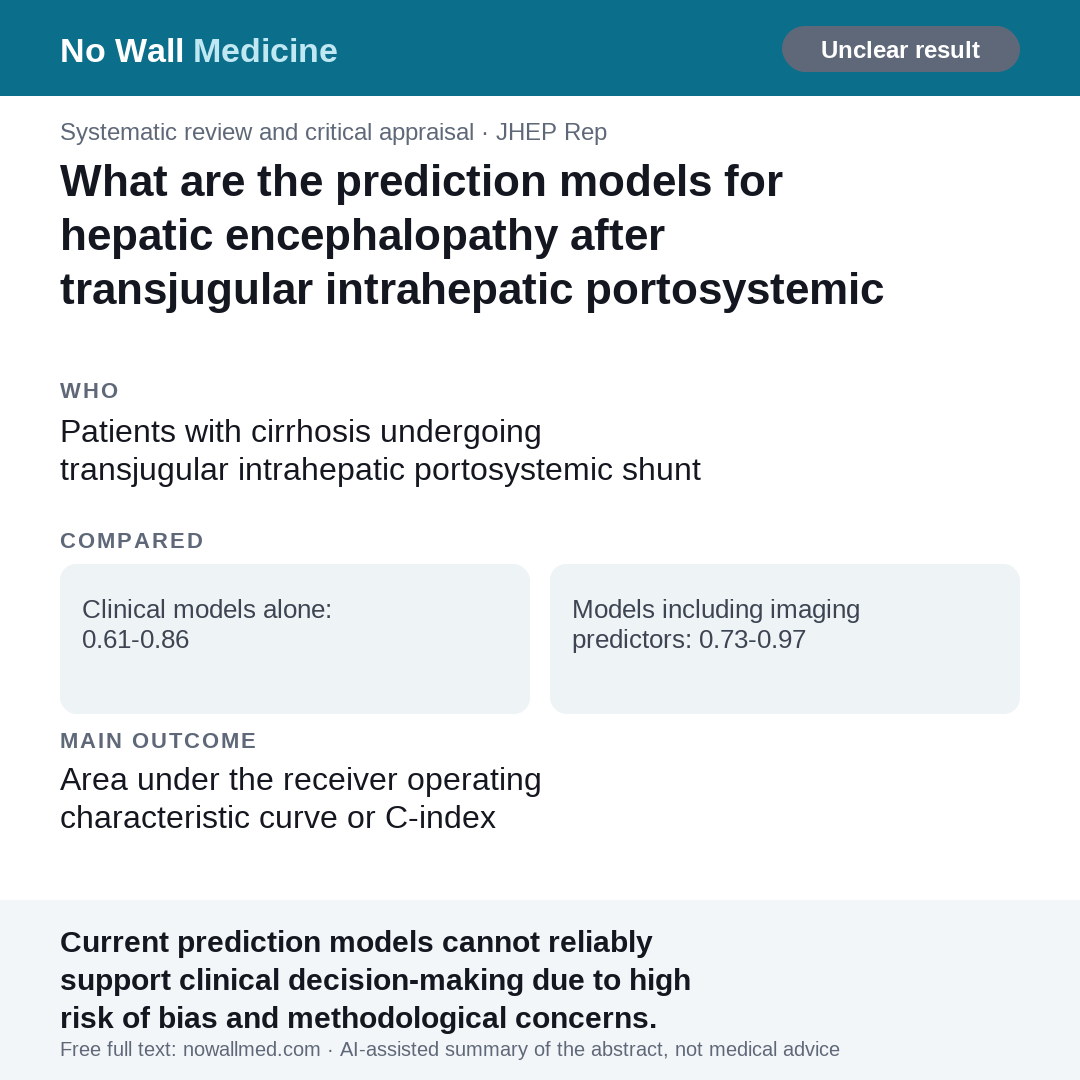
What are the prediction models for hepatic encephalopathy after transjugular intrahepatic portosystemic shunt?
Who
Patients with cirrhosis undergoing transjugular intrahepatic portosystemic shunt · 25 cohorts from Asia (93%)
Compared
Clinical models alone: 0.61-0.86
Models including imaging predictors: 0.73-0.97
Main outcome
Area under the receiver operating characteristic curve or C-index
Bottom line: Current prediction models cannot reliably support clinical decision-making due to high risk of bias and methodological concerns.
Limitation: High risk of bias, inappropriate patient exclusion, low events-per-variable ratio, and inadequate validation.
JHEP Rep · 2026-08-22Download image

Clinical question: What are the prediction models for hepatic encephalopathy after transjugular intrahepatic portosystemic shunt?

Why it matters: Doctors need accurate prediction of hepatic encephalopathy risk after TIPS procedure for patient selection

Key points

Limitation the authors note: Models had methodological concerns, including high risk of bias, inappropriate patient exclusion, and inadequate validation

Headline and key points written with AI from the paper’s abstract, with every number checked against it. Read the paper before relying on them.

Read the full paper free at PubMed Central ↗

Topics

Humans; Hepatic Encephalopathy; Portasystemic Shunt, Transjugular Intrahepatic; Hypertension, Portal; Risk Assessment; Risk Factors; Postoperative Complications; Severity of Illness Index; Liver Cirrhosis

DOI: 10.1016/j.jhepr.2026.102006 · PubMed: 42632423

Spotted a mistake? Suggest a correction

More in Gastroenterology & Hepatology

ResearchJHEP Rep · Nov 21, 2026 · Gastroenterology & Hepatology

Low public awareness of liver cancer risk factors found in survey

Low public awareness of hepatocellular carcinoma risk factors

ResearchJHEP Rep · Nov 21, 2026 · Gastroenterology & Hepatology

Pre-emptive TIPS reduces further decompensation after gastric variceal hemorrhage

Pre-emptive TIPS Reduces Further Decompensation Following Gastric Variceal Hemorrhage: A Real-World Multicenter Analysis

ResearchJHEP Rep · Nov 21, 2026 · Gastroenterology & Hepatology

Tenofovir associated with lower hepatocellular carcinoma risk than entecavir

Comparative risk of hepatocellular carcinoma among people with chronic hepatitis B treated with tenofovir or entecavir: A population-based linkage study
Randomized trialVisual abstractGut Microbes · Nov 21, 2026 · Gastroenterology & Hepatology

Antibiotic effects on gut-derived short chain fatty acid pools in healthy volunteers

Meta-analysisVisual abstractHepatol Commun · Nov 20, 2026 · Gastroenterology & Hepatology

Liver stiffness decreased by 2.76 kPa after 56 days of alcohol abstinence

Alcohol abstinence and liver stiffness by vibration-controlled transient elastography: A systematic review and meta-analysis