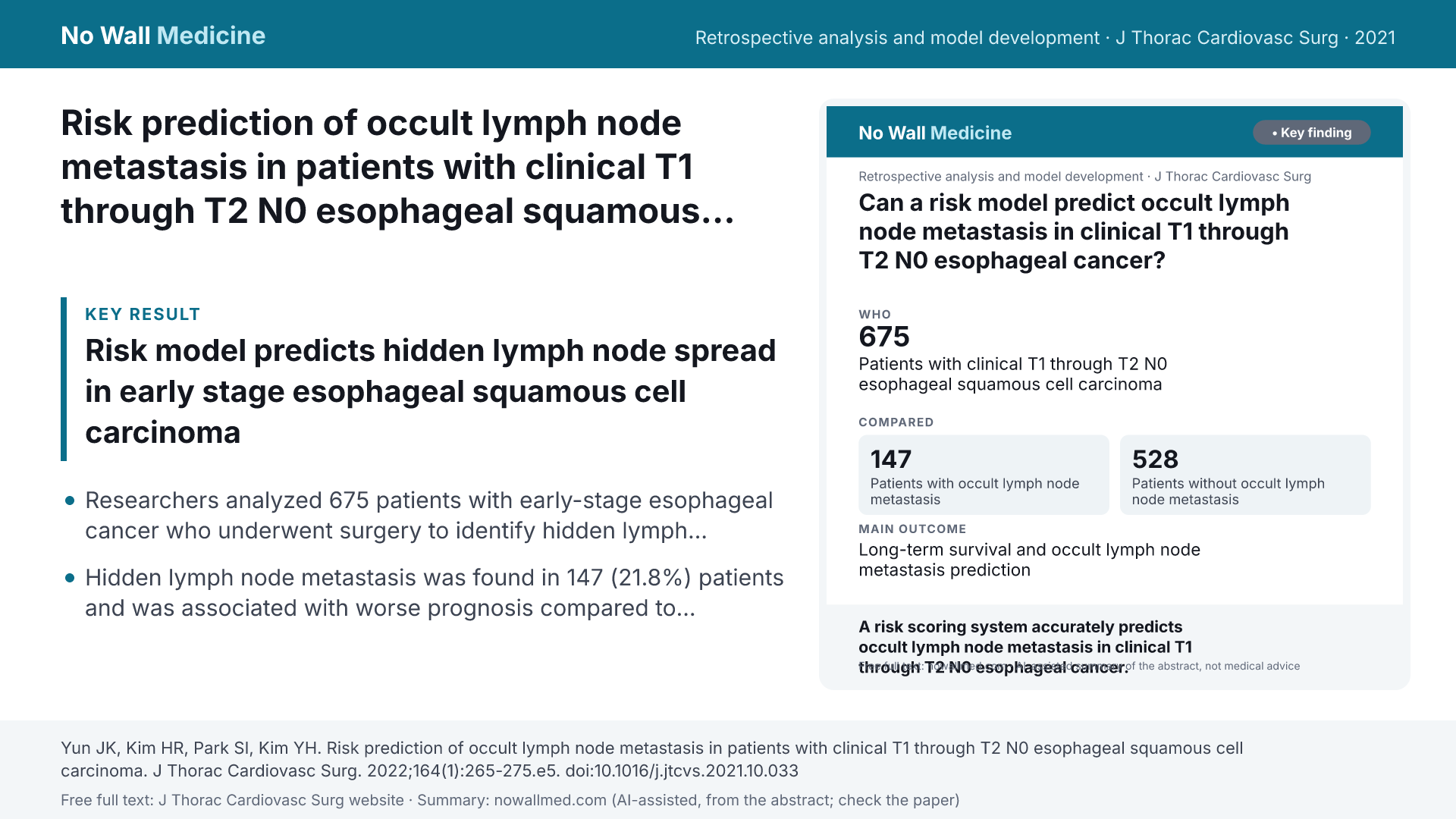
Risk model predicts hidden lymph node spread in early stage esophageal squamous cell carcinoma
Risk prediction of occult lymph node metastasis in patients with clinical T1 through T2 N0 esophageal squamous cell carcinoma
Retrospective analysis and model developmentKey finding
Can a risk model predict occult lymph node metastasis in clinical T1 through T2 N0 esophageal cancer?
Who
675
Patients with clinical T1 through T2 N0 esophageal squamous cell carcinoma
Compared
147Patients with occult lymph node metastasis (21.8%)
528Patients without occult lymph node metastasis (78.2%)
Main outcome
Long-term survival and occult lymph node metastasis prediction
Bottom line: A risk scoring system accurately predicts occult lymph node metastasis in clinical T1 through T2 N0 esophageal cancer.
J Thorac Cardiovasc Surg · 2021-10-28 · Save PNG
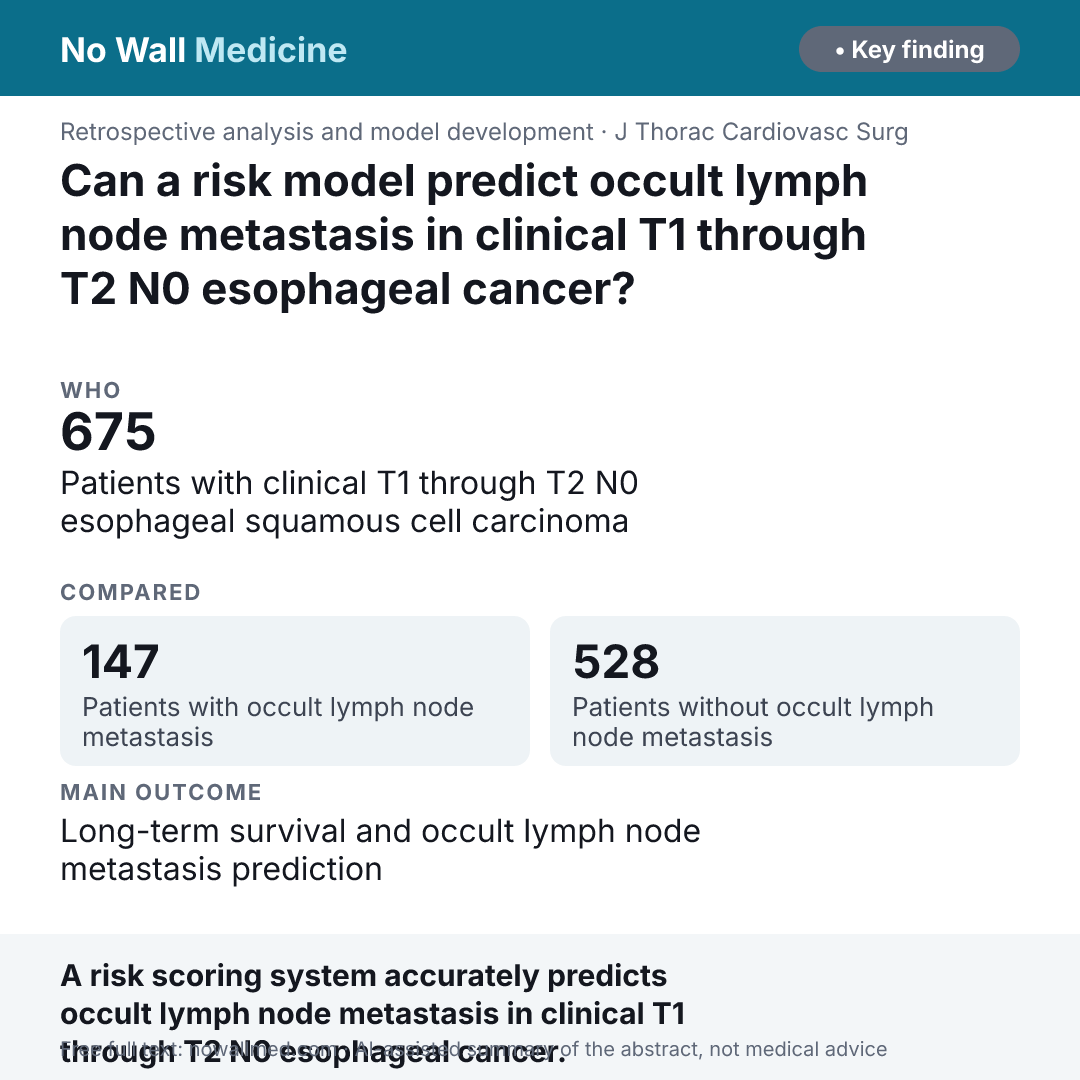
Clinical question: Can a risk model predict occult lymph node metastasis in clinical T1 through T2 N0 esophageal cancer?
Key points
- Researchers analyzed 675 patients with early-stage esophageal cancer who underwent surgery to identify hidden lymph node metastasis, which is cancer spread to lymph nodes not seen on initial scans.
- Hidden lymph node metastasis was found in 147 (21.8%) patients and was associated with worse prognosis compared to those without hidden spread.
- The risk model identified tumor maximum standardized uptake >3.8, histological differentiation grade, tumor length >25 mm, and advanced clinical T stage as independent risk factors.
Headline and key points written with AI from the paper’s abstract, with every number checked against it. Read the paper before relying on them.
Was this summary helpful?
Subject terms
Headline, design, result, key points, caveat and citation as plain text.
Cite this article
Yun JK, Kim HR, Park SI, Kim YH. Risk prediction of occult lymph node metastasis in patients with clinical T1 through T2 N0 esophageal squamous cell carcinoma. J Thorac Cardiovasc Surg. 2022;164(1):265-275.e5. doi:10.1016/j.jtcvs.2021.10.033
Spotted a mistake? Suggest a correction