Risk stratification of patients with diffuse large B-cell lymphoma using plasma NMR-based metabolomics at diagnosis
Retrospective study of randomized patientsBenefit found
Can plasma NMR-based metabolomics risk stratify patients with diffuse large B-cell lymphoma?
Who
154
Patients with diffuse large B-cell lymphoma treated by R-CHOP · REMARC phase 3 trial
Compared
Low-risk (0-1)
Intermediate-risk (2-3)
High-risk (4-5)
Main outcome
Overall survival and progression-free survival
Bottom line: A combination of three circulating metabolites linked to lipid metabolism significantly affects survival in diffuse large B-cell lymphoma.
Blood Adv · 2025-10-07Download image
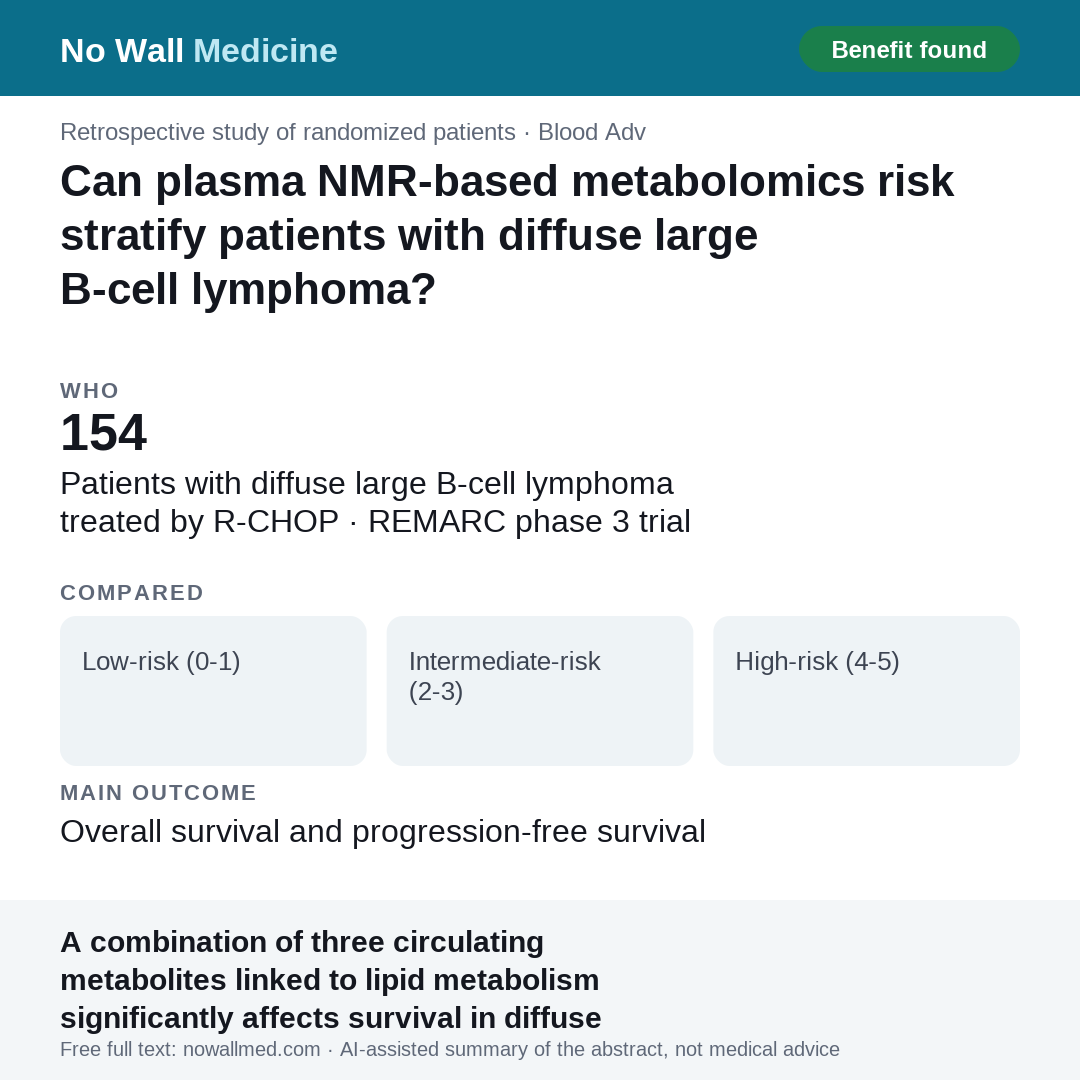
Clinical question: Can plasma NMR-based metabolomics risk stratify patients with diffuse large B-cell lymphoma?
Abstract
Early detection of ultrahigh-risk diffuse large B-cell lymphoma (DLBCL) is an unmet medical need to aid patient stratification for alternative treatment approaches. Metabolomics applied to biofluids of patients with cancer has emerged as a novel omics that could provide important information to better stratify these patients. In this work, the authors performed a retrospective study by nuclear magnetic resonance (NMR)-based metabolomics using plasma samples at diagnosis from 154 randomized patients with DLBCL treated by R-CHOP (rituximab, cyclophosphamide, doxorubicin, vincristine, and prednisone) (from the phase 3 REMARC [Reduced-intensity Maintenance therapy with Rituximab After R-CHOP in elderly patients with DLBCL] trial). Remarkably, a combination of 3 circulating metabolites was linked to lipid metabolism (named the "NMR score") that significantly affected overall survival (OS) (P< .0001) and progression-free survival (PFS) (P = .0003). The optimal cutoff for each metabolite was determined using X-Tile and confirmed by a training validation method. Combining 2-amino-butyrate, 3-hydroxy-butyrate, and LDL-1 lipoprotein yielded 3 risk groups with low- (0-1), intermediate- (2-3), and high-risk (4-5) patients. Germinal center B-cell (GCB)/non-GCB profile along with Bcl2 and Myc expression did not correlate with NMR score survival. In conclusion, the combination of 3 circulating metabolites linked to lipid metabolism is revealed as a feature that captures heterogeneity among patients with DLBCL. This NMR score seemed promising for DLBCL risk stratification, even among responder patients after R-CHOP treatment. This trial was registered at www.ClinicalTrials.gov as #NCT01122472.
Abstract reproduced under the article’s CC BY NC ND licence.
Topics
Cite this article
Montagne A, Bertho G, Papastergiou T, Chartier L, Ricci R, Jardin F. Risk stratification of patients with diffuse large B-cell lymphoma using plasma NMR-based metabolomics at diagnosis. Blood Adv. 2025. doi:10.1182/bloodadvances.2025017248
Spotted a mistake? Suggest a correction
Top studies every Monday
The week’s key trials and guidelines in your specialties, by email. Free.
Get the weekly digest