Risk Stratification Tools to Guide a Personalized Approach for Cardiac Monitoring in Embolic Stroke of Undetermined Source
Systematic reviewBenefit found
How effective are risk stratification scores for predicting atrial fibrillation after embolic stroke?
Who
Patients with embolic stroke of undetermined source
Compared
Decryptoring score: 0.94 [95% CI, 0.88-1.00]
Newly diagnosed atrial fibrillation score: 0.87 [95% CI, 0.79-0.94]
AF-ESUS score: 0.85 [95% CI, 0.80-0.87]
Main outcome
Predictive performance of risk scores for atrial fibrillation
Bottom line: Risk stratification scores can guide a personalized approach for cardiac rhythm monitoring after embolic stroke of undetermined source.
J Am Heart Assoc · 2023-09-08Download image
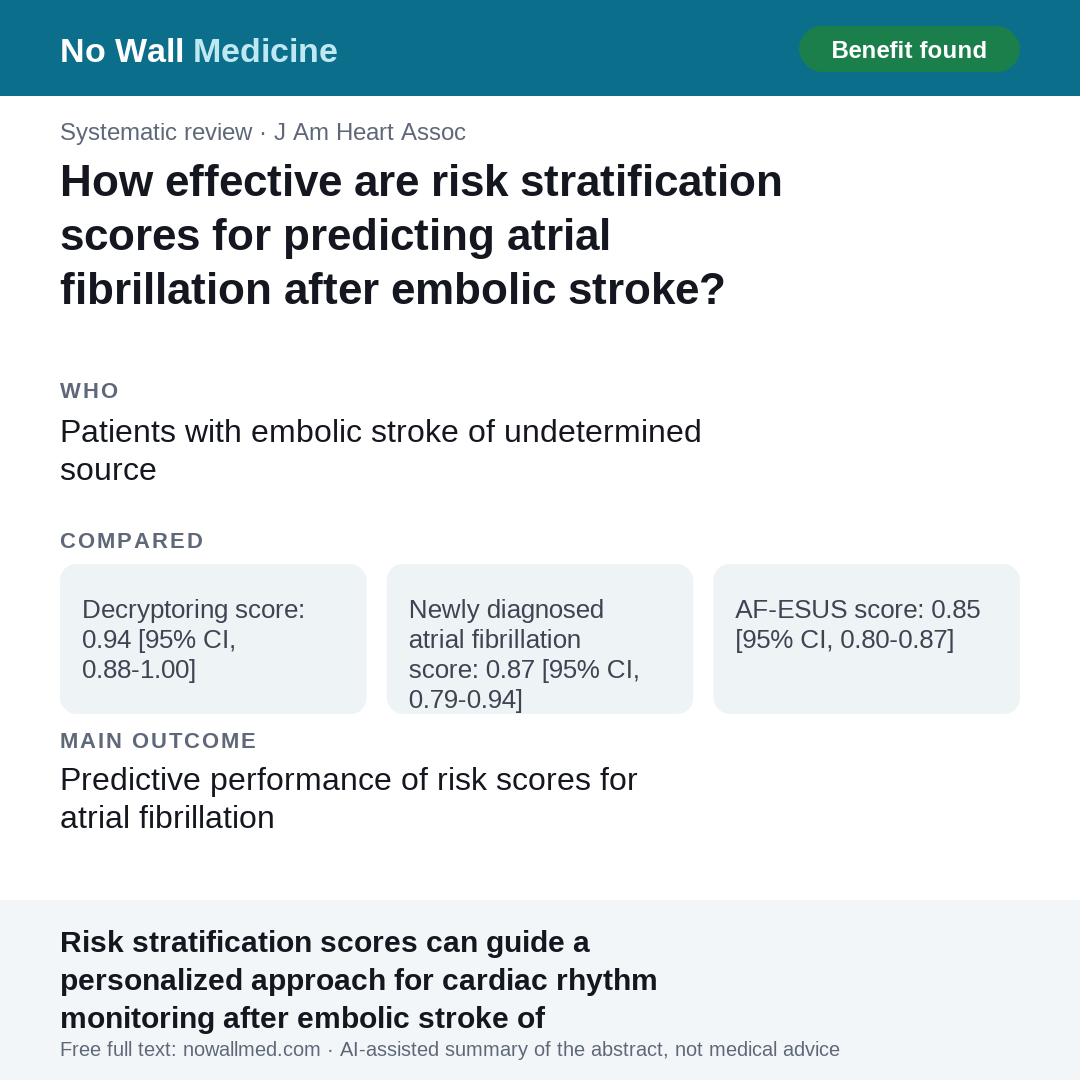
Clinical question: How effective are risk stratification scores for predicting atrial fibrillation after embolic stroke?
Abstract
Current recommendations support a personalized sequential approach for cardiac rhythm monitoring to detect atrial fibrillation after embolic stroke of undetermined source. Several risk stratification scores have been proposed to predict the likelihood of atrial fibrillation after embolic stroke of undetermined source. This systematic review aimed to provide a comprehensive overview of the field by identifying risk scores proposed for this purpose, assessing their characteristics and the cohorts in which they were developed and validated, and scrutinizing their predictive performance. We identified 11 risk scores, of which 4 were externally validated. The most frequent variables included were echocardiographic markers and demographics. The areas under the curve ranged between 0.70 and 0.94. The 3 scores with the highest area under the curve were the Decryptoring (0.94 [95% CI, 0.88-1.00]), newly diagnosed atrial fibrillation (0.87 [95% CI, 0.79-0.94]), and AF-ESUS (Atrial Fibrillation in Embolic Stroke of Undetermined Source) (0.85 [95% CI, 0.80-0.87]), of which only the latter was externally validated. Risk stratification scores can guide a personalized approach for cardiac rhythm monitoring after embolic stroke of undetermined source.
Subject terms
Cite this article
Louka AM, Nagraj S, Adamou AT, Perlepe K, Godefroy O, Bugnicourt JM. Risk Stratification Tools to Guide a Personalized Approach for Cardiac Monitoring in Embolic Stroke of Undetermined Source. J Am Heart Assoc. 2023. doi:10.1161/JAHA.123.030479
Spotted a mistake? Suggest a correction
Top studies every Monday
The week’s key trials and guidelines in your specialties, plus any topics you follow. By email, free.
Get the weekly digest